


News & Exhibitions
Latest Factory Updates, Industry Trends & Global Exhibition Information
How to size a hot press for your LVL production throughput
How to size a hot press for your LVL production throughput
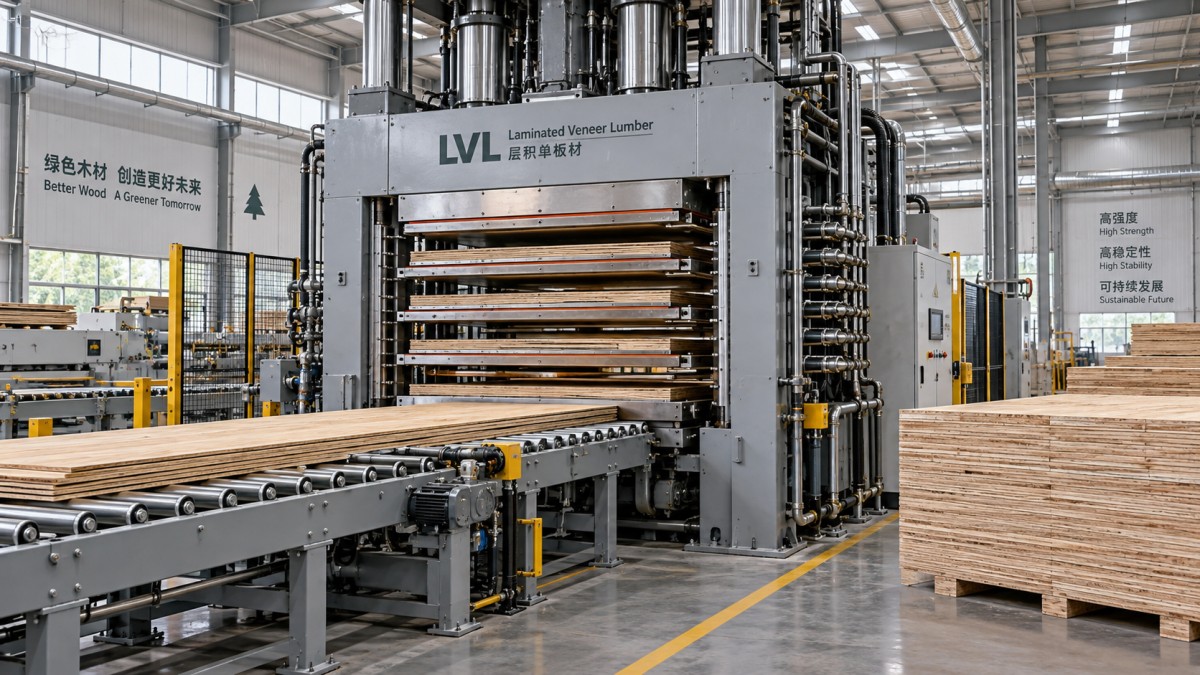
Sizing a hot wood press for LVL production starts with translating your target output into realistic press capacity—not simply choosing the largest platen or highest tonnage. The key is matching usable pressing area, opening configuration, specific pressure, and cycle time to billet dimensions, adhesive requirements, and upstream veneer supply. Underestimate these factors, and the press can become a bottleneck; oversize it, and capital and energy costs may rise without increasing saleable output.
The useful question is not “How much can this press produce?” It is “How much conforming LVL can this press deliver with our product mix, available hours, and validated pressing recipe?” Those are different calculations.
Define the output basis before comparing machines
Start with required saleable volume per shift, then work backward to gross pressed volume. Finished dimensions are not necessarily press dimensions: edge trimming, end trimming, sanding, and rejected material reduce the volume available for sale. Mixing finished-product volume with untrimmed billet dimensions makes a capacity calculation look better than it really is.
A useful sizing sheet should establish:
- Required saleable cubic metres per shift and scheduled shift hours.
- Pressed billet length, width, and thickness for each significant product.
- Expected volume yield from pressed billet to accepted finished product.
- Product mix, batch sizes, changeover frequency, and expected downtime.
- Veneer species, thickness, moisture range, and adhesive system.
Do not size exclusively around the most frequently produced billet. A thicker product with a longer validated heating cycle may control the schedule even if it represents a smaller share of monthly volume. Evaluate the major recipes separately, then calculate the hours required for the planned mix.
Calculate capacity from a complete operating cycle
For a batch press, the basic relationship is:
Saleable output per hour = volume per cycle × (60 ÷ cycle minutes) × operating availability × volume yield
Volume per cycle is the sum of the pressed volumes of all billets actually loaded. Count productive openings, not the maximum openings listed in a brochure. If some openings cannot be used with a particular loading arrangement, they do not contribute to that recipe’s capacity.
Cycle time must cover the complete repeatable sequence: loading, closing, pressure buildup, validated pressing time, any specified pressure-release stages, opening, and unloading. Where handling operations overlap, use the resulting elapsed cycle rather than adding every motion independently.
Keep loss accounting consistent. If routine loading time is already inside the cycle, do not deduct it again through an efficiency factor. Availability should represent additional time losses outside that cycle, such as breakdowns or waiting for material. Similarly, either deduct changeovers from scheduled hours or include them in availability—not both.
A worked example—not a machine performance claim
Assume a planning target of 60 m³ of saleable LVL in an eight-hour shift. For illustration only, each pressed billet measures 6.0 × 1.2 × 0.09 m, giving 0.648 m³. Four billets per cycle provide 2.592 m³ of gross pressed volume.
With an assumed complete cycle of 15 minutes, availability of 85%, and saleable volume yield of 90%, calculated output is:
2.592 × (60 ÷ 15) × 0.85 × 0.90 = approximately 7.93 m³/hour
That gives approximately 63.5 m³ per shift, only slightly above the target. If the complete cycle increases to 18 minutes, the same arrangement produces approximately 52.9 m³ per shift. The example shows why cycle validation matters more than a small apparent capacity surplus. None of these assumptions should be adopted without project-specific confirmation.
Match the platen and openings to the actual layup
Nominal platen dimensions are not automatically usable billet dimensions. Confirm the manufacturer’s permitted loading envelope, including edge clearances, handling access, caul arrangements where used, and the area over which temperature and pressure uniformity are specified.
Daylight must accommodate the uncompressed layup and loading equipment, not merely the finished billet thickness. Veneer thickness variation, assembly tolerances, and transfer-system clearance can determine whether a nominally suitable opening is practical.
More openings increase volume per batch only when every opening can be supplied and handled within the assumed cycle. Ask for a loading sequence showing how mats enter, how finished billets leave, and whether all openings close together. A large multi-opening press waiting for its final mat may deliver less useful capacity than expected.
For mixed-width products, also check approved loading patterns. Placing several narrow billets side by side changes the total loaded footprint and may create uneven loading. The press supplier should confirm permitted positions, load symmetry, and any restrictions on partial-area pressing.
Check specific pressure separately from throughput
Hydraulic force and bonding pressure are related, but they are not interchangeable specifications. The basic relationship is:
Required pressing force = specified pressure on the billet × loaded projected area
Using consistent units, pressure in MPa multiplied by area in m² gives force in MN. The applicable pressure must come from the qualified combination of veneer, adhesive, layup, and required product performance—not from a generic LVL rule.
For conventional multi-opening presses with openings stacked in series, required force is generally not multiplied by the number of openings: force passes through the stack. Several billets placed side by side within an opening, however, increase the loaded projected area. Have the supplier verify this distinction against the actual press architecture.
Pressure uniformity also matters. Frame stiffness, platen deflection, cylinder arrangement, and loading position affect how force reaches the billet. Request the allowable loading patterns and pressure-control accuracy under those conditions. Maximum hydraulic-system pressure alone does not establish bondline pressure or uniformity.
Treat heating and adhesive cure as the main uncertainty
A platen reaching its setpoint does not mean the coldest internal bondline has reached the required curing condition. Heat must travel through the layup, and its progress depends on billet thickness, veneer properties, moisture, initial temperature, adhesive chemistry, and the heating method.
Do not extrapolate a thin-billet cycle directly to a much thicker billet. Likewise, a higher platen temperature is not an automatic route to shorter cycles: it may change surface conditions, moisture movement, adhesive behaviour, or release requirements. Any revised schedule needs process validation.
Ask what supports the proposed pressing time. Useful evidence includes trials on representative layups, internal temperature measurements where appropriate, adhesive supplier guidance, and bond-quality testing against the applicable product requirements. A quotation should distinguish demonstrated results from estimates requiring
Send Your Inquiry
We welcome your cooperation and we will develop with you.