


CNC wood joinery machinery suits small-batch production when repeatable joint quality, reusable programs, and reduced manual fitting outweigh programming, workholding, tooling, and ownership costs.
For furniture manufacturers and woodworking workshops, batch size alone rarely settles the decision. Product families, repeat orders, and skilled labor availability often matter more.
A workshop producing ten related furniture designs may benefit more than one producing fifty unrelated pieces, particularly when shared joint geometry makes programs reusable.
The investment becomes attractive when it removes a measurable production constraint. Faster cutting offers limited value if programming, assembly, or finishing still determines delivery performance.
Before committing capital, decision-makers should compare complete production routes, test representative components, and establish whether expected savings remain credible under conservative demand assumptions over time.
Which small-batch conditions make CNC joinery worthwhile?
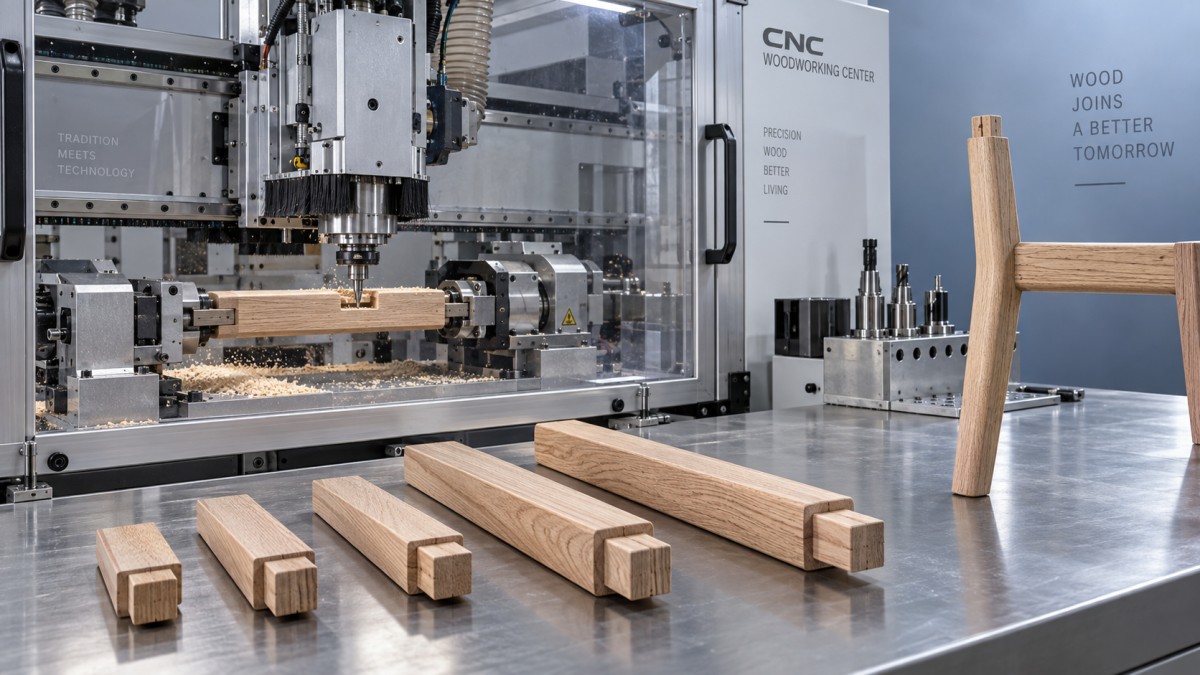
The strongest applications combine design variety with underlying repetition. Dimensions may change between orders, while joint types, machining sequences, and locating references remain broadly consistent.
Examples include dining tables with configurable sizes, cabinet frames sharing construction details, and chair components derived from an established design family with recurring joint geometry.
In these situations, operators can adapt proven programs instead of rebuilding every machining process. That reduces preparation effort and makes shorter runs easier to schedule.
Complexity also matters. Angled mortises, multiple joint positions, and components requiring several manual setups can create substantial opportunities, provided the selected machine supports those operations.
Labor constraints strengthen the case when experienced joiners spend excessive time marking, positioning, and correcting parts. CNC can redirect their attention toward process control and assembly.
However, automation still requires woodworking knowledge. Someone must understand grain direction, joint fit, tool condition, and safe clamping before a reliable program reaches production.
The comparison below provides an initial screening framework. It helps identify promising applications, but representative production trials should determine the actual commercial case before purchase.
Will setup time erase the production savings?
For small batches, setup often determines profitability more than cutting speed. A fast machining cycle cannot compensate automatically for lengthy programming and complicated fixture changes.
Measure preparation from the moment an order enters production engineering until the first acceptable component is approved. Include drawing checks, tooling, clamping, and trial machining.
Then separate work that happens once from work repeated with every order. A reusable fixture or validated program spreads its cost across future production.
Ask suppliers to demonstrate a change between two realistic jobs. Record tool changes, reference setting, loading adjustments, and first-piece inspection rather than watching cutting alone.
Program retrieval should also be tested. Operators need clear revision control so that repeat orders use the correct dimensions, joint allowances, and machining instructions.
Parametric programming can help when supported by the machine and software. Changing approved dimensions may be quicker than creating separate programs for every product variation.
Nevertheless, customization needs limits. Changes to joint orientation, stock thickness, or cutter access may require new fixtures and validation, even when the finished product looks similar.
A useful purchasing target is predictable changeover time across your common product families. Request evidence using your components, rather than accepting an unrelated demonstration piece.
How should you calculate the minimum economic batch?
Start with total cost per accepted component, not machine speed. Include setup, machining, handling, tooling, inspection, and the expected cost of defects or rework.
For illustration, assume an existing process needs thirty minutes of setup and twelve minutes per component. A CNC route needs ninety minutes and four minutes respectively.
The CNC route adds sixty setup minutes but saves eight minutes per component. On processing time alone, its advantage begins at approximately eight components.
That threshold excludes differences in hourly cost, tooling, and quality. It also assumes both routes produce acceptable parts without additional handling or unexpected interruptions.
If a repeat order reduces CNC setup to twenty minutes, the calculation changes substantially. Program reuse can therefore matter more than the original batch quantity.
Conversely, additional fixture preparation or inspection may push the threshold upward. Calculate separate scenarios for first orders, repeat orders, and genuinely new designs before investing.
Use the following cost categories to build an annual model. Count each expense once, especially when machine hourly rates already include depreciation or maintenance.
- Purchase, financing, installation, training, and software costs.
- Tooling, fixtures, extraction requirements, utilities, maintenance, and spare parts.
- Programming, setup, loading, inspection, and assembly labor.
- Scrap, rework, outsourcing, and realistic saleable capacity gains.
For a simple payback estimate, divide the installed investment by expected annual net cash benefit. Keep financing treatment consistent with your chosen cash-flow model.
Only value additional capacity when demand can absorb it. Labor time released creates cash savings only if staffing costs fall or productive output increases.
Finally, test lower utilization and slower repeat-order growth. An investment that depends on immediate full loading leaves little room for training delays or demand fluctuations.
Will more consistent joints improve business results?
Consistent joint geometry can reduce assembly interruptions, repeated adjustments, and component rejection. These benefits become particularly valuable when one inaccurate part delays an entire furniture set.
However, programmed accuracy does not guarantee a suitable joint. Wood moisture, movement, grain variation, cutter wear, and clamping pressure can all affect the final fit.
Define acceptance around the assembled product. Depending on the joint, evaluate alignment, fit, glue clearance, appearance, and relevant strength requirements alongside the measured machining dimensions.
Run trials using normal production stock, including expected variation. Carefully selected demonstration blanks may conceal handling or machining difficulties that appear during routine workshop production.
Inspect components from different positions within the trial. Include parts made after tool changes or fixture resets, when those events occur in the intended workflow.
Track the share of parts accepted without adjustment and the assembly time per unit. These measures connect machining consistency directly to delivery reliability and production cost.
Workholding deserves particular attention for narrow, short, or irregular components. Confirm safe restraint and machining access before treating a supplier’s general capability statement as sufficient.
Which machine capabilities and support commitments matter most?
Wood joinery machinery covers different equipment configurations. A CNC router, mortising machine, tenoning machine, or dedicated joinery center may suit different component geometries and workflows.
Begin with your required joints and stock dimensions. Check machining access, usable travel, clamping arrangements, tool capacity, and whether components need repositioning between operations.
Ask which operations the quoted configuration can complete in one setup. Additional axes or accessories may be necessary for angled features or machining multiple faces.
Software compatibility also affects ownership cost. Confirm how designs become machine instructions, which licenses are required, and who resolves programming or postprocessor problems after installation.
Training should cover setup, tool replacement, inspection, fault recovery, and routine maintenance. A single trained employee can become a new production bottleneck during absence.
For exported equipment, clarify installation responsibilities, electrical requirements, remote troubleshooting arrangements, replacement-part availability, and expected response times in writing before placing the order with suppliers.
Qingdao Zhongding Machinery Co., Ltd. brings more than twenty years of woodworking machinery experience. Buyers should request application-specific proposals, trial results, and defined support commitments.
Its technical support, spare parts supply, and after-sales service should be evaluated against your operating needs, including location, maintenance resources, and the consequences of downtime.
Does the rest of the workshop support the investment?
A joinery machine creates value within a production system. Poorly prepared blanks, inconsistent moisture conditions, or insufficient extraction can undermine otherwise capable equipment and scheduling.
Map the route from incoming timber through preparation, joint machining, assembly, sanding, and finishing. Identify where work accumulates and why before estimating additional throughput.
If finishing already limits shipments, faster joinery may increase unfinished inventory. The business case should explain how downstream capacity will handle the proposed output.
For products requiring textured surfaces, complementary equipment may include a Wire Drawing Machine, used for surface brushing and grain enhancement within the finishing workflow.
This surface-processing role is separate from joint machining. Trial the intended solid wood, MDF, or panel material to establish whether its surface construction suits brushing.
The supplied range lists ZD1000-4 and ZD1500-4 models. Confirm model-specific working widths, feed ranges, dimensions, and electrical requirements before planning floor space or production capacity.
Keep complementary equipment decisions tied to actual orders. Coordinating joinery and finishing capacity is useful; adding equipment without a measurable production need weakens investment discipline.
What evidence should trigger a purchase decision?
CNC joinery is a strong candidate when recurring designs, demanding joints, and measurable labor or quality constraints support savings across a realistic annual order mix.
Continue with existing methods when one-off engineering dominates, utilization remains uncertain, or a simpler fixture improvement can remove the same constraint at substantially lower cost.
Before purchasing, require a representative machining trial, a complete ownership-cost estimate, and agreed training and support arrangements. Include assembly results in the acceptance criteria.
The decisive question is whether CNC wood joinery machinery improves cost, consistency, and delivery across your actual workload. Small batches become viable when preparation remains controlled.