


News & Exhibitions
Latest Factory Updates, Industry Trends & Global Exhibition Information
When Chrome-Plated Platens Improve Hot Wood Press Release and Surface Life
A chrome-plated platen is worth specifying when the press surface itself is becoming a source of release problems, cleanup time, corrosion, or premature wear. It is not automatically the best choice for every hot press, but it can be a practical upgrade for operations that run frequent cycles, process resin-bearing panels, use moisture-sensitive materials, or need a consistently clean platen surface over a long service interval.
For a hot wood press with chrome plated platens, the main benefit is not simply a brighter appearance. The plated layer can help protect the working surface from resin adhesion, minor abrasion, oxidation, and chemical attack from cleaning agents or process residues. That protection matters because a platen is both a heat-transfer surface and a contact surface. Once it becomes scratched, stained, pitted, or heavily contaminated, press performance can become less predictable even when the heating system and hydraulic system are operating correctly.
The decision should therefore begin with the production conditions, not with the assumption that chrome is universally superior. The question is whether surface-related problems are limiting uptime, panel quality, or maintenance efficiency.
Release Problems Often Start at the Platen Surface
In hot pressing, release issues are often blamed immediately on adhesive formulation, release paper, caul plates, or operator practice. Those factors do matter. However, the platen surface can quietly make each of those variables harder to control.
Wood resin, adhesive squeeze-out, coatings, dust, and moisture-borne contaminants can accumulate on an untreated or worn platen. At first, this may only require more frequent wiping. Over time, residue can bake onto hot areas, creating localized roughness. A rough or contaminated surface is more likely to mark veneer, transfer contaminants to the workpiece, interfere with release sheets, or create sticking at panel edges where glue squeeze-out is concentrated.
Chrome plating does not eliminate the need for process discipline. Excess adhesive will still need to be managed, and damaged release sheets still need replacement. What it can do is make routine cleanup more effective and reduce the tendency of residue to bond aggressively to the platen surface. This is especially useful where the press handles repeated batches with similar adhesive systems and contamination gradually becomes a production habit rather than a single incident.
A smoother, intact plated surface also reduces the number of small mechanical anchors available for cured resin or debris. In practice, that can make release behavior more stable, provided the plating quality, base platen flatness, and cleaning method are all appropriate.
When Chrome-Plated Platens Deliver a Clearer Return
Chrome-plated platens are most justified when the press sees demanding surface conditions rather than occasional, carefully controlled use. The following situations deserve closer consideration during equipment specification.
- High-cycle production: Repeated loading, unloading, cleaning, and material movement expose platen surfaces to gradual scratching and handling wear. A protective plated finish can preserve a smoother working surface for longer.
- Adhesive-intensive pressing: Plywood, laminated panels, veneer assemblies, and other products with a risk of glue squeeze-out place greater demands on platen release and cleanup.
- Humid production environments: Moisture, condensation, and inconsistent shutdown practices can encourage surface oxidation. Chrome plating can improve resistance to corrosion when the surface remains undamaged and is maintained correctly.
- Appearance-sensitive products: Decorative veneer, finished laminates, and panels that will be inspected closely are less tolerant of platen marks, residue transfer, or localized surface defects.
- Frequent cleaning: If the production team repeatedly removes buildup, the platen finish must withstand cleaning without becoming progressively rougher or more vulnerable to corrosion.
These conditions do not mean that every operation needs chrome-plated platens. A low-volume press using protective caul plates, stable release media, and well-controlled adhesives may gain little from the added specification. The value increases when the platen is regularly exposed directly or indirectly to difficult materials and when surface condition has a measurable effect on output quality or cleaning downtime.
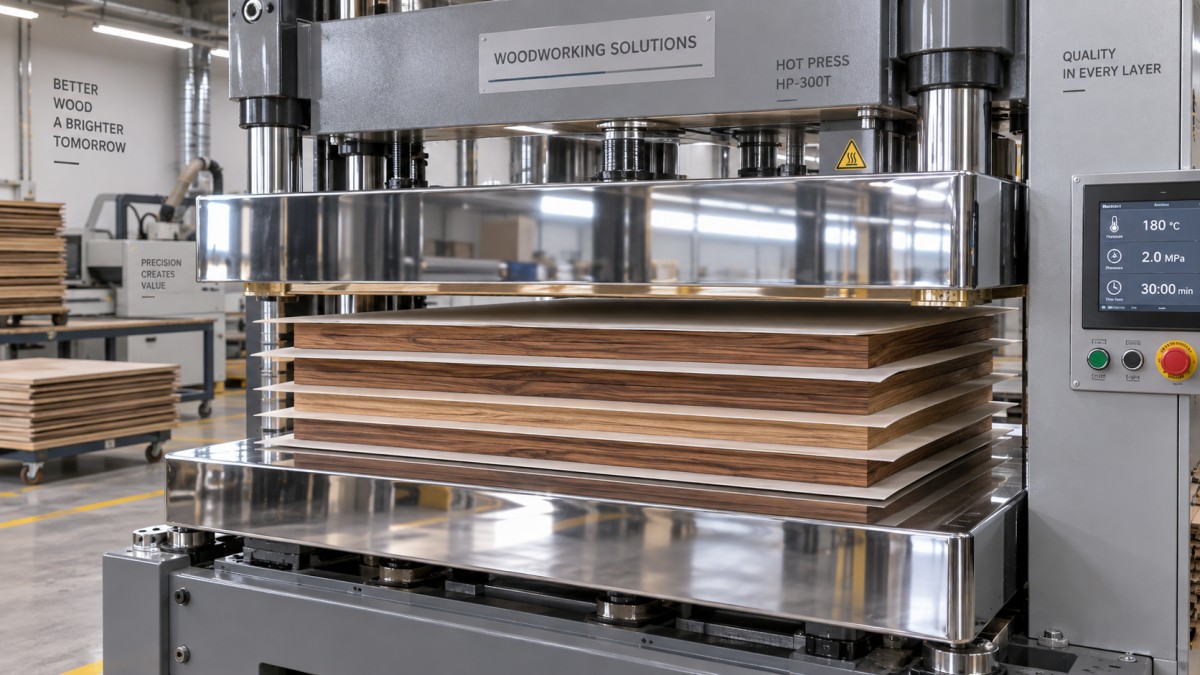
Surface Life Is More Than Resistance to Scratches
“Longer surface life” is sometimes interpreted too narrowly as resistance to visible scratches. Scratches are important, but the useful life of a hot press platen also depends on how well the surface resists corrosion, contamination, thermal cycling, and damage caused by improper maintenance.
A plated platen can help retain a smooth, cleanable contact face. That can reduce the likelihood that minor surface damage develops into a larger maintenance issue. For example, a small corroded area may hold resin more readily, which then requires harsher scraping or abrasive cleaning. The cleaning action can further damage the area, creating a cycle of increasingly difficult maintenance. A durable plated layer can slow this sequence, but only if operators avoid cutting, gouging, or aggressively grinding the surface.
The condition beneath the plating remains equally important. Chrome cannot compensate for a platen that is poorly machined, unevenly heated, distorted, or structurally damaged. Nor does a mirror-like surface guarantee better panels when pressure distribution, temperature control, loading practice, or board moisture are unstable. A plated finish protects the contact surface; it does not correct the press system around it.
Heat Transfer: Useful Benefit, Wrong Reason to Buy
It is reasonable to ask whether chrome plating improves heat transfer. The practical answer is that the condition of the surface matters more than the plating itself as a direct source of heating performance.
A clean, flat, well-maintained platen supports consistent contact with caul plates, release sheets, and the panel assembly. Consistent contact helps heat move predictably through the pressing stack. By resisting contamination and localized roughness, chrome plating can support this consistency over time. That is a meaningful operational advantage.
But chrome plating should not be specified as a cure for slow heating, uneven pressing temperatures, or poor panel core heating. Those problems usually require examination of platen temperature uniformity, heating medium flow, insulation, press cycle design, material thickness, moisture content, and stack construction. A surface upgrade may protect consistency, but it will not repair an inadequate thermal design.
Do Not Specify Chrome Without Reviewing the Whole Pressing Stack
A common selection mistake is to evaluate platens in isolation. In a working press, the visible platen face is only one part of the contact system. Caul plates, press pads, release sheets, panel layup, adhesive spread, and loading alignment all influence what the platen experiences.
If caul plates are warped, dented, or contaminated, a chrome-plated press platen will not prevent surface marks from reaching the workpiece. If loading is off-center or panel thickness varies substantially, pressure distribution can still become uneven. If adhesive spread is excessive, glue squeeze-out may continue to contaminate release materials and edges. The right conclusion is not that chrome plating lacks value, but that it should be paired with realistic operating controls.
During a technical evaluation, ask how the press will actually be used. Will boards be loaded manually or automatically? Will the platen frequently contact release sheets, cauls, or product surfaces directly? Are operators expected to clean the platen between shifts, between batches, or only after buildup is visible? Is there a defined method for removing cured adhesive without scratching the finish? These questions are more useful than comparing surface descriptions alone.
Plating Quality and Repairability Matter
Not all chrome-plated platens perform equally. The practical concerns are the quality of surface preparation, plating adhesion, surface uniformity, and the manufacturer’s approach to inspection and support. A plated layer that is poorly bonded or damaged during use can create a more difficult maintenance problem than a conventional surface because local defects may expose the substrate and encourage corrosion at the damaged point.
Technical purchasers should discuss the intended adhesive systems, temperatures, cleaning practices, and use of caul plates with the machine supplier before finalizing the specification. It is also useful to clarify how platen damage is assessed and what options exist if resurfacing or replacement becomes necessary. A finish should be treated as a maintainable production component, not as a permanent feature that requires no attention.
Cleaning procedures deserve the same attention. Metal scrapers, uncontrolled abrasive pads, and harsh chemical combinations can damage a protective surface or leave residues that affect later production. The preferred approach is usually to remove buildup early, use tools compatible with the platen finish, and avoid turning a small contamination issue into a mechanical repair issue.
When a Standard Platen May Be the Better Decision
Chrome plating is not always the most economical or operationally necessary option. A standard platen can be appropriate when production volume is moderate, the platen is reliably protected by good-quality caul plates, adhesive squeeze-out is well controlled, and the work does not place high demands on cosmetic surface quality.
It may also be a sensible choice where the process changes frequently and the main performance risk lies elsewhere, such as inconsistent board moisture, inadequate press capacity, poor temperature control, or unreliable material preparation. In those cases, directing budget toward better heating control, pressure stability, loading automation, or material handling can have a stronger effect on output than a plated surface.
The distinction is straightforward: choose chrome plating when platen condition is likely to be a recurring operational constraint. Do not choose it merely because it sounds like a premium feature.
A Practical Specification Review Before Purchase
Before approving a hot press configuration, review the platen decision against the expected workload. Start with the products being pressed, especially their adhesive behavior, surface sensitivity, moisture exposure, and use of release media. Then examine how the press will be cleaned and who will perform that work. Finally, consider the cost of a platen-related interruption: rejected panels, extended cleanup, poor release, corrosion repair, or replacement downtime.
A supplier with woodworking machinery experience should be able to discuss platen construction alongside heating method, pressure requirements, loading arrangement, and the maintenance conditions of the planned production line. Qingdao Zhongding Machinery Co., Ltd. provides woodworking machinery and technical support for furniture manufacturing, workshops, and industrial production applications, so the platen finish can be evaluated as part of the complete press configuration rather than as an isolated option.
The strongest reason to select chrome-plated platens is not appearance. It is the need to keep the press contact surface smooth, cleanable, corrosion-resistant, and reliable under the actual conditions of production. When release issues, resin buildup, frequent cleaning, or surface wear are persistent risks, the specification can protect both day-to-day operation and the usable life of the press.
Send Your Inquiry
We welcome your cooperation and we will develop with you.