


News & Exhibitions
Latest Factory Updates, Industry Trends & Global Exhibition Information
What drives the total cost of a turnkey woodworking production line?
For financial decision-makers, the total cost of a Turnkey Woodworking Production Line goes far beyond the initial machine quotation. A lower purchase price can look attractive in a capital expenditure review, yet become expensive once site modifications, installation delays, energy demand, rejected panels, maintenance interruptions, and limited local support enter the picture.
The more useful question is not, “What does the line cost?” It is, “What will this production system cost to own, operate, and adapt over its working life?” That distinction matters in furniture plants, cabinet factories, door manufacturers, and panel-processing operations where margins depend on stable throughput rather than on the price of one machine.
A turnkey project can reduce coordination work by bringing equipment, material flow, controls, commissioning, and technical support under a more unified scope. However, “turnkey” is not a universal specification. Two suppliers may use the same term while including very different responsibilities. A sound investment review therefore needs to separate visible costs from the items that usually appear later.
Begin with the production target, not the equipment list
The cost of a woodworking line is largely determined by what the factory expects it to produce. Before comparing suppliers, define the operating case in practical terms: panel types, board dimensions, veneer or laminate requirements, annual volume, shift pattern, desired output, product changeover frequency, and acceptable quality tolerance.
A line designed for a narrow range of standard cabinet panels has a different cost profile from one that must process variable furniture components in small batches. High mix production may require more flexible feeding, additional positioning controls, faster changeovers, and more operator involvement. High-volume, repetitive output may justify automated loading, buffering, conveying, inspection, and unloading.
This is where budgets often drift. A project may be approved around a basic capacity assumption, then later absorb upgrades because the actual product mix calls for wider boards, extra layers, more heating capacity, or better material handling. Financial approval should be tied to a documented production model, not just a supplier’s general configuration.
The machine price is only one layer of capital cost
Core equipment remains the most visible part of the investment, but even here the quoted amount is influenced by many design choices. Press capacity, spindle count, cutting accuracy, working width, hydraulic design, control system, safety protection, and steel-frame construction all affect cost. So do the level of automation and the degree to which the line is engineered around a customer’s existing workflow.
For veneering operations, for example, a press is not simply an isolated purchase. Its value depends on consistent pressure, controlled heat, substrate preparation, adhesive handling, loading rhythm, and downstream finishing. A robust Wood Veneer Hot Press Machine may be configured as part of a broader panel-processing flow for furniture, doors, cabinets, and interior woodworking applications. Its multi-layer pressing structure, hydraulic system, and steel-frame design can support consistent bonding of natural veneer to plywood, MDF, particle board, and other wood-based panels. Yet the project budget must also account for what feeds the press and what happens to each panel after pressing.
When reviewing a quotation, ask suppliers to identify whether each item is included, optional, or excluded:
- Main processing machines and standard tooling
- Infeed, transfer, buffering, turning, and outfeed systems
- Electrical cabinets, PLC controls, sensors, and operator interfaces
- Safety guarding, emergency systems, and compliance-related devices
- Dust extraction connection points and waste handling interfaces
- Adhesive, heating, cooling, pneumatic, or hydraulic auxiliary systems
- Installation materials, commissioning labor, and operator training
A transparent scope does not always produce the lowest initial number. It does, however, make it possible to compare offers fairly and prevent the finance team from approving an incomplete project total.
Automation changes both the cost and the risk profile
Automation is frequently discussed as a labor-saving feature, but the financial case is broader. Automatic loading and unloading can reduce repetitive handling, stabilize cycle times, improve workplace safety, and limit panel damage caused by inconsistent manual movement. At the same time, automation increases the initial investment, expands the controls package, and may require more specialized maintenance skills.
The right level is rarely “maximum automation.” It is the level that removes the most costly constraints in a particular factory. If skilled operators are difficult to retain, automated handling may carry a strong long-term case. If production is highly variable and volumes are modest, a simpler semi-automatic arrangement may offer more flexibility and lower capital exposure.
Finance teams should request a scenario comparison rather than accepting an automation upgrade as a general productivity claim. Compare labor requirements per shift, expected cycle-time stability, scrap reduction opportunities, planned maintenance needs, and the consequences of a control-system failure. The analysis should include how easily operators can bypass or recover a process when a sensor, conveyor, or material-flow component needs attention.
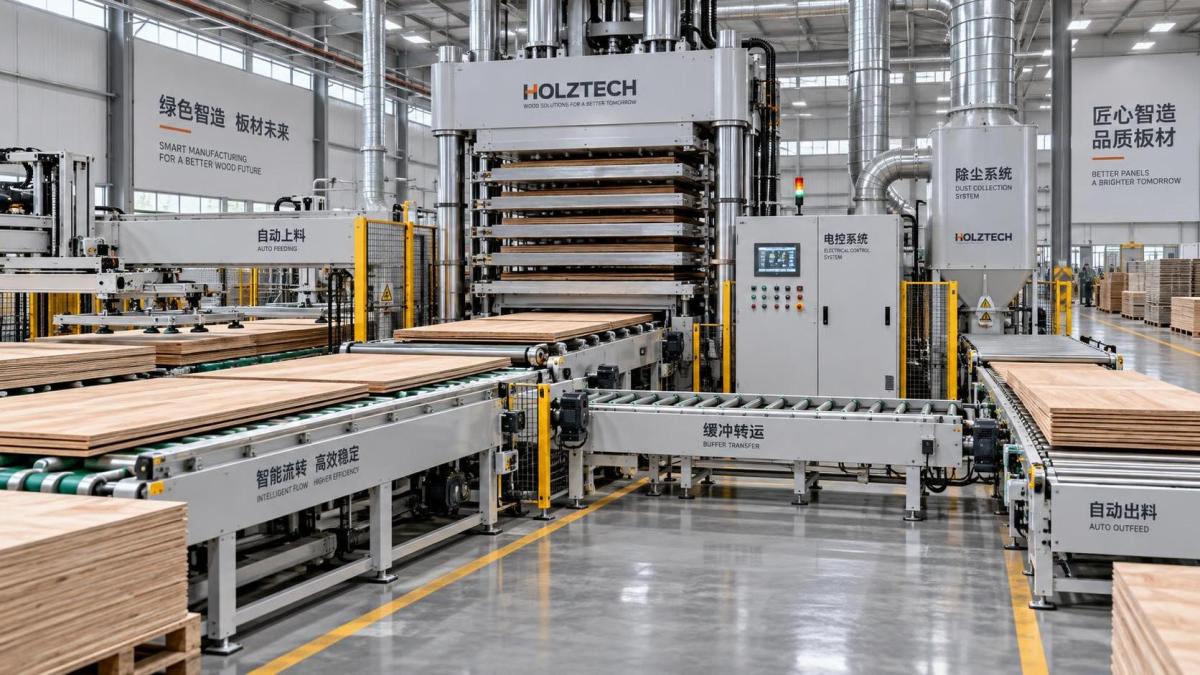
Site readiness is where “hidden” costs become visible
A woodworking production line cannot be evaluated independently from the building that will receive it. The available floor area is only the beginning. Machine footprints, maintenance access, loading zones, board storage, forklift routes, operator clearances, and future expansion space all influence layout and cost.
Electrical supply deserves early attention. A production line may require changes to incoming power, distribution panels, cable runs, grounding, voltage compatibility, or backup arrangements. Pneumatic systems must have sufficient clean, dry air at the required pressure. Depending on the process, heating, ventilation, dust collection, compressed air, and hydraulic oil management may also need upgrades.
For pressing, coating, sanding, cutting, and panel-handling operations, dust control and ventilation are not peripheral issues. Poor extraction can affect surface quality, worker conditions, machine reliability, and housekeeping labor. Likewise, a line that requires thermal energy or cooling capacity may create costs outside the machinery package.
These expenses are often managed by separate contractors, which makes them easy to omit from a machine budget. A better approach is to establish a site-readiness checklist during supplier evaluation and assign a preliminary allowance to each required modification. The final number may change, but the project will no longer be built on an unrealistically narrow equipment price.
Installation, commissioning, and ramp-up have a measurable value
Production does not begin when machinery arrives at the factory gate. Freight, unloading, customs procedures where applicable, positioning, assembly, wiring, testing, calibration, and trial production all consume time and money. If a line is delivered in sections, the interface between machines must be checked carefully: transfer heights, control signals, material direction, speed matching, safety interlocks, and utility connections.
Commissioning quality has a long shadow. A rushed start-up can leave the plant with unstable settings, unclear maintenance routines, or operators who know the buttons but not the process logic. That situation may not appear on the initial capital invoice, but it can surface as wasted material and uneven output for months.
Include the following questions in the approval process:
- How many installation and commissioning days are included?
- Who pays for travel, accommodation, local lifting, and site labor?
- What production conditions must the customer provide before technicians arrive?
- What acceptance criteria will confirm that the line is ready for handover?
- How much operator, maintenance, and process training is included?
- Is remote support available after the commissioning team leaves?
Clear answers help prevent an uncomfortable gap between “machine delivered” and “line producing saleable panels.”
Operating cost is shaped by consistency, not just consumption
Electricity, compressed air, heating, consumables, adhesive, lubricants, tooling, and labor are standard operating-cost categories. They should be estimated, but direct consumption tells only part of the story. In woodworking, inconsistent processing can create a much larger expense through rework, veneer defects, edge damage, bonding failures, incorrect dimensions, or unusable panels.
A line with stable process control may cost more upfront but lower the cost per finished unit by reducing variation. This is especially relevant when working with expensive veneers, decorative surfaces, or customer-facing furniture components. One rejected batch can erase the apparent saving from a less capable control or handling system.
Ask suppliers how settings are managed and repeated across shifts. Can recipes be stored? Are pressure, temperature, speed, and timing parameters visible to operators? Are faults recorded in a way that helps maintenance teams find recurring causes? These details influence yield, planning reliability, and the credibility of the projected return on investment.
Maintenance and spare parts should be budgeted before the purchase order
Every line has wear components and service needs. The financial concern is not whether maintenance will be required; it is whether the factory can plan it, afford it, and obtain parts before a minor issue becomes a prolonged shutdown.
Evaluate the expected maintenance schedule for bearings, belts, chains, hydraulic seals, filters, valves, sensors, cutters, press components, and electrical items. Determine which parts should be held in local inventory and which can be supplied on demand. Imported systems may have attractive specifications but create greater downtime exposure if common components are difficult to source quickly.
Supplier capability matters here. Qingdao Zhongding Machinery Co., Ltd. has more than 20 years of experience in woodworking machinery and positions its support around technical guidance, spare-parts availability, and responsive after-sales service. For a buyer assessing a turnkey investment, that long-term service capacity can be as relevant as the original equipment configuration. The practical test is simple: request recommended spare-part lists, service documentation, response procedures, and a clear statement of warranty boundaries before signing.
Compare lifecycle economics instead of headline quotations
A useful comparison model places each supplier’s offer into the same cost framework. The goal is not to predict every future expense with perfect precision. It is to reveal omissions, identify major risk areas, and compare alternatives on a consistent basis.
For each option, calculate cost per planned production unit using realistic utilization. Include planned downtime, changeovers, ramp-up time, and expected yield rather than assuming continuous nameplate output. The resulting model is usually more valuable than a simple payback calculation because it shows which assumptions must be true for the investment to perform as expected.
Questions that protect the budget
Before approving a Turnkey Woodworking Production Line, financial stakeholders should insist on a line-by-line responsibility matrix. Who supplies each utility connection? Who integrates upstream and downstream equipment? What happens if actual panel sizes differ from the original specification? Which performance indicators are subject to acceptance testing? What support is available after installation?
It is also wise to preserve contingency for items that cannot be fully defined at quotation stage, particularly building modifications, utility upgrades, local compliance work, and process adjustments during ramp-up. Contingency is not a sign of weak planning. In a complex manufacturing project, it is recognition that a line becomes productive only when equipment, materials, people, and site conditions work together.
The lowest quote may still be the right choice, but only after its exclusions and operating implications are understood. A well-scoped turnkey solution should make costs more visible, reduce coordination gaps, and provide a clearer route from capital approval to stable production. For finance leaders, that visibility is often the real basis for a confident decision.
Send Your Inquiry
We welcome your cooperation and we will develop with you.