


News & Exhibitions
Latest Factory Updates, Industry Trends & Global Exhibition Information
How to assess a woodworking machinery exporter before placing an order
The lowest quoted machine price rarely represents the lowest purchasing risk. In woodworking machinery, the real exposure often appears after the deposit is paid: a machine configuration differs from the approved specification, critical components are unavailable, documentation is incomplete for import clearance, or remote troubleshooting cannot resolve a production stoppage. Assessing a woodworking machinery exporter therefore means verifying whether it can control the full chain from technical definition and manufacturing to shipment, commissioning support, and replacement parts.
A polished website, a long product list, and fast quotation replies are not proof of that capability. The assessment should focus on evidence: who builds the machine, how the supplier controls configuration and quality, whether the proposed equipment fits the actual workpiece and process, and what service commitments can be executed after the cargo leaves the port.
Separate the exporter’s commercial role from its manufacturing responsibility
The term Woodworking Machinery Exporter can describe several different business models. A manufacturer may sell directly overseas; a trading company may source from several factories; or an exporter may combine machines, auxiliary equipment, and third-party components into a package. None of these models is automatically unsuitable. The risk arises when the buyer assumes direct manufacturing control where it does not exist.
Ask early and plainly which operations are performed in-house and which are outsourced. For a panel-processing line, this distinction matters more than it might for a simple standalone machine. Frame fabrication, machining of structural parts, electrical cabinet assembly, software configuration, final commissioning, and packaging may each involve different parties. A supplier that coordinates external partners can still be a viable choice, but it should be able to identify the responsible party for each critical subsystem and remain contractually accountable for the final machine.
Useful verification materials include a business registration record, factory address, production-floor photographs or live video, equipment lists, and examples of the supplier’s own serial-number or nameplate system. These are not substitutes for a formal audit, but they help establish whether the entity issuing the quotation has a real and stable relationship with the production source.
When an on-site visit is feasible, the most revealing areas are often not the showroom. Inspect the assembly area, incoming-parts storage, electrical cabinet workstations, test-run area, and finished-machine dispatch zone. Look for basic control discipline: identifiable parts, work orders, inspection records, protected storage for electrical components, and a clear method for separating completed machines from units awaiting correction.
Assess the machine against the production task, not the catalogue description
Woodworking machinery is frequently quoted by category—edge bander, CNC router, panel saw, drilling machine, sanding machine—while the buying decision depends on much narrower process conditions. A standard machine may be technically functional but commercially unsuitable if it cannot maintain required throughput, surface quality, changeover frequency, or material compatibility.
The technical request should describe the workpiece and operating conditions in measurable terms. For panel equipment, this usually includes board material, thickness range, minimum length and width, edge material, adhesive method where applicable, target feed speed, required finish quality, daily operating hours, dust-extraction interface, power supply, and available compressed air. For solid wood processing, grain direction, moisture range, workpiece variability, cutter configuration, and safety guarding may be equally decisive.
Do not accept broad wording such as “suitable for furniture production” as a technical commitment. Furniture production covers very different materials and tolerances. Melamine-faced particleboard, MDF, plywood, solid timber, lacquered boards, acrylic panels, compact laminate, and aluminum honeycomb composite panels impose different demands on feeding, cutters, pressure units, glue systems, trimming, scraping, and dust collection.
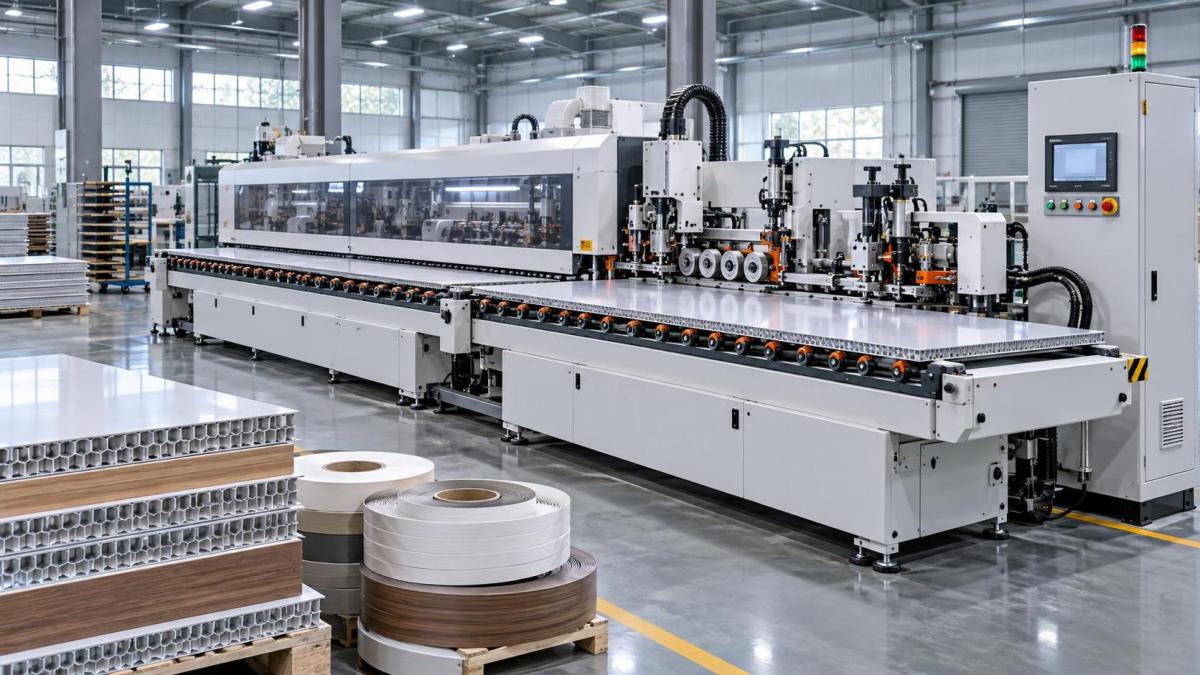
For example, an edge-banding proposal for aluminum honeycomb panels should be reviewed as a material-specific application, not as an ordinary furniture-board edge-banding purchase. The proposed Honeycomb Aluminum Panel Edge Banding Machine ZD450G is specified for aluminum honeycomb panels and composite boards, with a board-thickness range of 10–60 mm, edge-banding thickness of 1.0–3.0 mm, and feeding speed of 13–23 m/min. Those figures are useful only when checked against the purchaser’s real panel dimensions, edge material, production rhythm, available 0.6 MPa air supply, 24 kW electrical load, and installation space. Its stated overall dimensions of 10000 × 1000 × 1850 mm also affect freight planning, workshop layout, maintenance access, and installation routing.
Request a configuration sheet that lists the machine model, each working unit, motor ratings, control system, critical branded components where specified, tooling included, safety devices, and optional modules. The sheet should become an attachment to the purchase contract. A quotation that describes a machine only through a model number leaves too much room for later substitution.
Check whether stated performance can be demonstrated under representative conditions
Feed speed, installed power, and nominal processing range are not enough to establish usable output. The relevant question is whether the machine can process representative samples to the required quality level without repeated adjustment or unacceptable defects.
Before payment, provide sample materials when the application involves unusual boards, decorative surfaces, sensitive veneers, aluminum composite structures, special edge tape, or demanding finish requirements. The factory acceptance test should use an agreed sample or clearly defined substitute material. Video is helpful, but the acceptance criteria should be written before the test begins.
For edge processing, acceptance points may include edge alignment, glue-line appearance where glue is used, corner finish, trimming marks, chipping, pressure consistency, panel damage, and repeatability across several pieces. For CNC equipment, assess positioning consistency, cut quality, tool-path execution, vacuum holding, loading method, and software compatibility. A machine that produces one acceptable sample after extensive manual adjustment does not demonstrate stable production capability.
Require the supplier to record the final setup parameters used during testing. This has practical value during installation because it distinguishes a basic commissioning baseline from later process tuning caused by local material differences. It also prevents a common dispute in which the machine is deemed “tested” but neither party can identify the conditions under which the result was achieved.
Quality control is a process, not a pre-shipment photo
Buyers often request pre-shipment inspection, and it is sensible to do so. Yet a final inspection cannot fully compensate for weak upstream control. Important defects may be concealed inside electrical cabinets, pneumatic routing, mechanical alignment, software parameters, or component substitutions that are difficult to detect when the machine is already packed.
Ask how the supplier manages quality at several stages:
- Incoming inspection of motors, drives, bearings, pneumatic parts, electrical devices, and control components;
- Dimensional checks on frames, guide rails, shafts, and machined parts where relevant;
- Electrical wiring inspection, labeling, grounding, and cabinet testing;
- Dry-run and loaded functional testing before packing;
- Correction and re-test procedures when nonconformities are found.
The answer should produce records, not only assurances. Request the factory test report, machine serial number, electrical schematic, pneumatic diagram if applicable, parts list, operating manual, and packing list before the balance payment. For equipment that will be imported into regulated markets, compliance documentation must match the exact delivered configuration. A generic declaration or certificate unrelated to the machine’s actual electrical system, guarding, or installed options offers limited protection.
Certification should be assessed carefully. Requirements vary by destination and machine type. Where CE marking is applicable, the buyer should verify that the supplier can provide the relevant technical documentation and declaration for the delivered equipment; the CE mark itself is not a universal independent quality certificate. Electrical voltage, frequency, plug arrangement, language of warnings, safety labels, and emergency-stop configuration should be confirmed as part of the order, rather than treated as minor shipping details.
Examine component traceability and substitution control
Component brands are often listed in quotations because buyers associate them with reliability and serviceability. The more important issue is whether the proposed component list is controlled. A quotation naming a PLC, inverter, servo drive, bearing, or pneumatic valve has little value if the contract permits “equivalent” substitutes without buyer approval.
Define which components are critical and require written approval before substitution. Usually these include motion-control hardware, PLC and HMI systems, spindle motors, major electrical protection devices, gearboxes, precision guide systems, vacuum pumps, glue units, and safety components. Not every fastener or cable needs contractual control; the goal is to protect parts that affect performance, diagnostics, certification, and local availability.
Ask for part numbers rather than brand names alone. A global brand can have product ranges with very different specifications. Part-number records also make future spare-parts requests more accurate. On receipt of the machine, compare nameplates and installed components with the approved bill of materials before installation proceeds.
Evaluate export execution before negotiating the final payment terms
Export competence is not measured only by whether a supplier can issue a commercial invoice. Large woodworking machines require correct packing, safe internal protection, dimensional planning, lifting information, and document consistency. A packing error can damage precision assemblies; an inaccurate package dimension can affect freight planning; mismatched descriptions across invoice, packing list, and transport documents can delay clearance.
For a machine with a long bed or multiple modules, confirm whether shipment will be fully assembled, partially disassembled, or containerized in sections. The chosen arrangement affects installation time, alignment work, and the tools required at destination. Obtain package dimensions and gross weights early enough for freight quotations and site-access checks. A 10-meter machine body, for instance, is not merely a transport issue: unloading route, door opening, foundation condition, and maintenance clearance must be reviewed before dispatch.
Clarify the agreed Incoterm, named place or port, loading responsibilities, cargo insurance responsibility, and the point at which risk transfers. These terms should align with the actual freight arrangement rather than being copied from an earlier purchase. If the machine requires wood packaging, ensure the packaging approach is suitable for the destination’s import rules; the exporter should be able to provide the relevant packing information where required.
After-sales support should be tested as an operating system
A woodworking machine does not become reliable merely because a warranty period appears on the quotation. The buyer needs to know how faults will be diagnosed when a sensor fails, a drive alarm occurs, a board jams, a glue application becomes unstable, or a finishing unit loses adjustment. The best time to assess this is before ordering, when the supplier has an incentive to answer specifically.
Ask who provides remote support, in which language, through which channels, and during what working hours. Request an example of the information normally required for diagnosis: photographs, alarm codes, HMI screenshots, wiring references, or short videos. A capable service team should be able to explain its diagnostic sequence rather than offering only a general promise of online assistance.
Spare-parts planning deserves separate attention. The supplier should identify recommended commissioning spares, wear parts, and critical items whose failure would stop production. For edge-banding equipment, that may include selected cutters, scrapers, pressure-wheel elements, sensors, heaters, belts, or pneumatic components depending on configuration. For CNC machines, it may include collets, tool holders, vacuum consumables, sensors, and selected drive-related parts. The appropriate spare kit depends on operating hours, local service capability, and lead time—not on a generic list.
Obtain a priced spare-parts catalogue tied to machine part numbers. Confirm whether parts can be shipped independently, how serial number and configuration are used to identify them, and whether control-system backups will be supplied. If parameters, PLC programs, or HMI projects are necessary for recovery, the ownership and access arrangement should be clear without compromising the supplier’s legitimate intellectual-property controls.
Use the contract to convert claims into measurable obligations
Many procurement failures begin with a technically detailed discussion followed by a commercially vague purchase order. The final contract should bring the two together. It should identify the exact model and configuration, approved drawings where relevant, workpiece scope, electrical specification, included tooling, documents, inspection method, delivery condition, packing requirements, warranty terms, spare-parts commitments, and remedies for material nonconformity.
Acceptance should not be defined only as “machine runs normally.” It should refer to the agreed test conditions and visible output requirements. At the same time, avoid imposing performance promises that depend mainly on uncontrolled destination-side variables, such as unstable power supply, unsuitable compressed air, poor dust extraction, untrained operators, or unapproved material. A workable agreement distinguishes supplier-controlled machine performance from site-dependent commissioning conditions.
Payment milestones should preserve leverage through the point at which meaningful evidence is available. The exact structure depends on transaction history and risk tolerance, but the balance should not be released solely because shipping space has been booked. Review the signed inspection result, final configuration confirmation, photographs or video of the identified machine, serial-number record, packing information, and document draft before funds are transferred.
The strongest exporter is not necessarily the one offering the broadest catalogue or the most aggressive price. It is the one that can define the machine precisely, demonstrate it against the intended process, document what will be delivered, execute shipment without avoidable ambiguity, and support the installed equipment with identifiable parts and accountable technical communication. That standard of assessment turns machinery sourcing from a comparison of quotations into a controlled decision about production continuity.
Send Your Inquiry
We welcome your cooperation and we will develop with you.