


News & Exhibitions
Latest Factory Updates, Industry Trends & Global Exhibition Information
How to verify a wood product manufacturing machinery supplier
A machinery quotation can look complete while leaving the most expensive questions unanswered: Can the supplier actually build the machine described? Will it run the buyer’s profiles, substrates, adhesive system, and shift pattern? Who will diagnose a fault when production is stopped? For a wood product manufacturing machinery supplier, verification should begin before price comparison, because a low initial price can be outweighed by poor commissioning, unavailable wear parts, or a machine configuration that does not match the process.
The practical test is not whether a supplier has an attractive catalog. It is whether its manufacturing evidence, technical answers, commercial documents, and service commitments agree with one another. A dependable supplier can explain the process limits of a proposed machine, identify the information still needed from the buyer, document what is included, and provide a realistic route for installation, training, parts, and fault support.
Start with the production task, not the supplier list
Verification is easier when the required result is defined first. “Woodworking machinery” is too broad to evaluate. A supplier may be competent at panel processing but not at profile wrapping, solid-wood machining, edge finishing, or automated material handling. Before requesting quotations, describe the workpiece and the operating conditions that matter on the shop floor.
- Material type, moisture condition, dimensions, and expected variation
- Finished product requirements, including surface quality, tolerances, and acceptable defects
- Required throughput per shift or per hour, rather than a general statement that the machine must be “fast”
- Available power supply, compressed air, floor space, dust extraction, and loading method
- Operator skill level, changeover frequency, and maintenance resources
- Materials supplied to the machine, such as film, veneer, paper, edge banding, adhesive, or coating
This preparation exposes a common sourcing problem. A supplier may quote a standard machine around its published maximum capacity, while actual production involves narrow parts, short pieces, uneven stock, frequent profile changes, or sensitive decorative surfaces. The machine may still be usable, but its achievable output and accessory requirements can be very different from the headline specification.
Ask for evidence that the supplier controls manufacturing
A supplier should be able to show more than finished-machine photographs. Verification does not always require an on-site audit, but it does require evidence that connects the organization to the machine being offered. Request current factory information relevant to the product category, such as workshop photos or video, assembly areas, machining equipment, electrical assembly, inspection steps, and packaging procedures. The materials should be specific enough to show that the supplier is not simply presenting generic imagery.
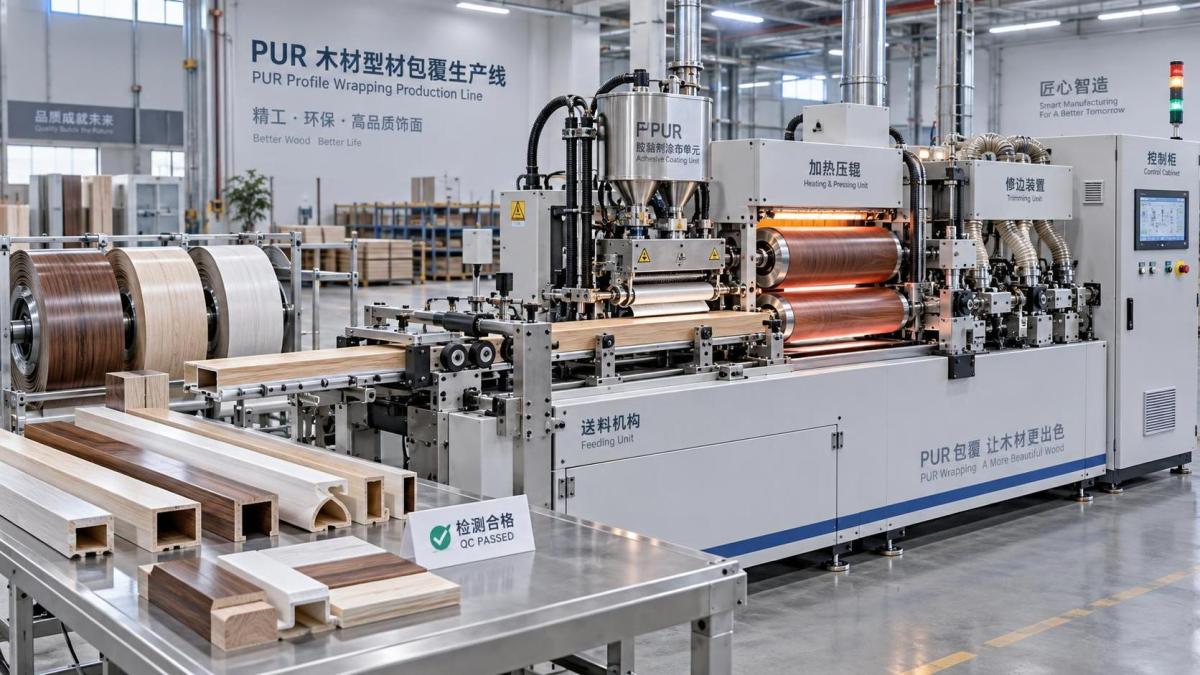
Pay attention to how technical questions are handled. A manufacturer or technically capable integrator can normally identify the key assemblies, explain their purpose, and discuss optional configurations. For example, when a line includes feeding, adhesive application, heating, pressing, trimming, and control systems, the supplier should state which elements are standard and which depend on the workpiece or material.
Useful questions include:
- Which major components are made, assembled, or tested under your control?
- Which components are externally sourced, and how are their specifications managed?
- What checks occur before shipment: dry running, electrical testing, calibration, safety-function checks, or sample processing?
- Can you provide a machine serial-number convention and an equipment list tied to the quotation?
- Who prepares electrical drawings, pneumatic diagrams, manuals, and spare-parts lists?
The quality of the answer matters as much as the format. Vague assurances are less useful than a clear explanation of inspection points, test conditions, and documentation. Avoid treating a large factory building or a long product list as proof of capability. What matters is whether the supplier can demonstrate control of the specific machinery category needed.
Check whether the quoted specification is usable in real production
Specifications should be read as operating boundaries, not just sales features. Ask the supplier to annotate the quotation with the assumptions behind each value. Maximum width, speed, height, and material diameter may not be achievable together on every product geometry or facing material. A machine’s speed range, for instance, can depend on adhesive open time, substrate condition, profile complexity, heating capacity, and the quality standard required at the exit.
For a wrapping application, a proposed machine such as the PUR WRAPING Machine 300 should be checked against the actual profile and facing material rather than selected by width alone. Its stated maximum lamination width is 300 mm, maximum processing height is 80 mm, minimum processing length is 600 mm, and lamination speed range is 0–45 m/min. Those figures help establish a starting fit, but they do not replace confirmation of the profile shape, feeding stability, coating or film behavior, adhesive requirement, and required finish quality.
Ask for dimensional drawings early. A layout drawing identifies whether there is enough clearance for loading, unloading, maintenance access, rolls, adhesive units, electrical cabinets, and material flow. It can also reveal whether quoted dimensions refer only to the main frame rather than the full installed footprint. For the PUR300 configuration, the overall dimension is stated as 6000 × 850 × 2000 mm and the machine weight as 2500 kg; site planning should also account for safe access around the equipment and any upstream or downstream equipment that forms part of the process.
Use sample testing to verify process understanding
Where the product has a visible surface requirement or a difficult material combination, sample testing is one of the strongest verification tools. The purpose is not to demand a perfect production guarantee from a short trial. It is to see whether the supplier understands the variables and can record the setup in a way that can be repeated during commissioning.
Send representative samples rather than only ideal pieces. Include the normal substrate, the intended facing material, and enough information about the desired finish. If the product range includes more than one profile, identify which profile is most difficult and which represents most of the volume. A useful test discussion covers feeding direction, surface preparation, adhesive type, heating, pressure setting, speed, trimming or finishing requirements, and likely defect causes.
During review, ask to see the sample before it is packaged and request close images or video of critical surfaces. Inspect bonding consistency, edge treatment, wrinkles, squeeze-out, marks from pressure elements, misalignment, and the behavior at profile transitions. The supplier should not conceal limitations. A credible response may state that a different guide, pressure arrangement, material preparation step, or slower speed is needed for a specific part.
When a physical trial is not possible, request a technical review based on drawings, photos, material details, and expected output. Treat this as preliminary evidence only. It is better than a generic promise, but it cannot confirm all behavior of the actual material combination.
Separate machine scope from project scope
Disputes often arise because “machine supplied” and “line ready to produce” are assumed to mean the same thing. They do not. The quotation should state the delivery boundary in practical terms. Check whether it includes the main machine, infeed and outfeed sections, safety guards, tools, adhesive equipment, electrical cabinet, dust connections, installation materials, commissioning support, manuals, and training.
Also identify exclusions with equal care. Foundation work, local wiring, air piping, extraction, unloading equipment, consumables, operator labor, customs arrangements, and lifting equipment may sit outside the supplier’s scope. Exclusions are not automatically a warning sign; unclear exclusions are. A supplier that defines boundaries precisely makes it easier to build an internal budget and installation plan.
Documents that should agree before an order is released
- The quotation and itemized configuration list
- General arrangement drawing and utility requirements
- Technical specification with defined material and workpiece limits
- Electrical and pneumatic scope, including rated voltage and major loads
- Acceptance criteria or a description of the pre-shipment test
- Installation, commissioning, and training responsibilities
- Packing list format, manual language, and spare-parts documentation
Compare these documents line by line. A mismatch between an offer, drawing, and email discussion is often more revealing than a small price difference. Resolve it in writing before payment milestones are finalized.
Evaluate service as an operating capability
A machine supplier’s after-sales promise should be tested through details. Ask who receives service requests, what information they need for remote diagnosis, and how replacement parts are identified. “Support available” is not enough when a production line is waiting for an answer. A clear system typically includes machine identification, parts drawings or coded lists, electrical documentation, fault-description guidance, and an escalation path for complex problems.
For parts support, distinguish between standard purchased items, wear parts, and custom mechanical components. Request a recommended startup spare-parts list based on the machine configuration. The list should show part names, quantities, and identifiers so that future reorders do not depend on unclear photographs or informal descriptions. Ask which items are advisable to keep on site, especially parts that are inexpensive but can stop operation if they fail.
Service verification should also cover language and time-zone practicality, particularly when installation is outside the supplier’s home market. Confirm the planned commissioning method: on-site support, remote guidance, or a combination. For equipment using PUR adhesive and heated assemblies, the operating and cleaning instructions should be sufficiently specific to support routine maintenance and safe handling procedures at the facility.
Review commercial reliability without relying on assumptions
Commercial checks are not separate from technical checks. The legal entity named in the quotation, contract, invoice, bank details, warranty statement, and shipping documents should be consistent. Verify the supplier’s business identity through appropriate official channels in the relevant jurisdiction and confirm that the party receiving payment is the party responsible for the equipment obligation.
Payment structure should match the amount of verification completed. Before a major production payment, the buyer should have an agreed configuration, approved drawings where relevant, and defined acceptance conditions. Before final payment, confirm how the inspection, shipment release, machine documents, and warranty start date will be handled. The aim is not to impose a universal contract format; it is to avoid leaving material issues to verbal interpretation.
Be cautious when the discussion shifts rapidly between technical contacts, trading names, or bank accounts without a documented explanation. The same applies when a supplier avoids providing a serial-number system, parts documentation, or any defined test procedure. One gap may be correctable. Several gaps across engineering, commercial documents, and service planning suggest that the supplier may not be ready to support the project.
Make the final decision from comparable evidence
When several offers are being considered, score each one against the same production requirement rather than comparing only quoted price and maximum capacity. One supplier may offer a lower base machine but omit essential guides, testing, or startup parts. Another may appear more expensive because the quotation includes a more complete configuration. Normalize the scope before drawing conclusions.
A final review should answer four practical questions: Does the machine fit the actual workpiece range? Has the supplier shown control over manufacturing and testing? Is the installation boundary documented? Can the supplier support parts and diagnosis after delivery? A wood product manufacturing machinery supplier that provides consistent, specific answers across these questions is usually easier to work with than one offering broad assurances without evidence.
Keep the records used to make the decision. Approved drawings, samples, test notes, configuration lists, and service contacts become useful references during installation and later maintenance. They also make it easier to verify that the delivered equipment matches the equipment that was evaluated.
Send Your Inquiry
We welcome your cooperation and we will develop with you.