


News & Exhibitions
Latest Factory Updates, Industry Trends & Global Exhibition Information
What determines the price of wood product manufacturing machinery?
The purchase price of woodworking equipment is only the visible part of the investment. Two machines described as panel saws, CNC routers, edge banders, or sanding lines can have materially different prices because they are built for different throughput, accuracy, duty-cycle, labor, and service expectations. A lower quotation can be economically sound for intermittent workshop use; it can also become the more expensive choice when it creates bottlenecks, rejects, unplanned downtime, or dependence on unavailable parts.
For capital approval, the relevant question is not simply “What is the wood product manufacturing machinery price?” It is whether the machine’s total cost over its useful operating life is justified by the capacity, quality consistency, and risk reduction it brings to the production process. The answer depends on how price is constructed and which cost drivers actually matter in the intended application.
Machine category establishes the starting price range
Wood product manufacturing covers very different production tasks: rough cutting of solid wood, panel sizing, drilling, routing, edge processing, sanding, pressing, finishing, and material handling. The price difference between machine categories is not just a matter of motor size. It reflects the mechanical architecture required to perform a task at a defined level of precision and repeatability.
A basic manual machine may use mechanical stops, hand-adjusted settings, and operator-controlled material positioning. A production-oriented model may add servo axes, programmable settings, automatic tool movement, electronic measurement, and safety interlocks. A machine designed as part of a connected line may also require interfaces for feeders, return conveyors, dust extraction, labeling, or production data systems.
These distinctions affect both acquisition cost and the operating model. A manually adjusted machine can be suitable where product variety is high, batches are small, and experienced labor is available. It becomes less attractive where repeated changeovers, standardized panel dimensions, or tight delivery commitments make setup time and operator variation expensive.
Automation changes more than the purchase quotation
Automation is often treated as a premium feature, but its financial value lies in the type of cost it removes. Automatic lifting, tilting, positioning, feeding, or program recall can reduce setup dependence and stabilize repeated work. That does not mean every automated function pays back quickly. The economic case depends on the number of setups, the batch structure, labor cost, production hours, and the cost of an incorrect cut or machining operation.
In panel processing, for example, a digitally positioned fence can have a direct effect on repeat work and dimensional consistency. Its value is lower where settings change infrequently and operators can verify dimensions without interrupting output. Its value rises where a machine repeatedly switches among cabinet components, furniture panels, or custom-sized orders.
Automation also introduces additional cost layers: servo drives, controls, sensors, electrical cabinets, software, commissioning requirements, and a more specialized service dependency. Approval should therefore distinguish between automation that removes a measured production constraint and automation that merely duplicates a task already handled efficiently by the existing process.
Precision and structural rigidity are major hidden price drivers
Wood-based materials do not remove the need for machine stability. MDF, plywood, laminated panels, solid wood, and composite boards each place different demands on cutting quality, clamping, feed control, and tooling. When tolerances are tight, the machine must maintain alignment under operating load rather than only when measured at rest.
The components supporting that stability are costly: heavy frames, machined cast-iron tables, precision guideways, rigid sliding systems, balanced spindles, reliable bearings, and accurate adjustment mechanisms. Their cost is less visible than a touchscreen or a branded motor, but they often determine whether a machine continues to produce acceptable work after prolonged use.
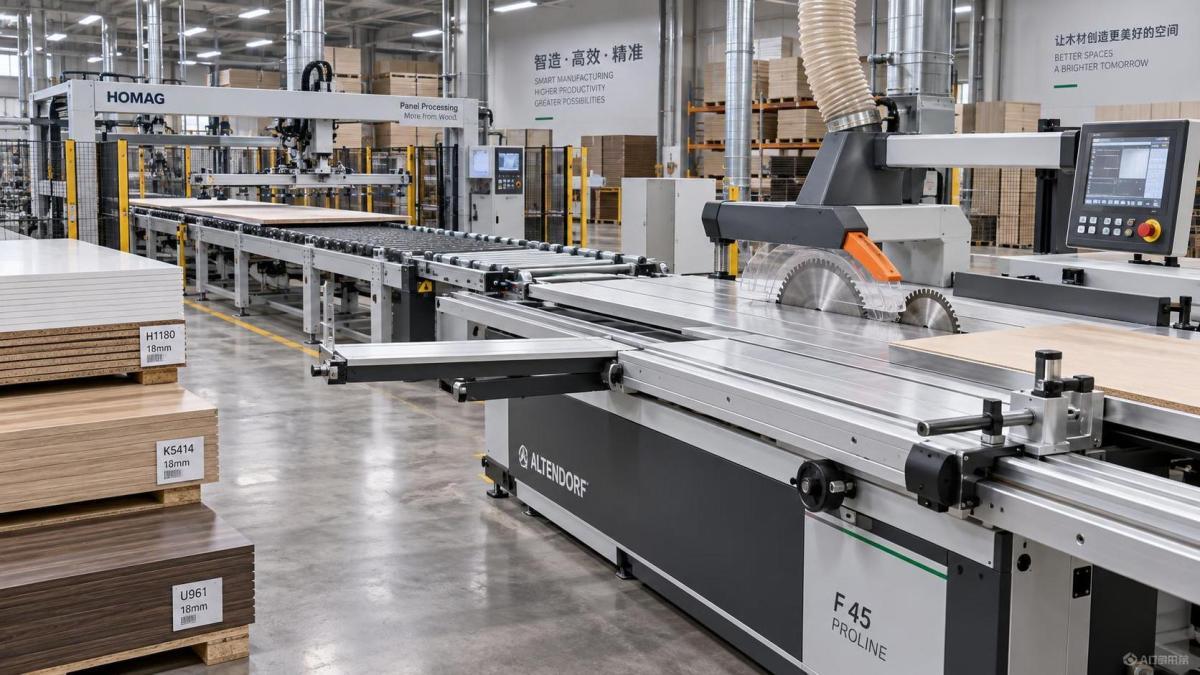
A sliding table saw illustrates the point. Table travel, guideway quality, saw-arbor alignment, fence repeatability, and the rigidity of the main structure affect squareness and finish quality. A large cutting capacity alone does not establish production value. The machine must sustain its geometry when handling sheet material, running at the required speed, and moving through repeated operating cycles.
Where laminated panels are a significant share of production, a scoring saw can also affect the financial result. Chipping at the underside of coated board can turn a dimensionally correct panel into a rejected or downgraded component. The incremental price of a scoring unit, adjustment capability, and suitable tooling should be assessed against the actual cost of defects and rework, not against the initial machine price in isolation.
Capacity specifications must match the production constraint
Larger machines command higher prices because they require more material, stronger drives, longer guideways, larger working envelopes, and more substantial shipping and installation arrangements. Yet purchasing capacity that cannot be used is a common form of overinvestment.
The relevant capacity measures differ by machine type. For a saw, they may include maximum cutting length, cutting width, blade diameter, cutting height, motor power, and usable table support. For a CNC router, the meaningful constraints may be working area, spindle configuration, tool-changing arrangement, vacuum hold-down, and loading method. For an edge bander, the issue may be feed speed, workpiece dimensions, glue system, and the number of processing stations.
Capacity should be assessed against the largest regular workpiece, not an unusual order that may appear occasionally. If a rare oversized job drives the entire investment upward, outsourcing that operation or using an alternative process may be less costly than carrying permanently underused machine capacity. Conversely, a machine selected exactly at today’s maximum requirement leaves little room for product changes, fixture needs, or safe material support.
The CNC Sliding Table Saw in model ZD400T-AD provides a useful example of how specifications translate into cost. Its 3,200 mm cutting length and 1,250 mm cutting width address full-size panel work; its 400 mm main blade and stated 120 mm maximum cutting height at 90 degrees support thicker material applications. A 5.5 kW main saw motor, 1.1 kW scoring motor, cast-iron worktable, screen-based angle display, servo-driven fence, and automatic lifting and tilting functions all add to equipment complexity. Whether those features justify their cost depends on actual panel formats, cutting schedules, angle changes, and quality requirements—not on the specification list alone.
Component selection affects maintenance exposure and downtime risk
Machinery quotations may look similar while using different grades of electrical, mechanical, pneumatic, and control components. The cost effect emerges over time through bearing life, switchgear reliability, belt and chain wear, guideway condition, sensor failures, drive availability, and the ease of replacing consumable items.
This is not an argument that the highest-priced component is always the right choice. Some operations are straightforward enough that standard, widely available parts provide a rational balance of cost and reliability. The concern is traceability. A quotation should make it possible to identify major motors, drives, electrical components, bearings, pneumatic parts, and control systems. If these items are unspecified, the buyer cannot accurately compare lifecycle exposure between offers.
Parts availability deserves separate attention. The practical cost of a failed component is not its invoice value; it is the lost contribution margin during the period in which the machine cannot produce. This risk is amplified when the equipment is imported, installed far from the supplier, or uses nonstandard control components. A spare-parts recommendation should distinguish between routine consumables, wear parts that should be held locally, and major components that depend on supplier stock and shipping lead time.
Safety, electrical configuration, and export readiness affect landed cost
The ex-works machine price rarely represents the approved project amount. Freight, cargo insurance, packaging, import duties and taxes where applicable, customs handling, inland transport, unloading, installation, electrical work, dust extraction connections, compressed-air supply, tooling, training, and commissioning can materially change the final investment.
Machine dimensions and weight matter in this calculation. A saw with a long sliding table or a heavy cast-iron structure may need specific container loading arrangements, lifting equipment, and adequate access at the destination. Site preparation should be reviewed before the order is placed: door clearances, floor loading, machine layout, maintenance access, power supply, dust collection capacity, and the routing of material before and after the machine.
Electrical requirements must be confirmed in writing. Voltage, frequency, phase configuration, plug or terminal arrangement, and control cabinet specifications must fit the destination facility. Retrofitting a machine after shipment can consume both time and budget, particularly where replacement motors, transformers, or control modifications are required.
Safety requirements should likewise be treated as a project condition, not as a late-stage documentation request. Required guarding, emergency stops, braking arrangements, dust-control provisions, and destination-market conformity obligations vary by jurisdiction and machine application. A supplier’s general statement of compliance is not a substitute for confirming the documentation and machine configuration required for the intended market.
Service support has a measurable economic value
After-sales support is frequently described in broad terms, yet it should be evaluated as an operating-cost variable. The useful questions are concrete: What documentation is supplied? Are electrical diagrams, parts lists, and maintenance instructions available in the working language of the facility? Can faults be diagnosed remotely? Which parts are normally stocked? What is the escalation path if the machine cannot be commissioned or develops a control issue?
A lower purchase price may be justified when internal maintenance capability is strong and the equipment is simple. The calculation changes when the machine relies on software, servo systems, complex pneumatics, or specialized calibration. In those cases, delayed technical support can outweigh a modest saving at purchase.
Support quality also influences the useful life assumed in the capital model. A machine that can be maintained with documented procedures, available consumables, and accessible replacement parts has a more defensible residual-value and depreciation assumption than one whose service history is uncertain. This does not require assuming a specific resale price; it requires recognizing that maintainability affects both operational continuity and disposal options.
Do not confuse a low quotation with a low total cost
Comparing quotations line by line is necessary, but it is not sufficient. Suppliers may include different scopes: tooling may be excluded; installation may be optional; export packing may differ; safety accessories may be priced separately; and a machine described with the same generic name may have a different control system, table construction, or adjustment method.
A useful internal comparison separates the investment into four layers:
- Delivered equipment cost: machine, selected options, export packing, freight, insurance, duties, and local delivery.
- Readiness cost: site work, utilities, extraction connection, lifting, installation, commissioning, and initial tooling.
- Annual operating cost: labor, energy, blades or cutters, maintenance, spare parts, calibration, and expected downtime.
- Quality and capacity effect: usable output, setup time, scrap, rework, throughput constraints, and the ability to meet the required product mix.
This framework prevents an artificial comparison between a bare machine quotation and a fully configured production solution. It also reveals when a higher initial investment is justified by lower setup loss, fewer rejected parts, or a reduction in external processing.
Return on investment should be built from incremental cash effects
ROI calculations are most credible when they use changes that can be traced to the machine. These may include labor hours removed from a repeated operation, outsourced cutting brought in-house, reduced material loss, shorter changeovers, higher output through an identified bottleneck, and lower repair expenditure on an obsolete asset. Revenue should not be assumed merely because a machine has higher nominal capacity. Additional output creates financial value only if there is demand, available downstream capacity, and sufficient working capital to support the added activity.
The model should also include conservative allowances for ramp-up, training, planned maintenance, blade and tooling costs, and lost production during installation. For imported machinery, exchange-rate exposure and payment timing can affect the committed capital amount. A deposit paid in one currency and a balance due months later may alter the final cost even when the supplier’s unit price does not change.
Where expected operating life is uncertain, sensitivity analysis is more useful than a single payback figure. Test the outcome under lower utilization, higher maintenance cost, slower production gains, and a delayed start of operation. If the project remains acceptable under reasonable downside assumptions, the approval case is more resilient.
The most reliable buying decision begins with a defined production requirement
Price is determined by the production problem the machine is designed to solve: material size, product mix, finish standard, frequency of changeover, required accuracy, operating hours, staffing model, and service environment. Asking suppliers for a price before these conditions are defined often produces quotations that are technically comparable only in appearance.
A sound approval record should therefore link each costly feature to a stated requirement. A longer table should correspond to a panel format. A stronger motor should correspond to material thickness, blade size, and duty cycle. Servo positioning should correspond to measurable setup or repeatability needs. A heavier structure should correspond to accuracy and workload expectations. Service provisions should correspond to the facility’s maintenance capability and distance from support.
That discipline turns the wood product manufacturing machinery price from a purchasing figure into an investment decision. The objective is not to buy the least expensive machine or the most heavily specified one. It is to acquire a machine whose delivered cost, operating risk, and productive capacity are proportionate to the work it must perform.
Send Your Inquiry
We welcome your cooperation and we will develop with you.