


News & Exhibitions
Latest Factory Updates, Industry Trends & Global Exhibition Information
Movable-Platen Hot Wood Presses: Matching Daylight Travel to Panel Thickness
Movable-Platen Hot Wood Presses: Matching Daylight Travel to Panel Thickness
For procurement teams selecting a hot wood press with movable platen, daylight travel should be specified from actual loading conditions, not panel thickness alone.
The correct opening improves operator access, protects panel surfaces, supports stable pressure application, and avoids paying for unnecessary machine height, stroke, and energy use.
This guide explains how to match movable-platen travel with panel construction, production methods, tooling, and future capacity needs before issuing a purchase specification.
Why Daylight Travel Is a Procurement Decision, Not a Minor Specification
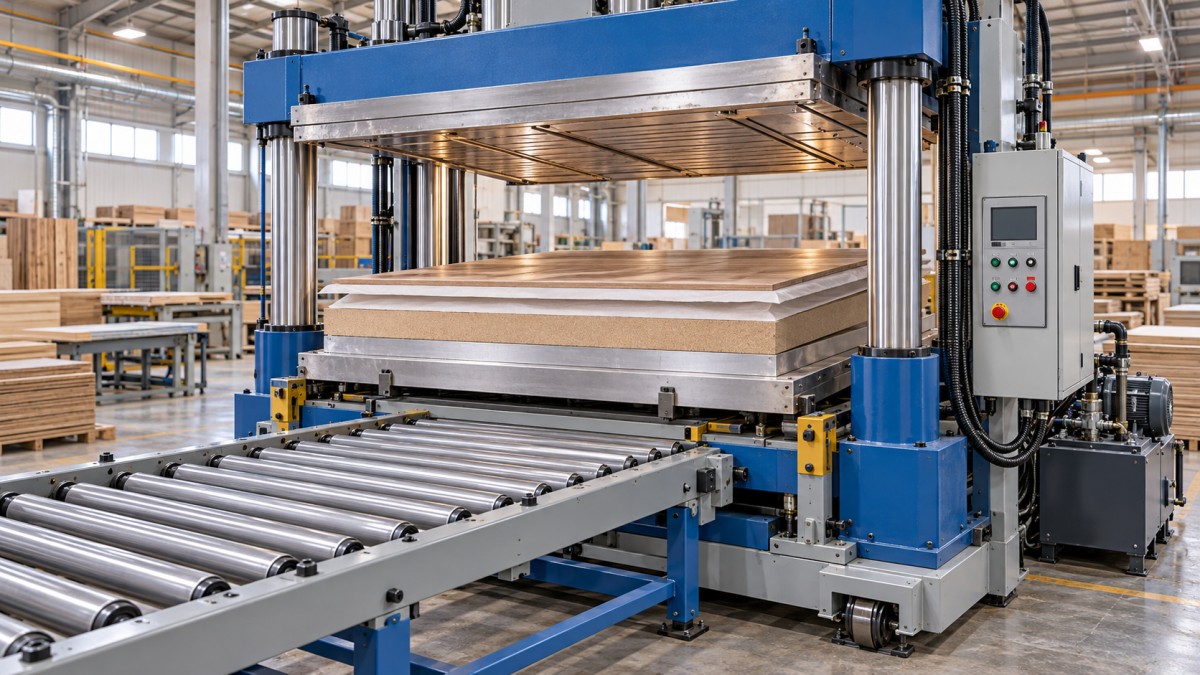
Daylight travel is the maximum vertical distance between the press platens when the movable platen is fully open.
In a hot wood press with movable platen, this clearance determines whether operators or automated equipment can load, align, and unload workpieces safely.
Buyers sometimes compare press tonnage, platen size, and heating power first, while treating daylight as a secondary dimensional detail.
That approach creates avoidable operating problems because the press may generate adequate force but remain difficult to load in real production.
A machine with insufficient opening can slow panel handling, damage veneers during insertion, restrict caul plate use, and increase operator fatigue.
Conversely, excessive daylight travel can increase frame cost, require a taller installation area, and lengthen platen movement if controls are poorly configured.
The purchasing objective is not to select the largest possible opening. It is to select usable clearance with a practical operating margin.
That margin must account for the finished panel, adhesive spread, protective sheets, cauls, loading fixtures, and the chosen material-handling method.
For furniture factories, this calculation matters particularly when production includes different door panels, laminated boards, veneered panels, and composite assemblies.
A well-matched configuration helps maintain throughput across product changes without forcing the factory to use temporary spacers or inefficient manual workarounds.
Start With the Real Press Stack, Not the Nominal Board Thickness
The most reliable way to determine required daylight is to calculate the full press stack at the point of loading.
Nominal board thickness may be only one part of that stack, especially when veneer pressing or multi-layer lamination is involved.
For a simple single panel, the stack may include the substrate, adhesive film, veneer, release paper, and one or two protective sheets.
For thicker assemblies, it may also include caul boards, aluminum plates, moulds, edge protection, or calibrated spacer systems.
Procurement teams should request production samples or detailed stack drawings from the process engineering department before comparing machine quotations.
Measure the maximum combined thickness after materials are positioned for loading, rather than relying on finished product drawings alone.
For example, a 25 mm veneered panel may require substantially more initial opening when paired with cauls and protective press accessories.
The needed daylight must also allow the operator to guide the stack into position without scraping the platen, frame, or neighboring material.
When loading is manual, usable insertion clearance often matters more than the theoretical minimum gap between platens.
When loading is automated, the requirements may be higher because conveyors, lift tables, vacuum loaders, or shuttle systems need defined clearance paths.
A practical specification begins with the thickest routine production stack, then adds an operating allowance appropriate for the handling method.
Use a Simple Calculation to Establish the Required Opening
A procurement specification should state daylight requirements in measurable terms, rather than asking suppliers for a “suitable” platen opening.
A useful starting formula is maximum loaded stack height plus handling clearance plus allowance for dimensional variation and future product changes.
The maximum loaded stack height includes every item that enters the press together, including reusable tools that may not appear on product drawings.
Handling clearance is the space required to insert and remove the stack without forcing operators to tilt, drag, or compress the assembly.
For manual loading, this allowance should reflect glove use, panel size, weight, and the risk of veneer displacement during positioning.
For mechanized loading, clearance must be validated against the lift stroke, conveyor height, guide dimensions, and gripper or vacuum system geometry.
Dimensional variation includes material thickness tolerance, warped sheets, accumulated adhesive layers, and differences between suppliers or product batches.
Future allowance should be deliberate rather than excessive, based on planned product expansion, new panel constructions, or possible accessory requirements.
As an example, a 60 mm stack with cauls may need an additional 80 to 120 mm of accessible clearance for safe manual loading.
The exact margin depends on panel format and workflow, but it should be discussed with operators instead of set only by purchasing staff.
Ask suppliers to confirm both maximum daylight and the minimum closed height, because these dimensions together affect usable pressing conditions.
Match Daylight Travel to the Panel Types You Actually Produce
Different woodworking applications require different daylight ranges, even when finished panels appear similar in size and material composition.
Thin laminated boards often need limited opening, but large formats may still require generous clearance to prevent edge contact during handling.
Veneered MDF or particleboard panels commonly use cauls, release materials, and alignment care that increase the practical opening requirement.
Solid wood laminated components can vary more in thickness because of machining tolerances, moisture movement, and irregular surface profiles.
Door cores, honeycomb panels, curved assemblies, and built-up furniture components usually need greater clearance than standard flat boards.
Some factories use the same press for both thin decorative panels and thicker special-order assemblies to improve equipment utilization.
In that situation, select daylight based on the thickest recurring job rather than the most common thin panel.
However, avoid specifying a very large opening merely for rare products that could be outsourced or processed on another suitable machine.
A press designed around exceptional workpieces can raise capital cost and reduce efficiency for the production that drives daily revenue.
Classify products into routine, seasonal, and exceptional jobs before setting the final opening requirement for a hot wood press with movable platen.
This classification gives procurement teams a defensible basis for comparing alternative configurations and explaining investment decisions to management.
Consider Platen Travel Speed and Cycle Time Together
Daylight travel affects cycle time because the movable platen must travel farther during every loading and unloading sequence.
Longer travel is not automatically slower if the machine has appropriate rapid approach speed, deceleration control, and hydraulic system capacity.
Still, buyers should not assume that a larger opening has no productivity cost simply because the quoted pressing time remains unchanged.
A complete cycle includes opening, unloading, loading, closing, rapid approach, pressure buildup, heating dwell, decompression, and reopening.
For short pressing cycles, platen movement can represent a meaningful share of total production time, especially in high-volume lamination lines.
Ask suppliers for a documented cycle-time estimate at the proposed daylight setting, panel thickness, target pressure, and operating temperature.
The estimate should separate rapid movement from slow pressing movement, because controlled low-speed contact protects panels and distributes pressure more consistently.
Variable-speed hydraulic control can be valuable where workpiece thickness changes frequently or where delicate veneer faces need gentle closing behavior.
Programmable stop positions can also reduce unnecessary travel when the machine processes several product families with different stack heights.
For procurement evaluation, compare usable output per shift rather than only nominal press specifications or theoretical machine movement speeds.
That comparison reveals whether a lower-cost press could create labor or throughput losses over its operating life.
Check Pressure, Frame Design, and Platen Parallelism
Correct daylight travel does not compensate for weak pressure performance, inadequate frame rigidity, or poor platen parallelism.
Once the press contacts the stack, pressure must build evenly across the working area to create a stable bond and uniform panel thickness.
Large platen openings can place additional demands on guiding systems because the movable platen must remain aligned throughout its travel.
Buyers should ask how the platen is guided, how parallelism is maintained, and how the manufacturer controls unequal cylinder movement.
Multi-cylinder designs, guided columns, precision-machined structures, and reliable hydraulic synchronization can improve repeatability in demanding applications.
The supplier should define platen flatness, parallelism tolerance, maximum pressure, and pressure distribution performance in the technical proposal.
These values should be assessed against panel size, adhesive requirements, and the actual pressure expressed at the workpiece surface.
Total tonnage alone can be misleading because the same force produces different pressure levels across different platen areas.
Procurement teams should calculate required specific pressure from panel area and bonding process, then confirm the machine can achieve it reliably.
For wide furniture panels, insufficient or uneven pressure may cause weak bonding, veneer defects, thickness variation, and increased rework rates.
A technically sound quotation connects daylight travel with platen dimensions, cylinder arrangement, pressure capacity, and structural stiffness.
Plan for Loading, Unloading, and Plant Layout
The best daylight specification can still fail operationally if the press layout does not support efficient material flow around the machine.
Manual loading requires enough front-side clearance for operators to handle panels without twisting, lifting excessively, or contacting hot surfaces.
Large panels may need roller tables, scissor lifts, vacuum lifters, or loading carts that influence the effective clearance needed below the upper platen.
Automated lines require coordinated dimensions between the press, infeed conveyor, outfeed conveyor, alignment devices, and stacking equipment.
Confirm the height of the lower platen relative to the floor, because this affects ergonomic loading and compatibility with adjacent handling equipment.
Also verify the machine’s overall height at full opening, including hydraulic pipes, safety guards, lifting points, and electrical cabinet clearances.
A high-daylight model may require building modifications, greater ceiling clearance, or different transport planning during installation.
Safety systems deserve equal attention because movable platens create pinch zones that must be controlled during loading and service work.
Evaluate two-hand controls, photoelectric protection, emergency stops, safety distances, guarding design, and access for maintenance personnel.
Ask whether safety equipment affects usable opening or loading access, especially on presses designed for automated or semi-automated production.
Plant layout drawings should be reviewed before purchase order release, not after the machine has been manufactured and shipped.
Evaluate Heating Performance for Your Pressing Process
Daylight travel determines access, but platen heating performance determines whether the press can deliver repeatable bonding results at production speed.
Specify the required platen temperature range based on adhesive type, veneer process, laminate material, curing time, and local operating conditions.
Hot water, thermal oil, steam, and electric heating systems have different infrastructure requirements, temperature control characteristics, and maintenance implications.
Electric heating can simplify installation in some workshops, while thermal oil systems may suit factories operating several heated machines or higher temperatures.
Buyers should request information on heating zones, temperature uniformity, sensor locations, insulation, warm-up time, and control accuracy.
Uneven platen temperature can create inconsistent curing, especially when pressing large decorative surfaces or using adhesives with narrow process windows.
Temperature stability becomes more important when a hot wood press with movable platen operates across multiple shifts with frequent product changes.
Ask the supplier how temperature settings, pressure stages, dwell times, and platen positions are stored and recalled by the control system.
Recipe-based controls can reduce setup errors and help operators repeat validated processes when switching between panel formats or material types.
Energy consumption should be considered over the expected annual operating hours, including standby losses and heat recovery opportunities where available.
A lower purchase price may be less attractive when heating inefficiency, slower warm-up, or poor control causes long-term operating costs.
Build a Purchase Specification That Suppliers Can Quote Clearly
A detailed purchase specification reduces ambiguity and makes quotations easier to compare across manufacturers, models, and equipment configurations.
State the maximum panel length, width, finished thickness, maximum loaded stack height, and required daylight travel in measurable units.
Include panel materials, adhesive systems, target temperature, required specific pressure, expected daily output, and normal operating shift pattern.
Describe whether loading is manual, roller-assisted, vacuum-assisted, or automated, because each method changes the usable opening requirement.
Specify desired platen movement speeds, programmable positions, control language, electrical standards, safety requirements, and available utility connections.
Request machine drawings showing full-open height, service access, foundation loads, hydraulic unit location, and recommended installation clearances.
Suppliers should identify standard features separately from optional equipment, allowing procurement teams to compare total delivered capability rather than base pricing.
Useful options may include loading tables, automatic panel positioning, pressure recording, temperature recording, spacer systems, and remote diagnostic support.
For international sourcing, verify documentation, export packing, commissioning scope, spare parts availability, warranty terms, and after-sales response arrangements.
Qingdao Zhongding Machinery Co., Ltd. can support buyers with woodworking press configurations matched to practical panel production requirements and operating conditions.
Early technical discussion helps ensure that platen travel, heating, pressure, and handling arrangements work together as one productive press solution.
Questions Procurement Teams Should Ask Before Ordering
Before selecting a supplier, ask what maximum loaded stack the proposed daylight can accommodate under normal, safe production conditions.
Request a clear explanation of the difference between maximum theoretical opening and the opening that remains practical with guards and loading equipment.
Ask for reference applications involving similar panel dimensions, materials, adhesive systems, and production volumes whenever those details are available.
Confirm how the machine maintains platen parallelism throughout travel and whether adjustment procedures are needed during regular maintenance.
Determine the expected cycle time for each key product family, including loading and unloading movements instead of focusing only on dwell time.
Ask what happens when panel thickness changes unexpectedly and whether the control system provides pressure limits, travel limits, or recipe protection.
Clarify recommended preventive maintenance for hydraulic cylinders, seals, guides, heating circuits, temperature sensors, and electrical control components.
Review the spare parts list and identify critical items that should be stocked locally to avoid extended downtime after commissioning.
Finally, evaluate service capability as part of total ownership cost, particularly for presses supporting export-oriented furniture production schedules.
A supplier that understands the complete process can help buyers avoid a technically compliant machine that proves inconvenient in everyday operation.
Conclusion: Select Usable Clearance That Supports Productive Pressing
Matching daylight travel to panel thickness means assessing the entire loaded stack, handling process, production mix, and future capacity plan.
The right hot wood press with movable platen provides enough room for safe, efficient loading while avoiding unnecessary travel, cost, and installation demands.
Procurement teams should evaluate daylight alongside pressure, platen parallelism, heating performance, controls, handling equipment, and service support.
By turning actual workpiece requirements into a clear technical specification, buyers can compare suppliers accurately and choose equipment that delivers lasting production value.
Send Your Inquiry
We welcome your cooperation and we will develop with you.