


News & Exhibitions
Latest Factory Updates, Industry Trends & Global Exhibition Information
Hot-Water-Heated Wood Presses: Comparing Energy Costs and Heat-Up Performance
A hot-water-heated wood press is often evaluated on its electricity or fuel bill alone, yet the purchase outcome is determined by a wider cost pattern: energy source, heat transfer losses, warm-up schedule, press utilization, temperature consistency, and the cost of keeping heat available between production runs. A hot wood press with hot water heating can be economically attractive where an existing boiler, thermal oil circuit, heat-recovery system, or centralized hot-water network already serves the facility. Its strongest advantage is usually stable platen temperature during sustained production rather than the fastest possible cold-start cycle.
The comparison should begin with the required production pattern. A press running through long shifts has a different energy profile from one used for intermittent veneering, small-batch panel lamination, door assembly, or repair work. Hot-water heating stores and transfers heat through the press platens gradually. That can reduce sharp electrical demand and support a more predictable thermal load, but it also means that heat-up planning matters. A system that is economical during continuous use can become inefficient when it is heated repeatedly for short, irregular jobs.
Energy Cost Is a System Calculation
The press itself is only one part of the heating system. Energy enters through a boiler or heat source, travels through supply piping, passes through hoses or rotary connections where applicable, circulates through platen channels, and eventually leaves through the return line. Each stage affects the cost per productive pressing hour.
Electric-heated platens convert purchased electricity directly at the machine. The arrangement is mechanically simple and can reach working temperature quickly on smaller presses, especially when heaters are divided into independently controlled zones. The cost exposure is direct: when electricity tariffs are high, every maintained platen temperature is reflected in the machine's electrical consumption. Electrical systems can also create high peak demand when several presses begin heating at the same time.
Steam-heated presses transfer heat efficiently where steam is already generated for other plant processes. Steam carries substantial energy, and it can heat large platen masses quickly. However, steam systems need condensate management, traps, pressure control, piping maintenance, and attention to water quality. A steam press that loses heat through leaking valves, failed traps, or poorly insulated piping may appear to have a platen problem when the real issue is in the distribution network.
Thermal-oil systems are common where higher operating temperatures or very uniform heat transfer are required. They can provide strong thermal stability, but the circuit usually involves a dedicated heater, expansion equipment, pumps, fluid monitoring, and a more demanding maintenance regime. The initial installation and fluid-management responsibilities should be included in the capital comparison rather than assigned only to the press budget.
Hot-water systems work at lower temperatures than steam or thermal oil in many configurations, so their economics depend heavily on the target pressing temperature. They are well suited to processes that do not require extreme platen temperatures and that benefit from a stable, moderate heat supply. When hot water is generated by efficient central equipment, recovered process heat, or a source with favorable fuel cost, the press may operate with a lower marginal energy cost than direct electric heating. Where the hot-water source must be installed only for one lightly used press, that advantage can disappear after piping, pumps, controls, insulation, and commissioning are counted.
Heat-Up Time Needs a More Exact Definition
“Heat-up time” is frequently treated as the time from power-on to the temperature shown on the controller. That is not enough for production planning. A press is ready only when the platen surface, the internal heat-transfer circuit, the upper and lower platen, and the control sensor response have reached a sufficiently stable condition for the intended adhesive and material thickness.
A hot-water circuit can show a rapid rise in return temperature before the full platen mass has equalized. If pressing begins at that point, the first panels may receive less heat near platen edges or in slower-flow sections. The result may be longer cure time, inconsistent bond development, veneer bubbles, or a need to hold panels in the press longer than the nominal cycle suggests. The energy system then appears inexpensive per hour while throughput quietly declines.
Platen mass matters. Thick steel platens absorb more energy during start-up but resist temperature swings once stabilized. Lightweight platens respond faster, though they can be more affected by cold workpieces, frequent opening, and rapid loading changes. Neither characteristic is automatically better. Large panels, thick laminates, and long press cycles generally favor thermal stability. Short-cycle production with frequent product changes places more value on response speed and accurate zone control.
Water supply temperature sets a physical limit. Heat flows from hotter water to the platen, then from the platen to the wood assembly. If the supply temperature is only slightly higher than the desired platen setting, the system will approach the setpoint slowly and may struggle to recover after a cold load enters the press. Raising water flow without enough temperature difference improves circulation but cannot create the missing heat input. Conversely, very hot supply water paired with poor controls can cause overshoot, especially after a press sits idle with no load removing heat.
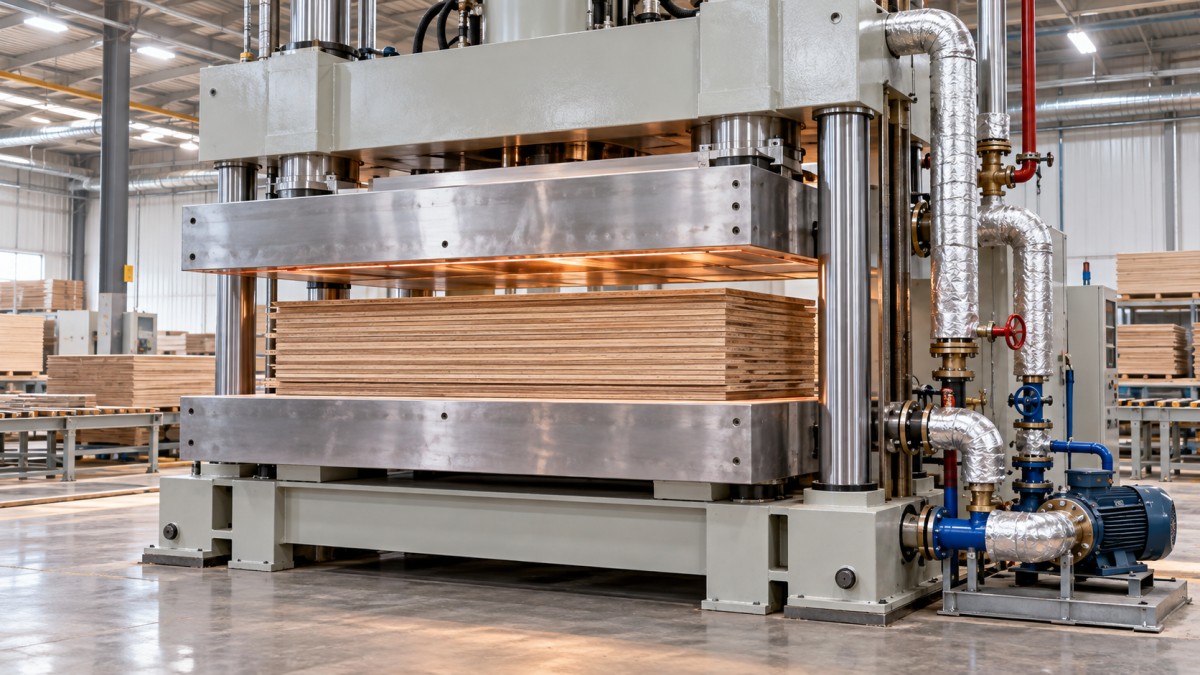
The useful commissioning test is not simply an empty-press warm-up record. It is a record of platen temperatures at several locations during warm-up, followed by measurements after representative panels are loaded and after several production cycles. The comparison should include top and bottom platen behavior. Uneven heating across opposing platens can alter glue-line conditions even when the controller displays the same nominal temperature for both.
Where Hot Water Performs Well
Hot-water-heated presses fit best where process temperatures are compatible with the available water circuit and where the press remains active for enough of the shift to amortize warm-up energy. Veneer pressing, panel lamination, furniture-component assembly, and similar medium-temperature duties can benefit from the steady heat of a well-designed water loop. The system becomes more compelling when the heat source also supports drying, space heating, cleaning processes, or other thermal loads, because generation and maintenance costs are shared rather than assigned entirely to one machine.
A stable thermal source also reduces the need to repeatedly energize large electrical heater banks. This can simplify site electrical planning where installed capacity is constrained. It should not be assumed that water heating eliminates electrical costs: circulation pumps, control valves, temperature instrumentation, and potentially a boiler blower or burner still consume power. Their consumption is often modest relative to platen heating, but it belongs in the operating-cost model.
Production schedule has an outsized effect. A press heated before a full shift and held within a controlled standby band may use less total energy than one allowed to cool completely between closely spaced jobs. The reverse can be true when the gap is long enough for standby losses to exceed the energy needed for reheating. The correct standby policy comes from measured cool-down behavior, expected next-use timing, insulation quality, and the cost of the heat source. A fixed rule such as “always leave it on” or “always shut it down” is rarely defensible.
Conditions That Weaken the Cost Case
Long distribution lines are a common source of disappointment. A remote press supplied through uninsulated or poorly insulated pipework loses heat before it reaches the platen. The resulting low return temperature can be misread as efficient heat extraction, while the actual cause is heat loss into the building. Pipe insulation, valve insulation, and correctly sized lines are practical cost controls, not cosmetic installation details.
Undersized pumps create another misleading condition. The water may reach the press at the correct temperature, but inadequate flow prevents even distribution through the platen passages. Control sensors near the inlet can read satisfactorily while distant areas lag. Oversized pumps create their own penalty through unnecessary electrical use, noise, erosion risk, and unstable valve behavior. The required flow should be based on platen circuit design, pressure loss, water temperature difference, and the number of presses operating simultaneously.
Water quality deserves attention before installation. Scale, corrosion products, and suspended debris restrict narrow channels and reduce heat transfer. The process may then require a higher supply temperature or a longer warm-up period to achieve the same platen condition. Strainers protect pumps and valves, but they need accessible placement and a maintenance routine. Closed-loop treatment, filtration where appropriate, and air removal reduce the likelihood of circulation problems that later resemble a press defect.
Intermittent operation is the other major limitation. A short press cycle does not automatically mean a short heating requirement. If the platen must be warmed from ambient temperature for a brief job and then allowed to cool, the thermal mass may dominate the energy cost. Direct electric heating can be more practical for isolated work where quick local startup is worth a higher unit energy rate. The comparison should therefore use annual hours at working temperature, not only the energy price per kilowatt-hour or per unit of fuel.
Comparing Costs Without False Precision
A credible evaluation separates one-time cost, fixed annual cost, and variable production cost. The equipment quotation is only the starting point. Installation may include a heat source connection, supply and return piping, insulated valves, circulation pump, expansion arrangements, controls, safety devices, electrical supply for auxiliaries, foundations, and commissioning time. Existing infrastructure should be assessed for spare heating capacity at the required supply temperature, not merely for the presence of a nearby pipe.
Variable cost should be estimated from the heat needed to bring platens to temperature, the heat lost while idling, the heat transferred into each panel assembly, and the efficiency of generating and delivering that heat. Panel moisture content matters because water in the material absorbs substantial energy. Cold stock stored in an unheated area can extend recovery time and obscure the performance of the heating system. Veneer species, core material, panel thickness, adhesive type, glue spread, and press closing time also affect the actual thermal load.
Cycle time should not be converted into savings until bond quality and panel flatness are confirmed at the intended temperature and pressure. Reducing a dwell time because a controller reaches setpoint faster can create expensive downstream defects. Delamination, telegraphing, blistering, or surface damage may emerge after machining, finishing, or changes in humidity, when the original heating shortcut is difficult to trace.
For a comparison that can withstand review, use the same product mix and shift pattern for every option. Record warm-up from a defined starting condition, recovery after representative loads, standby consumption, average press-open time, and actual pressing dwell. Include expected maintenance stoppages: electrical heater access differs from valve, pump, hose, and circulation-loop service. There is no need to force these items into a single speculative number. A transparent range built from known operating conditions is more useful than a precise-looking estimate built on unverified assumptions.
Installation Details That Affect Long-Term Performance
Supply and return connections should allow the platen circuit to be filled, vented, isolated, drained, and serviced without draining an entire plant loop. Air pockets reduce effective flow and often produce uneven temperature patterns that change from day to day. Instrumentation placed only at the boiler offers limited diagnostic value; temperature and pressure readings near the press reveal whether the machine is receiving the planned conditions.
Flexible hoses need to tolerate movement, temperature, pressure, and routing without rubbing against press frames or pinch zones. On moving-platen designs, hose length and bend radius must be considered across the full opening stroke. A hose that survives installation but repeatedly flexes beyond its intended path will impose unplanned downtime later. Isolation valves and accessible unions shorten service work, provided they do not introduce excessive restriction into the circuit.
Temperature control also needs to reflect the process rather than the convenience of a single sensor location. Separate monitoring of upper and lower platens is valuable when product quality is sensitive to asymmetric heating. Periodic surface checks at the center and near edges provide an independent view of actual platen conditions. When measured surface temperature differs consistently from the controller, the correction should address sensor placement, circulation, or heat transfer before production settings are changed.
The most defensible choice is the one that matches the available heat source, required platen temperature, expected operating hours, and production rhythm. Hot-water heating rewards stable utilization and disciplined installation. Where those conditions are absent, a faster-reacting or more self-contained heating method may produce a lower total cost despite a less favorable energy rate.
Send Your Inquiry
We welcome your cooperation and we will develop with you.