


News & Exhibitions
Latest Factory Updates, Industry Trends & Global Exhibition Information
What is the best equipment for small-scale wood manufacturing operations?
Choosing the best equipment for small-scale wood manufacturing operations is less about buying the largest or most automated machine and more about building a workflow that fits the products, labor skills, available space, and cash flow of the business. For a workshop making cabinets, solid wood furniture, doors, panels, or custom components, every equipment decision affects material yield, delivery reliability, surface quality, and the ability to take on more profitable orders.
Business owners often begin with a simple question: “Which machine should we buy first?” In practice, the better question is: “Where does our current production flow lose the most time, accuracy, or material?” A slow cutting stage can hold up every downstream task. Inconsistent edging can make otherwise good panels look unfinished. Limited drilling capacity may turn a straightforward cabinet order into a scheduling problem.
The most effective small-scale setup is usually a balanced combination of cutting, edge processing, machining, sanding, and dust-control equipment. The exact mix changes by product type, but the selection principles remain the same: protect accuracy, reduce manual rework, keep operation manageable, and leave room for growth.
Start with the production route, not a machine catalogue
A compact woodworking operation should map its work from raw board or lumber intake to packed finished parts. This exercise quickly reveals which equipment deserves investment and which processes can remain manual or outsourced for the moment.
For panel furniture, the typical route includes panel cutting, edge banding, drilling or routing, assembly, cleaning, and packing. A solid wood furniture workshop may need rough cutting, planing, thicknessing, precision sizing, shaping, sanding, and finishing preparation. Door and frame producers may place greater emphasis on spindle moulding, mortising, tenoning, and wide-belt sanding.
Do not purchase machinery simply because it is common in a larger factory. A high-capacity machine can become an expensive bottleneck if it requires more floor space, power, skilled labor, or order volume than the business can support. Conversely, choosing only entry-level equipment may create hidden costs through repeated setups, rejects, inconsistent dimensions, and overtime.
Before requesting quotations, define these operational points:
- Primary materials: MDF, particleboard, plywood, melamine panels, hardwood, softwood, veneer, or composite boards.
- Typical part dimensions, thickness range, and maximum workpiece size.
- Expected daily or monthly output, including peak-season demand.
- Required tolerances and finish expectations for the target market.
- Available workshop area, electrical supply, compressed air, and dust extraction capacity.
- Number and experience level of operators.
- Whether production is repetitive, customized, or a mix of both.
These details turn equipment sourcing from a general shopping exercise into a practical investment plan.
The core machines for most small wood manufacturing workshops
1. A dependable cutting solution
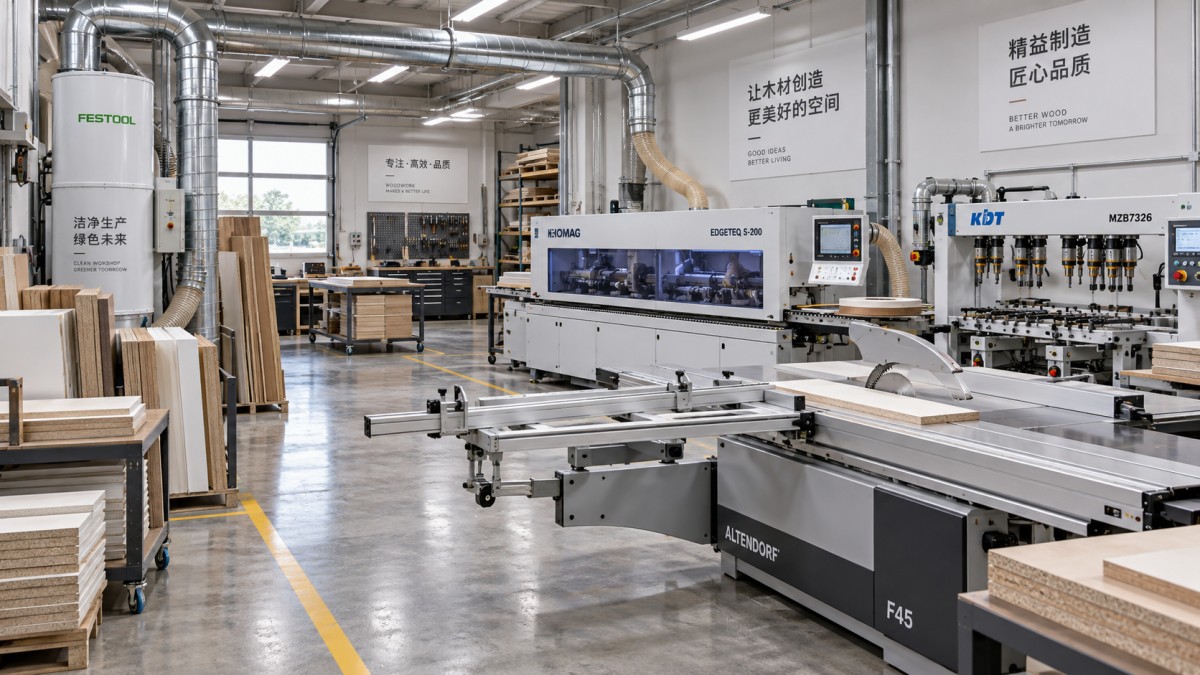
Cutting accuracy sits at the beginning of the production chain. If panels or timber components are not square and sized correctly, edge banding, drilling, assembly, and installation all become harder. For many small-scale panel operations, a sliding table saw remains a sensible and flexible starting point. It handles straight cuts, crosscuts, sizing tasks, and smaller custom batches without requiring the investment level of a fully automated production line.
When the business frequently processes larger quantities of sheet goods or needs nested parts, a CNC router may be a better fit. CNC nesting can combine cutting, grooving, drilling, and shaping in one program-driven process. However, it is not automatically the best first purchase. It requires reliable programming, tool management, vacuum holding, material handling, and operators who understand how to prevent chip-out and maintain cutting quality.
For a workshop centered on solid wood, a panel saw alone is not enough. A well-configured table saw, often paired with a crosscut saw or optimized cutting system as volume grows, can provide better control over lumber preparation and component sizing.
2. Edge banding that matches your quality position
For cabinet, office furniture, retail fixture, and melamine-panel producers, an edge banding machine is often one of the most important upgrades after cutting. Hand-applied edging may be acceptable for prototypes or occasional work, but it can limit consistency when order volumes rise. Customers may not describe a furniture panel in technical terms, yet they notice gaps, loose tape, glue marks, uneven trimming, and poor corner finishing immediately.
A compact automatic edge bander typically provides a useful combination of glue application, tape feeding, end trimming, flush trimming, scraping, and buffing. The right configuration depends on the materials used and the finished appearance required. A machine with only basic trimming may suit utility furniture, while a business serving retail interiors or higher-end cabinetry may benefit from more refined scraping and polishing functions.
Decision-makers should look beyond nominal feed speed. Ask how quickly the machine can be changed between edge tape thicknesses, whether the glue system is easy to clean, how stable the pressure system is, and whether common wear parts are readily available. In a small factory, downtime caused by a neglected glue pot or unavailable cutter can be more damaging than a modest difference in purchase price.
3. Drilling and routing capacity for repeatable assembly
Holes determine whether furniture components assemble smoothly. Shelf pins, hinge cups, dowel holes, connector fittings, and drawer hardware all rely on placement accuracy. A multi-spindle boring machine can be a highly cost-effective choice for recurring cabinet and panel furniture work. It is simpler than a full CNC machining center, faster than manual marking and drilling, and well suited to standardized layouts.
For operations with frequent design changes, shaped components, or integrated machining requirements, a CNC drilling and routing center offers greater flexibility. It can reduce manual measuring and make repeat production more reliable, particularly when linked to design or production software. Still, the investment should be justified by order mix. A workshop producing varied one-off jobs may gain more from a versatile CNC router than from several specialized drilling machines.
The key is to choose a system that reduces errors without introducing unnecessary programming complexity. A good machine should make it easier for operators to produce correct parts consistently, not create a process that only one technician can run.
4. Surface preparation equipment that prevents rework
Sanding is often underestimated during equipment planning because it appears to be a finishing-stage task. Yet it influences paint adhesion, veneer appearance, touch quality, and the time needed before final finishing. For solid wood manufacturing, a wide-belt sander can dramatically improve consistency on panels, doors, and glued-up components. It also reduces the fatigue and variability associated with extensive hand sanding.
A smaller workshop does not necessarily need the widest or most complex machine available. What matters is whether the sanding width, abrasive configuration, conveyor stability, and dust collection match the workpieces being produced. A calibration sander may be sufficient for thickness consistency, while a combination machine with different sanding heads can support more demanding finish preparation.
For shaped work, orbital sanders and manual stations will still have a role. The goal is not to eliminate skilled handwork, but to reserve it for the areas where it adds value rather than using it to correct machine-related inconsistencies.
Equipment that may be essential for specific product lines
Some machines do not belong in every small workshop, but they can be transformative in the right production environment.
Planers and thicknessers are central to solid wood work. They prepare lumber to consistent dimensions and create a reliable starting surface for downstream machining. Workshops buying pre-surfaced timber may need less capacity, while those processing rough lumber in-house should treat this as a core investment.
Spindle moulders and shapers are valuable for profiles, mouldings, door components, grooves, and decorative edges. They remain practical for many applications, although CNC routing may be preferable where designs change frequently or complex shapes are required.
Mortisers, tenoners, and copy shapers suit chair, door, frame, and traditional joinery production. Their value depends heavily on repeat volume. If mortise-and-tenon joints are a major part of the product line, dedicated equipment can save substantial labor and improve fit.
Cold presses, vacuum presses, or membrane presses become relevant for veneering, laminating, curved panels, and decorative door production. They should be selected based on pressing area, pressure requirements, adhesive process, and cycle times rather than simply on bed size.
How to decide between standalone machines and a CNC-led setup
This is one of the most important purchasing decisions for a growing workshop. Standalone machinery usually offers lower upfront cost, straightforward maintenance, and clear workstations. It can be an excellent choice when parts are relatively standardized and the team has strong hands-on woodworking experience.
A CNC-led setup provides greater flexibility and can reduce dependence on manual layout. It is especially useful for custom cabinetry, variable-size orders, shaped parts, and production that requires frequent changes. Yet automation does not remove the need for process discipline. It shifts the focus toward digital drawings, nesting strategy, tool libraries, machine calibration, and organized material flow.
For many businesses, the most sensible path is gradual. A sliding table saw, automatic edge bander, and boring machine can establish a stable panel-furniture cell. Later, a CNC router can be added when customization, volume, or labor constraints justify it. This staged approach avoids tying up capital in features that will sit idle during the first years of growth.
Calculate cost beyond the machine price
When comparing quotations, the purchase price is only one part of the cost. A lower-priced machine may be a sound choice if its performance fits the job and support is accessible. But it can become costly if spare parts are difficult to obtain, instructions are unclear, setup is time-consuming, or local technicians cannot service key components.
Build a total-cost view that includes transportation, installation, commissioning, tooling, training, electrical work, air lines, dust extraction, consumables, routine maintenance, and likely production interruption during the learning period. Ask suppliers what is included in the standard machine package and which accessories are optional. For example, extra saw blades, router bits, pressure rollers, glue system parts, sanding belts, and cutter heads should be considered before production begins.
Machine utilization also matters. A high-output edge bander that operates for only a few hours per week may not provide the return expected. On the other hand, a machine used every day to remove a persistent bottleneck can pay for itself through shorter lead times, reduced rejects, and the ability to accept more orders.
Questions business leaders should ask a woodworking machinery supplier
A productive supplier discussion should go beyond a brochure and a price list. Share drawings, sample parts, material specifications, and expected output. The supplier should be able to discuss the workflow around the machine, not only the machine itself.
- Can the equipment process our board types, thicknesses, and part sizes reliably?
- Which operations are included as standard, and what optional units are genuinely necessary?
- What operator training is required before production can begin?
- Which wear parts and consumables should we keep in stock?
- How are remote technical support, documentation, and troubleshooting handled?
- What maintenance tasks must be completed daily, weekly, and monthly?
- Can the machine layout be integrated with our existing material flow and dust collection system?
Experienced manufacturers such as Qingdao Zhongding Machinery Co., Ltd. can be particularly useful at this stage because equipment selection should reflect the entire woodworking process. With more than 20 years in woodworking machinery, the company supports workshops and furniture producers with machines and practical production solutions, alongside technical support and spare parts planning. For a smaller operation, that continuity can matter as much as the machine specification itself.
A practical buying sequence for controlled growth
If capital is limited, prioritize the operation that causes the greatest daily constraint. For panel-based furniture, this is often accurate cutting or dependable edge banding. For solid wood products, it may be lumber preparation and sanding. Improve the most restrictive stage first, then make sure the next stage can absorb the increased output.
Avoid purchasing several machines at once without considering staffing and workflow. New equipment changes how materials move, how jobs are scheduled, and how quality is checked. Introducing machines in logical phases gives operators time to learn, allows management to measure results, and keeps production disruptions under control.
The best equipment for small-scale wood manufacturing operations is therefore not a single universal machine. It is a carefully chosen set of capabilities that turns raw material into accurate, attractive, repeatable products at a cost the business can sustain. Start with the product range, identify the true bottleneck, assess the full ownership cost, and choose suppliers able to support the machine long after installation. That approach creates a workshop that is not merely equipped for today’s orders, but prepared for the next stage of growth.
Send Your Inquiry
We welcome your cooperation and we will develop with you.