


News & Exhibitions
Latest Factory Updates, Industry Trends & Global Exhibition Information
How to assess a honeycomb panel hot press supplier before ordering
A honeycomb panel hot press may look straightforward on a quotation: platen size, nominal pressure, heating method, and price. The difficulty usually appears later, when the press must bond thin face materials to a lightweight core without telegraphing, weak edges, local crushing, or inconsistent panel thickness. A low initial price can quickly lose its advantage if the machine requires frequent adjustment, lacks usable process support, or cannot maintain repeatable pressure across a full platen.
Before ordering, assess a honeycomb panel hot press supplier by asking whether the supplier can prove three things: the press is correctly sized for your panel construction and output target; its manufacturing and quality controls support stable operation; and its service team can support installation, commissioning, spare parts, and troubleshooting after delivery. A polished catalog is not enough. The supplier should be able to discuss the bonding process in practical terms and provide machine-specific evidence.
Start with the panel you actually need to produce
Supplier evaluation should begin with your process sheet, not with a standard machine model. Honeycomb panels vary considerably. Face sheets may be MDF, plywood, particleboard, HPL-laminated board, veneer, aluminum, or other decorative materials. The core may be paper honeycomb, plastic honeycomb, aluminum honeycomb, or another lightweight structure. Adhesive type, panel thickness, surface finish, and required flatness all affect press selection.
Prepare a short technical brief before requesting quotations. It should state the finished panel dimensions, minimum and maximum thickness, face material thickness, core type, adhesive system, expected daily or shift output, and whether panels are loaded manually or through an automated line. Include restrictions that may affect operation, such as limited factory height, electrical supply, compressed-air availability, or required loading direction.
This information changes the questions you should ask. A supplier recommending a press without confirming panel construction may be offering a generic solution rather than evaluating your bonding requirement. For example, a fragile paper honeycomb core may need carefully controlled pressure and platen parallelism, while a different panel build may place more emphasis on heat transfer or a longer dwell period. The correct press is not simply the one with the highest rated tonnage.
Check whether the technical proposal is complete
A useful proposal explains how the machine will achieve pressure, heat, alignment, and repeatability. Avoid comparing two offers based only on table dimensions and total hydraulic force. Those figures matter, but they do not show whether the press is suitable for consistent production.
Pressure capability and distribution
Ask the supplier to state the recommended working pressure range for your panel type, not merely the maximum cylinder force. Honeycomb panels can be damaged by excessive localized loading, while insufficient or uneven pressure can leave poorly bonded areas. The supplier should explain how pressure is adjusted, monitored, and maintained during the pressing cycle.
Also ask about the hydraulic layout: cylinder arrangement, hydraulic components, pressure control method, and whether the system is designed to keep the moving platen level. A large platen supported poorly can create uneven pressure near corners or edges. This may not be obvious during a short no-load demonstration, but it can affect yield once full-size panels are pressed repeatedly.
Platen flatness, parallelism, and rigidity
The frame and platen structure influence the finished panel as much as hydraulic force does. Ask how the supplier controls platen flatness and parallelism during fabrication and assembly. The answer should be more specific than “high precision.” A capable supplier can describe the machining process, structural design, assembly inspection, and method used to verify movement under operating conditions.
For thin decorative faces or high-flatness products, request acceptance criteria that can be checked before shipment. The press should close smoothly without visible racking, and the platen should remain properly aligned across the usable working area. If your process uses caul plates, release boards, or a buffering layer, discuss these with the supplier because they affect both pressure transfer and usable opening height.
Heating and temperature control
Not every honeycomb panel process needs a hot press in the same way. Some adhesives respond primarily to heat; others use heat only to shorten curing time or stabilize production. Confirm the heating medium, temperature range, zone arrangement, temperature sensing points, control accuracy specification, heat-up behavior, and insulation approach.
Ask how the supplier checks temperature uniformity across the platen. A single displayed temperature does not confirm that the whole pressing surface performs consistently. Uneven heating can produce different curing conditions between the center and edges, especially with larger panels or materials that absorb heat differently. The supplier should clarify whether the quoted cycle time is based on actual production conditions or only on machine movement.
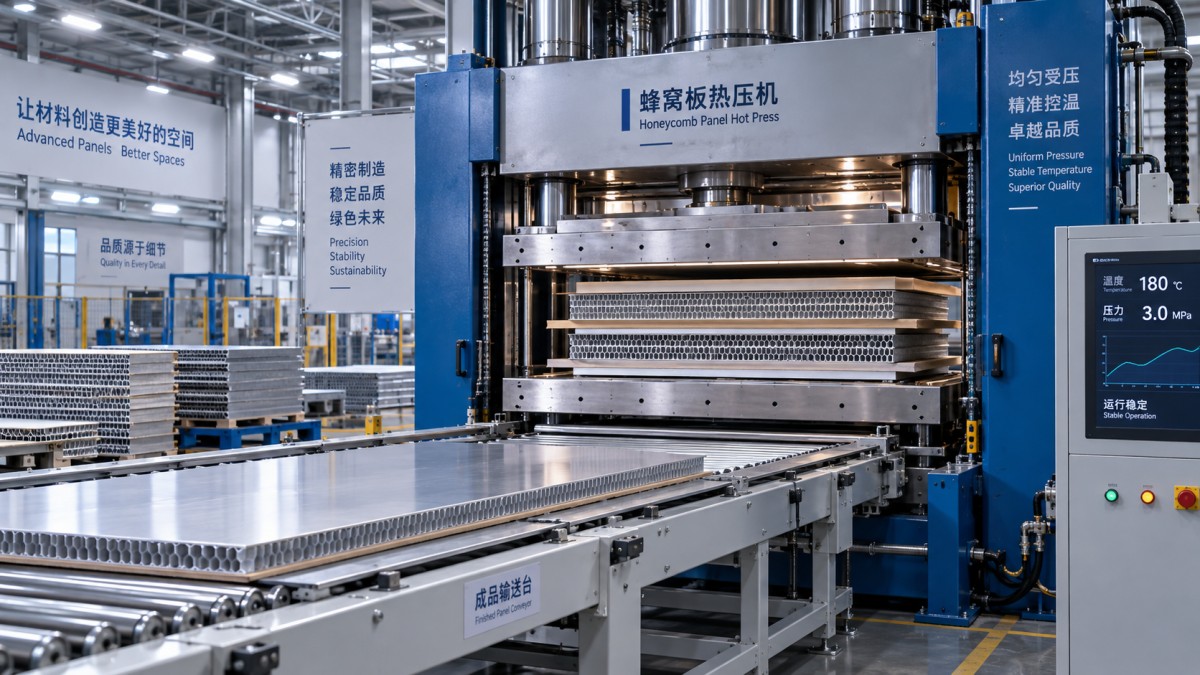
Daylight opening and loading method
Measure the full stack entering the press, not just finished panel thickness. Consider the panel, caul plates, protective sheets, trays, fixtures, and any loading device. Insufficient daylight opening creates an awkward loading process and raises the risk of edge damage or operator handling errors.
Determine whether loading will be manual, assisted by lifting equipment, or integrated with conveyors. A supplier should be able to identify clearance requirements, loading direction, safety interlocks, and the interface points needed if you plan to automate later. A machine that fits the panel but disrupts material flow can become a bottleneck.
Look beyond the quotation to the supplier’s manufacturing discipline
When two suppliers offer similar specifications, their fabrication, assembly, and testing practices often make the practical difference. Ask for information that reveals how the machine is built rather than relying on general claims about quality.
- How are press frames welded, stress-relieved, machined, and inspected?
- Which critical components are made in-house, and which are sourced externally?
- How are hydraulic pipes, valves, seals, electrical parts, and heating elements selected and documented?
- What inspections occur before final assembly and before shipment?
- Can the supplier provide drawings showing the main press structure, platen arrangement, hydraulic circuit, and electrical control scope?
The goal is not to force every supplier to disclose proprietary details. It is to see whether they answer with clear engineering information or broad sales language. A manufacturer familiar with press equipment should be comfortable discussing service access, wear points, control components, and the limits of its standard design.
Pay attention to consistency between documents. The platen dimensions, opening, installed power, pressure rating, and included accessories should match across the quotation, technical drawing, commercial invoice draft, and acceptance document. Contradictions at quotation stage often lead to unclear responsibility later.
Use a factory acceptance plan before production begins
Factory acceptance testing is most effective when the criteria are agreed before the supplier completes the machine. Waiting until the machine is ready can leave little room to resolve disagreements about what “normal operation” means.
A practical acceptance plan can include verification of machine dimensions, platen opening, safety devices, hydraulic movement, pressure adjustment, heating function, control panel functions, and no-load cycle operation. For a hot press, also identify the set temperature range to be demonstrated and the points where temperature will be checked. If production materials are available, a trial using representative panel construction is more informative than an empty-machine test. However, panel quality also depends on adhesive preparation, material moisture, assembly time, and process settings, so acceptance terms should clearly distinguish machine performance from process variables outside the supplier’s control.
Ask who will witness the test, whether remote observation is possible, what records will be supplied, and how nonconformities will be handled. Photographs and video can be helpful, but they should support—not replace—written test records. For high-value or customized equipment, independent inspection may be appropriate when travel is not possible.
Assess customization by asking about boundaries, not promises
Custom features can improve handling and productivity, but vague customization is a common purchasing risk. A supplier may agree to “customize as required” without defining the technical responsibility. Instead, describe the feature precisely and ask how it changes the base machine.
Examples include an enlarged platen, special daylight opening, multiple press openings, movable loading table, automatic loading and unloading, additional temperature zones, customized electrical standards, special panel locating devices, or a connection point for line controls. For each item, confirm the drawing revision, delivery scope, effect on lead time, required utilities, and whether it is tested before shipment.
Be careful when combining several changes in one order. A custom press is not necessarily risky, but the supplier should show that the design has been reviewed as a complete system. An enlarged platen can affect frame rigidity; a faster cycle may require changes to hydraulic capacity; automation may alter guarding and operator access. A reliable supplier identifies these connections early instead of treating every request as an isolated add-on.
Calculate cost through operating risk, not purchase price alone
The lowest quotation may exclude elements that later become essential: caul plates, loading aids, oil cooling, spare heating components, export packing, commissioning support, or detailed electrical documentation. Request an itemized offer that separates the standard machine, optional equipment, installation scope, commissioning scope, recommended spare parts, and freight-related packaging requirements.
Operating cost should be considered in the same comparison. Ask about installed electrical load, normal heating demand, hydraulic oil maintenance, recommended consumables, and the service interval for parts subject to wear. Do not expect a supplier to predict your exact energy cost, because that depends on panel size, cycle settings, ambient conditions, and production schedule. They should still be able to explain the main consumption sources and maintenance tasks.
Test the after-sales response before signing the order
After-sales support is easier to assess before payment than after delivery. Send a few technical questions and observe the quality of the response. Does the supplier answer the actual question? Do they provide drawings, photographs, or a clear explanation when needed? Can they distinguish between standard supply and optional supply? Slow or vague communication during evaluation does not automatically mean poor service, but it is relevant evidence.
Confirm what documents will be delivered with the machine. At minimum, buyers usually need an operation manual, maintenance guidance, hydraulic and electrical information appropriate to the supplied configuration, a parts list for routine replacement items, and a clear record of machine settings or parameters that should not be altered without instruction.
Spare-parts planning deserves particular attention. Ask which components are recommended for initial stock, which items are likely to require periodic replacement, and how parts are identified when ordering. A useful spare-parts list includes part descriptions, quantities, and enough technical detail to avoid confusion. For control or hydraulic components, clarify whether locally sourced equivalents can be used and whether substitution affects machine operation.
Questions that reveal whether a supplier understands the application
A capable supplier does not need to provide a universal answer to every bonding issue, because adhesive chemistry and panel materials vary. They should, however, ask relevant questions and explain the relationship between press settings and panel behavior. During technical discussions, use questions such as these:
- What pressure range do you recommend for this core and face-sheet combination, and what adjustment method does the press provide?
- How do you verify platen temperature and parallel movement before shipment?
- Which process variables remain the buyer’s responsibility, especially adhesive application and curing conditions?
- What causes uneven panel thickness or weak bonding in similar press applications, and which machine checks should be made first?
- What information do you need before confirming cycle time and machine capacity?
- Which spare parts should be ordered with the machine to avoid preventable downtime?
Answers should be technically cautious. Be wary of a supplier that guarantees bonding quality without reviewing materials, adhesive instructions, and operating conditions. Good equipment supports repeatability, but it cannot compensate for every issue in core quality, adhesive spread, veneer condition, or panel assembly.
Make the final decision from documented evidence
Before issuing the purchase order, consolidate the commercial offer, technical specification, layout, utility requirements, customization list, acceptance procedure, document list, spare-parts scope, warranty terms, and delivery responsibilities into one controlled set of documents. Each point should identify whether it is included, optional, supplied by the buyer, or excluded.
The strongest choice is rarely the supplier with the longest feature list. It is the one whose press design matches your panel process, whose technical commitments are specific enough to verify, and whose support arrangements remain clear after the machine leaves the factory. That approach gives purchasing teams a practical basis for comparing offers and reduces the chance that an apparently simple hot press becomes an expensive production problem.
Send Your Inquiry
We welcome your cooperation and we will develop with you.