


News & Exhibitions
Latest Factory Updates, Industry Trends & Global Exhibition Information
What Should You Check Before Buying a Hot Press for Wood Panels?
A hot press for wood panels should be selected around the panel you need to produce, not around the machine’s headline tonnage or purchase price. The critical question is whether the press can apply uniform pressure and stable heat across your actual panel size, veneer or laminate construction, adhesive system, and required production rhythm. A press that is oversized in one respect and underspecified in another can create weak bonds, surface defects, excessive glue consumption, or unnecessary energy and maintenance costs.
Before buying a hot wood press, define the job in measurable terms: panel dimensions, board substrate, face material, adhesive type, target thickness, daily output, and acceptable pressing cycle. Those inputs determine almost every meaningful specification, from platen size and hydraulic capacity to temperature range, loading arrangement, and factory utility requirements.
Start with the panel construction, not the machine catalog
“Wood panels” covers very different products. A press used to veneer MDF is not necessarily suitable for plywood layup, door skin production, high-pressure decorative laminates, curved parts, or thick solid-wood laminations. The substrate’s density and moisture condition, the face material’s sensitivity to heat, and the adhesive’s cure profile all affect the pressing window.
For example, veneer bonding requires attention to veneer moisture, glue spread, and the risk of telegraphing substrate imperfections through a thin face layer. Plywood production may require a pressing schedule that accounts for veneer species, layup thickness, core-gap control, and steam release. Melamine-faced board and other pre-finished surfaces raise different concerns: platen cleanliness, pressure distribution, temperature consistency, and protection against embossing or surface damage.
Ask the supplier to assess your intended process with a clear material description rather than a generic statement such as “for furniture panels.” Useful information includes:
- Maximum and minimum panel length, width, and thickness;
- Substrate type, such as MDF, particleboard, plywood, blockboard, or solid wood;
- Face material, including veneer, PVC film, decorative paper, laminate, or other overlay;
- Adhesive chemistry and recommended cure temperature;
- Required press cycle, including loading, closing, dwell, opening, and unloading time;
- Whether panels are flat, profiled, edge-glued, or built from multi-layer assemblies.
A machine quotation should identify the operating assumptions behind its proposed configuration. Without this, it is difficult to know whether the stated capacity is relevant to your product.
Check platen size and usable pressing area
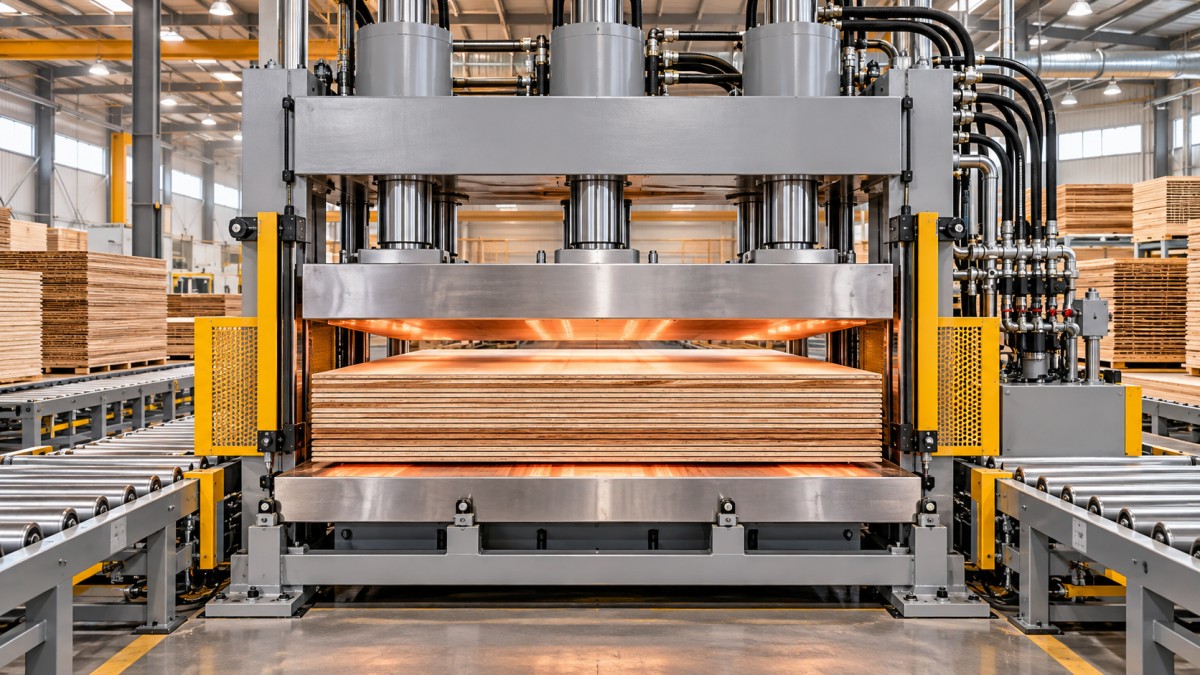
Platen dimensions are often treated as a simple pass/fail item: the panel either fits or does not. In practice, the usable area should be larger than the nominal board footprint. Small margins are needed for layup positioning, cauls, release sheets, and process variation. Running panels exactly at the platen edge can make loading less forgiving and may expose the work to less consistent conditions near the perimeter.
For shops processing several board formats, consider the mix rather than only the largest panel. A large platen can accommodate more work, but it also requires more heat-up energy and can be inefficient if most production uses small components. In some cases, multiple openings or a multi-daylight press provides better throughput than one very large single-opening press, especially when operators can prepare one loading station while another opening is in its dwell stage.
Also examine platen flatness, thickness, and construction. A platen must resist deflection under working load. If it bends slightly under pressure, the center and edges of a panel may not receive the same force. That becomes more important with large-format panels, high-pressure applications, and thin decorative surfaces where non-uniform bonding can be difficult to detect until later machining or finishing.
Calculate pressure from the actual glue-line requirement
Hydraulic tonnage alone is not a reliable basis for comparison. What matters is pressure over the panel area. The same total force produces very different pressure values on a small door blank and on a full-size sheet. Suppliers may state nominal total pressing force, cylinder force, or pressure in different units, so the calculation should be normalized before comparing models.
The basic relationship is:
Average panel pressure = total effective pressing force ÷ loaded pressing area.
The required pressure is not simply “as high as possible.” Insufficient pressure can leave voids or incomplete contact at the glue line. Excessive pressure can squeeze out too much adhesive, crush low-density core materials, force glue through veneer, or imprint delicate surfaces. The correct range depends on substrate density, adhesive viscosity, veneer thickness, panel flatness, and the manufacturer’s adhesive recommendations.
Pressure uniformity matters as much as the calculated average. Check the number and layout of hydraulic cylinders, the rigidity of the moving beam and frame, guide arrangement, and whether the design keeps platens parallel through the closing stroke. An apparently powerful press can still perform poorly if its structure allows uneven loading or platen misalignment.
A useful clarification during technical discussions is whether the quoted force is available across the entire stroke and whether it is the machine’s rated working force rather than a theoretical peak. Ask how system pressure is monitored and whether the control system allows different pressure stages during a cycle. Some adhesive systems benefit from a controlled closing phase followed by a defined pressing stage, rather than an abrupt full-force closure.
Temperature control determines bond consistency
Heated platens are not interchangeable merely because they reach the same maximum temperature. The decisive issue is how evenly and how reliably heat is transferred to the workpiece over time. Uneven platen temperature can produce inconsistent curing, especially at panel corners and along edges. A press may show the required temperature on its display while local zones remain outside the process tolerance.
Confirm the heating method: electric resistance heating, thermal oil, steam, or another system. Each has different implications for installation, response time, operating utilities, maintenance, and temperature control. The best choice depends partly on what heat source already exists at the facility and partly on the required process temperature.
Important questions include:
- What is the specified working temperature range, not only the maximum temperature?
- How is temperature measured and controlled across each platen?
- What temperature uniformity can the manufacturer specify under normal operating conditions?
- How long does the press take to heat from ambient conditions to the required setpoint?
- Can upper and lower platens be controlled independently when the process requires it?
- How are sensors, heating zones, and insulation serviced if a fault occurs?
Do not assume that platen surface temperature equals glue-line temperature. Heat must move through the face material and substrate, and thicker or wetter panels respond differently from thin, dry ones. Pressing schedules should therefore be validated with the actual materials, particularly when changing adhesive supplier, panel thickness, or decorative surface.
Examine the hydraulic system beyond its rated pressure
The hydraulic system governs closing speed, pressure stability, platen movement, and a large share of maintenance exposure. A basic specification such as “high-pressure hydraulic system” says little about how the press will behave over years of production.
Look for a coherent design that includes suitable cylinders, seals, hoses, valves, filtration, cooling where required, and accessible maintenance points. Oil contamination can damage valves and pumps, while internal leakage can make pressure hold unstable. A machine that cannot hold set pressure consistently through its dwell period may compromise bonding even if it reaches the correct force at the start of the cycle.
Closing speed deserves careful review. Fast closing reduces non-productive time, but the final approach to the workpiece should be controlled. A press that closes aggressively onto a misaligned layup can damage veneers, shift components, or create safety risks. The control sequence should allow a practical balance between throughput and controlled contact.
For facilities where electricity costs or heat management are material concerns, ask about motor control and idle behavior. The relevant comparison is not only installed motor power. It is how the hydraulic unit consumes energy during pressing, pressure holding, unloading, and periods between cycles.
Match the press configuration to material flow
A hot press is part of a production cell, not an isolated machine. Its practical output depends on how materials arrive, are loaded, pressed, cooled if necessary, inspected, and moved to the next operation. A press with a short theoretical cycle can remain underused if layup preparation is slow or if unloading creates a bottleneck.
Manual loading may be appropriate for low-volume work, frequent product changes, or smaller panels. Larger panel sizes and repetitive production may justify roller tables, scissor lifts, loading trays, automatic infeed and outfeed equipment, or multi-opening designs. These additions can improve consistency and reduce handling strain, but they also require floor space, guarding, controls integration, and reliable material staging.
Check the opening height and daylight arrangement. The opening must accommodate the workpiece, cauls, release materials, and safe loading clearance. A very large opening is not automatically beneficial; it can increase stroke time and complicate handling. Where several openings are used, confirm that each daylight receives the intended pressure and heat conditions and that the loading method does not create uneven cycle timing.
Floor layout should include more than the press footprint. Allow room for panel preparation, operator movement, maintenance access, hydraulic unit placement, electrical cabinets, material carts, and safe removal of finished panels. Doorways, ceiling height, floor loading, and installation route can become decisive for large press frames.
Safety functions are operating requirements, not optional extras
Hot platens, moving beams, high hydraulic force, and heavy boards create obvious hazards. Safety design should be reviewed as part of machine suitability, together with applicable requirements in the destination market. The purchaser remains responsible for confirming the regulatory obligations that apply to the installation and use of the equipment.
Relevant features may include emergency-stop devices, guarded pinch points, two-hand controls where appropriate, safety cords or edge devices, interlocked guards, overpressure protection, controlled platen descent, thermal shielding, and lockout provisions for maintenance. Their placement matters. An emergency stop that is difficult to reach from the loading position is less useful than one integrated into the real work area.
Clarify what documentation is supplied: electrical diagrams, hydraulic diagrams, operating instructions, maintenance schedules, spare-parts lists, safety declarations, and any certification documentation required for the intended market. Documentation should match the delivered configuration, including automation options and locally required electrical components.
Assess controls by repeatability and serviceability
A programmable controller is valuable when it helps maintain repeatable recipes for different products. Useful control functions can include temperature setpoints, staged pressure profiles, dwell time, automatic opening, alarm history, and storage of validated process settings. However, a complicated interface is not a substitute for a stable mechanical and thermal system.
Check whether operating parameters can be protected from unauthorized changes, whether alarms identify the fault clearly, and whether the control system supports remote diagnostics if that service model is important to your operation. Ask what happens after a power interruption, sensor failure, or hydraulic pressure fault. A controlled response can prevent damaged panels and reduce recovery time.
For cross-border purchases, electrical compatibility must be specified precisely: voltage, frequency, phase arrangement, control voltage, plug or hardwire requirements, and relevant component preferences. Retrofitting electrical systems after delivery is more expensive and riskier than confirming compatibility before production.
Compare lifecycle support, not only the delivered machine
Hot presses contain wear items and critical components that will eventually need attention: seals, hoses, valves, sensors, heating elements or circulation components, switches, contactors, and control hardware. The purchase decision should include the availability, identification, and lead time of these parts.
Ask for a recommended commissioning-spares list and distinguish between ordinary consumables, operational spares, and major proprietary components. If the press uses standard industrial components, confirm their exact brands and models rather than relying on general descriptions. If proprietary parts are used, establish how replacements are supplied and what technical information is available for diagnosis.
Support quality is easier to assess through concrete questions than through broad promises. Who handles installation guidance? Is remote commissioning available? What information must be provided when troubleshooting? Are manuals supplied in a usable language? Can the supplier provide hydraulic and electrical schematics? These details affect downtime far more than a generic warranty statement.
Do not treat trial pressing as a formality
Where the order value and product risk justify it, a trial should use representative material rather than convenient sample stock. The objective is not merely to see the platens close and heat up. It is to verify that the press can meet the intended process conditions with the relevant substrate, overlay, adhesive, dimensions, and cycle time.
Inspect bonded panels after conditioning where appropriate, not only immediately after pressing. Look for incomplete adhesion, bubbles, veneer cracking, glue bleed-through, panel distortion, surface marking, edge lifting, and differences between the center and perimeter. If production will involve multiple panel types, identify which one is the most demanding and use that as the basis for acceptance discussion.
The right hot press is therefore the one that produces stable results within a realistic operating window, fits the actual material flow, and can be supported throughout its working life. Price remains relevant, but it should be compared against usable capacity, bond quality risk, utility demand, safety implementation, and the cost of production interruptions. Those are the factors that determine whether the machine improves panel manufacturing or simply adds another constraint to it.
Send Your Inquiry
We welcome your cooperation and we will develop with you.