


News & Exhibitions
Latest Factory Updates, Industry Trends & Global Exhibition Information
What working width do you need in a panel sanding machine?
Choose a panel sanding machine with a usable working width that accommodates the widest workpiece you need to sand in its intended feed direction, plus the operating clearance specified for that machine. Base this on the panel dimensions at the sanding stage, which may be larger than the finished dimensions. Then decide whether occasional oversized work justifies a wider machine or can follow a separate production route.
A machine that is too narrow can force changes to your process. Extra width also brings costs through machine size, abrasive selection, extraction requirements, and installation. The right choice starts with your actual parts and production sequence, rather than the largest width available in a catalog.
Measure the dimension that crosses the conveyor
Working width is the usable sanding capacity across the feed direction. Panel length normally travels along the conveyor, while panel width spans the machine. Confusing these dimensions can lead to specifying a much larger machine than the job requires.
For example, consider a hypothetical panel measuring 2,400 × 1,200 mm. Feeding it with the 2,400 mm dimension along the conveyor presents a width of 1,200 mm to the sanding heads. Rotating it sideways presents 2,400 mm instead. The first orientation needs less working width, but it also requires suitable support and handling space for the longer feed length.
Rotation is not always a free choice. On solid wood and veneered surfaces, sanding direction can affect scratch visibility and the finished appearance. Conveyor grip, panel stability, and the sanding head arrangement also influence which orientation works reliably. Establish the intended feed direction before comparing machine widths.
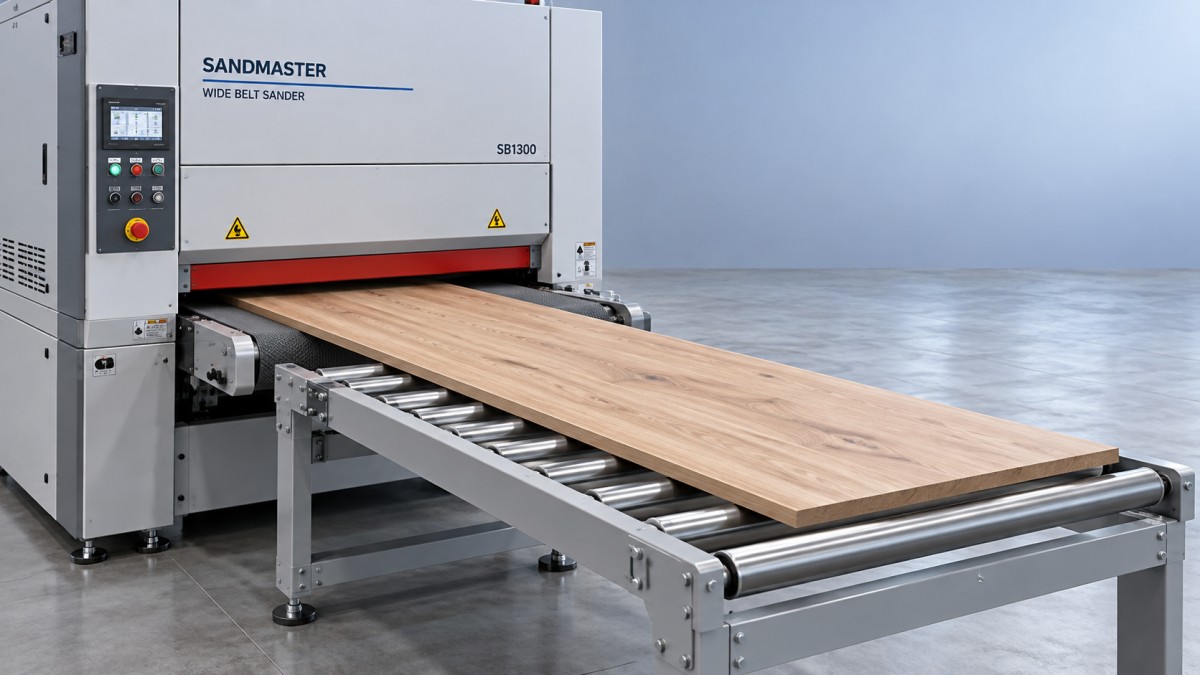
Use the actual incoming dimensions, including any trimming allowance. If panels are sanded before final sizing, the finished drawing understates the width the machine must accept. Include carriers or fixtures where the process requires them, because these also occupy space within the working envelope.
Build the width requirement from your production mix
A useful starting point is a part list grouped by sanding-stage width, material, thickness, and monthly volume. This shows whether your widest panel is a regular production requirement or an occasional exception.
Separate the work into three practical groups:
- Routine production: parts that run frequently and should move through the machine without special arrangements.
- Committed wider work: panels required by confirmed orders or an approved product range.
- Occasional exceptions: unusual dimensions that could be outsourced or processed through another suitable route.
The widest routine or committed panel usually sets the minimum capacity. An oversized job that appears rarely deserves a cost comparison before it determines the entire investment. Conversely, a wider part with a low monthly volume may still be essential if delivery depends on keeping that process in-house.
Future capacity should follow a defined product plan. A confirmed move into wider tabletops or assembled furniture panels gives a sound reason to reserve width. A general expectation that “larger jobs may come later” provides much less guidance and can lead to paying for capacity that remains unused.
Check where sanding belongs in the production sequence
Whether you sand before or after cutting can change the required width substantially. Processing full sheets keeps the sanding operation upstream, but demands enough capacity for the entire sheet. Cutting first may allow a narrower sander to handle the resulting components.
That decision must follow the manufacturing process. Sanding individual pieces before glue-up, for example, does not remove the need to level an assembled panel afterward. Smaller parts can also become harder to convey safely, particularly when they approach the machine’s minimum permitted length or thickness.
For a cutting-first workflow, a sliding table saw such as the ZD350 can prepare MDF, plywood, and solid wood components before sanding. Its specified 1,250 mm blade-to-fence cutting width describes a sawing capacity; it does not establish the working width required for a downstream sander. That requirement comes from the dimensions of the cut parts and any later assemblies.
Map one representative product through cutting, assembly, sanding, and finishing before settling on a width. This often reveals whether full-panel capacity is necessary or whether component sanding better matches the production route.
Allow clearance without inventing a universal margin
Maximum usable workpiece width matters more than abrasive belt width or conveyor width. These dimensions are related, but they are not interchangeable. Belt tracking, guards, pressure elements, and the machine’s feed arrangement can affect the permitted workpiece envelope.
Do not assume that a panel matching the advertised width will have adequate operating clearance. Ask for the maximum permitted workpiece width and the loading conditions associated with it. A panel must enter squarely and remain controlled throughout the pass; an opening that accepts it while stationary does not demonstrate reliable production feeding.
There is no single clearance allowance suitable for every machine. The appropriate margin depends on the machine design, dimensional variation in the panels, and how they are loaded. Use the manufacturer’s operating limits and evaluate representative workpieces near your proposed maximum.
Keep two decisions separate: the clearance needed to run today’s panels reliably, and the extra capacity reserved for larger products. The first is an operating requirement. The second is an investment choice. Combining them into an arbitrary allowance makes quotations harder to compare.
Do not treat two overlapping passes as equivalent to full-width sanding
A narrow machine may appear economical if a wider panel can be sanded in overlapping passes. That possibility depends on the machine’s construction and the required finish. An enclosed machine may physically prevent an oversized panel from passing through at all.
Some open-sided designs can accommodate wider work through repeated passes, but the overlap needs careful evaluation. It can leave differences in stock removal, scratch pattern, or surface level. These differences may become more visible after coating, especially where a consistent appearance across the entire face is important.
For accurate thickness calibration or demanding finish preparation, a machine that processes the full panel width in one pass is generally the stronger starting point. Repeated passes also require more handling and occupy machine time that could otherwise serve the next part.
If overlapping passes are being considered for occasional work, evaluate the complete result: final thickness across the panel, appearance after finishing, handling time, and repeatability. A successful rough-sanding pass alone does not establish suitability for the finished product.
Width only helps productivity when the rest of the machine supports it
A wider panel sanding machine does not automatically produce more finished parts per shift. Throughput also depends on feed speed, removal per pass, abrasive sequence, head configuration, loading time, and the condition of the incoming material.
Full-width sanding can place a heavier demand on the sanding heads than running a narrow component at the same removal setting. Compare motor capacity, head arrangement, feed capability, and extraction requirements against the material and stock removal you actually need. A width specification says how large a part can fit; it does not describe the entire sanding duty.
Feeding several narrow components side by side can improve use of the available width, but only within the machine’s operating rules. Parts with different incoming thicknesses may receive uneven pressure or material removal. Short pieces may also have different conveying requirements from long panels.
Evaluate usable output as acceptable parts per shift, including repeat passes, abrasive changes, and handling. For a small-component workflow, reliable feeding and quick changeovers may contribute more than unused width. For regular broad-panel production, sufficient width can eliminate a persistent processing constraint.
Compare the installed cost and usable floor space
Review width options as installed systems. Alongside the machine price, compare the specified electrical demand, compressed air requirements where applicable, extraction capacity, abrasive sizes, delivery access, and service space.
Abrasive availability deserves attention before ordering. Belt dimensions affect sourcing options, stockholding, and replacement planning. Wider belts may cost more individually, but they can also process more surface area; compare abrasive cost per acceptable panel or production batch rather than belt price alone.
The machine’s footprint is only part of the space requirement. Long panels need room to enter and leave straight, with suitable support. Operators also need access for belt changes, cleaning, adjustment, and maintenance. A machine that fits between two walls may still be impractical to run.
For export installations, include spare parts and technical support in the comparison. Qingdao Zhongding Machinery Co., Ltd. supplies woodworking machinery with technical support, spare parts, and after-sales service. These provisions belong alongside capacity specifications because access to replacement components and troubleshooting affects the long-term usability of any selected machine.
Put a measurable requirement into the quotation request
Instead of asking only for a machine of a particular nominal width, describe the work it must perform. Include the largest sanding-stage panel dimensions, intended feed orientation, materials, thickness range, required removal, finish expectations, and production volume. State whether panels are processed individually, side by side, or on carriers.
For the final comparison, request three things:
- A defined working envelope: maximum usable width, minimum permitted part dimensions, thickness limits, and any loading restrictions.
- A representative sanding demonstration: using your widest demanding panel and relevant narrow components, with the abrasive sequence and feed settings recorded.
- An installation proposal: showing handling space, utilities, extraction connections, maintenance access, and consumable requirements.
The demonstration should assess thickness consistency across the width, surface quality, feeding stability, and the number of passes required. Where coating appearance matters, inspect a finished sample as well as the freshly sanded surface.
Choose the smallest working width that reliably covers routine production, committed larger work, and the required operating clearance. Move to a wider option when it enables a defined product range, removes a recurring bottleneck, or reduces enough outside processing to justify the additional cost. Put that production reason into the purchase specification so the selected capacity has a clear job to do.
Send Your Inquiry
We welcome your cooperation and we will develop with you.