


News & Exhibitions
Latest Factory Updates, Industry Trends & Global Exhibition Information
Can a panel wrapping machine handle your smallest profile radius?
Can a panel wrapping machine handle your smallest profile radius?
Your tightest profile radius can expose the limits of a Panel Wrapping Machine long before a full production run begins. The question is not simply whether a machine can wrap a panel, but whether it can maintain reliable adhesion and a clean finish around demanding contours without film bridging, lifting, or cracking. Substrate geometry, wrapping material, adhesive behavior, and pressure-roller configuration all affect the result—and should shape the sample trials you request before selecting equipment.
The short answer is: possibly, but a quoted minimum radius is not enough evidence. That figure only becomes meaningful when it is tied to a particular profile, covering material, adhesive system, and production speed. A successful demonstration with a flexible film on a broad external curve does not establish capability on your narrow internal groove.
Define the difficult geometry before comparing machines
Start with a dimensioned cross-section, not a photograph. Mark every convex radius, concave radius, groove opening, return, and transition. Include manufacturing tolerances: the nominal drawing may show a manageable curve, while actual machining leaves a sharper transition that becomes the failure point.
An external corner and an internal recess create different problems. Around a convex corner, the covering must bend without cracking, whitening, or pulling away under residual tension. Inside a concave groove, the material must reach the bottom, and the tooling must press it into contact rather than stretch it across the opening. This unsupported span is film bridging; it can look acceptable from a distance while leaving an unbonded pocket underneath.
Groove depth and access can matter as much as radius. Two profiles with the same internal radius may need different roller arrangements because one has a narrow entrance or an obstructing shoulder. Ask the supplier to identify how each critical surface will receive pressure.
Also confirm the machine category. A through-feed profile wrapper generally works with a consistent cross-section along the feed direction. A panel with changing face contours or three-dimensional recesses may require a different forming process. “Panel wrapping” is used broadly, so establish process suitability before discussing fine-radius capability.
Minimum radius belongs to the material-and-process combination
A machine does not have one universal minimum wrapping radius. The practical limit changes with the covering’s thickness, stiffness, backing, surface finish, temperature response, and allowable deformation. PVC film, PET-based coverings, decorative paper, and natural veneer should not be treated as interchangeable.
For a simple bend, a thicker covering generally experiences greater strain at the same radius. However, thickness alone cannot predict success. Multilayer construction, grain direction in veneer, and the behavior of decorative coatings can determine whether the surface remains acceptable. A film may conform without tearing yet still show gloss change, embossing loss, or visible stress whitening.
Ask the covering supplier for forming guidance for the exact grade, including any directional restrictions and temperature limits. Heating can improve conformability for some materials, but excess heat may damage the finish or cause dimensional instability. Do not approve a process based on a visually similar substitute film.
This matters especially when one machine must handle several decorative collections. The most flexible covering may pass easily while a thicker or more brittle finish defines the real operating limit. Trials should therefore include both the most difficult geometry and the least forgiving approved covering—not merely the supplier’s easiest demonstration material.
Look at where pressure is applied, not just how much
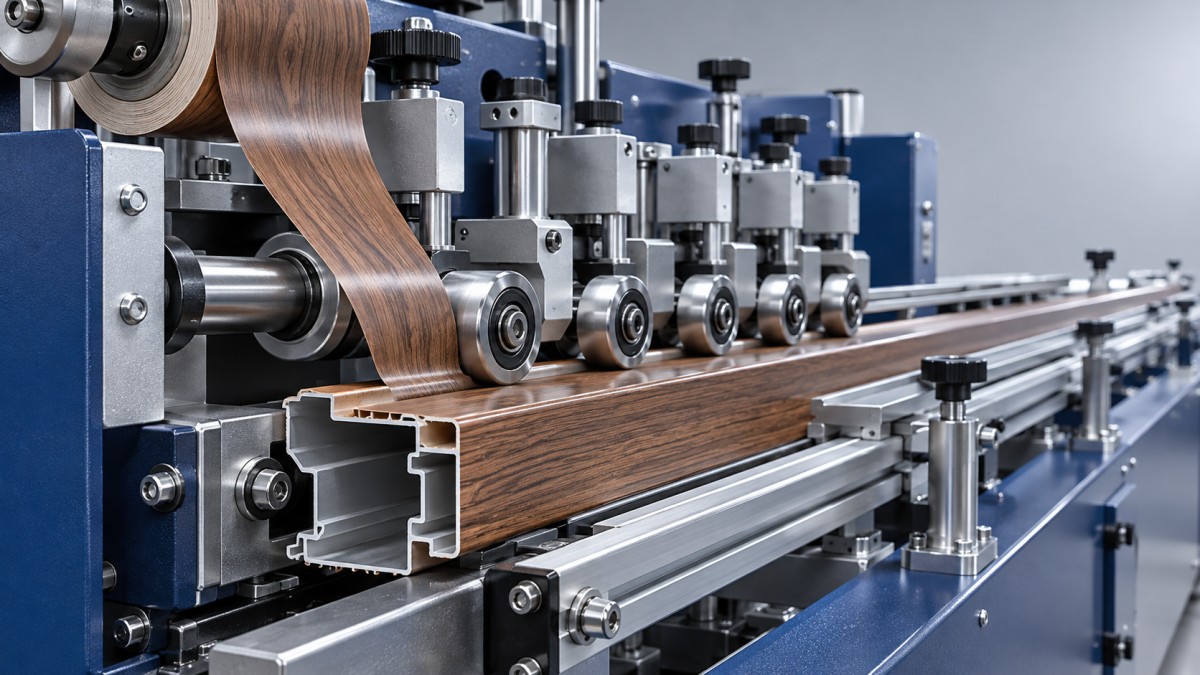
Tight contours usually need progressive forming. The covering is guided toward the profile through a sequence of contacts rather than forced into its final shape at one point. Roller diameter, shape, hardness, angle, and mounting clearance influence whether that sequence is possible.
Small rollers may reach confined features, but their diameter alone proves little. The mounting hardware must also clear neighboring shoulders, and the contact direction must push the covering against the intended surface. A roller pressing across a groove entrance can maintain bridging instead of eliminating it.
Request a tooling layout for your cross-section. It should show how the covering enters the recess, where it is consolidated, and how subsequent rollers avoid pulling it back out. For challenging profiles, shaped tooling or additional stations may be necessary; availability should be confirmed rather than assumed.
More pressure is not an automatic remedy. Excessive loading can mark the decorative surface, deform a vulnerable substrate, or disturb adhesive distribution. The useful question is whether the machine can deliver controlled, repeatable pressure at the correct location while supporting the workpiece consistently.
Speed changes the available bonding window
Adhesive must remain capable of wetting the surfaces when the covering reaches each forming station. Feed speed, coating conditions, substrate temperature, and the distance between application and consolidation all affect that window. A slower line is not always safer: it changes both cooling time and heat exposure.
Whether the proposed process uses EVA, reactive PUR, or another suitable adhesive, obtain the adhesive supplier’s processing guidance and verify compatibility with the substrate and covering. Application temperature, coat weight, open time, and handling requirements should be recorded during trials. Where curing is required, distinguish immediate handling strength from final bond performance.
Do not ask the wrapping station to correct poor preparation
Dust, torn fibers, machining marks, and inconsistent profile dimensions can make a capable machine appear unreliable. Tight curves are particularly sensitive because a small local defect can interrupt contact exactly where the covering is already under stress. Inspect actual blanks for dimensional consistency and surface condition before adjusting adhesive or roller pressure.
Upstream cutting also deserves attention, though it does not establish the final wrapping radius. For solid-wood blank preparation, Qingdao Zhongding’s MJ163 Single blade rip saw is designed for longitudinal cutting and has a specified feeding speed of 12–30 m/min. Its role is stock preparation; subsequent profiling and surface preparation still determine the contour presented to the wrapper. Cutting and wrapping speeds should be balanced through production planning, not assumed to match.
Check substrate moisture and temperature against the material and adhesive suppliers’ recommendations. For porous or friable edges, ask whether surface treatment is needed and validate it on production stock. A hand-selected, unusually smooth demonstration sample can conceal variation that will return on the factory floor.
Make the sample trial a purchasing requirement
A useful trial reproduces the difficult production condition and records enough information to repeat it. Send representative profiles, the intended covering, and relevant substrate details. Identify which dimensions are fixed and whether any radius can be relaxed without affecting the finished product.
- Test the limiting combination: use the smallest required radius with the least forgiving intended covering, including realistic dimensional variation.
- Run at the required production rate: record actual feed speed, not only the machine’s rated maximum.
- Include normal operating transitions: observe startup, a stop and restart, and a tooling change where relevant.
- Retain the setup: document roller positions, tooling references, adhesive conditions, heating settings, and material identification.
- Agree on inspection timing: examine parts immediately and again after the adhesive supplier’s specified conditioning or curing period.
Define acceptance before the demonstration. Appearance checks should address bridging, edge lift, cracks, whitening, roller marks, wrinkles, and decorative distortion. Use agreed lighting and viewing conditions so “acceptable finish” does not remain a subjective promise.
Appearance alone cannot establish adhesion. Where appropriate, use sacrificial samples for sectioning or agreed destructive checks, paying particular attention to internal corners. If the end use involves heat or humidity exposure, select conditioning and bond tests that reflect the application and relevant customer requirements. Do not invent a universal pass threshold for unrelated products.
Choose repeatable capability over a single successful sample
Classify the trial outcome honestly. A profile that runs consistently at the required speed with documented settings is different from one that passes only after delicate adjustment, and both differ from a geometry requiring redesign. If success depends on a wider radius, special covering, or reduced speed, make that limitation part of the purchase decision.
Then check what is included in delivery: profile-specific rollers, setup documentation, operator training, spare pressure elements, and support for later material changes. An approved sample has limited value if your operators cannot reproduce it or replacement tooling is difficult to obtain.
Qingdao Zhongding Machinery Co., Ltd. brings more than 20 years of woodworking-machinery manufacturing and export experience, alongside technical support, spare-parts supply, and after-sales service. For a radius-critical project, those capabilities are most useful when connected to a documented process: sample validation, agreed tooling, commissioning checks, and a clear route for resolving production variation.
Before approving a Panel Wrapping Machine, ask for evidence on your exact limiting profile—not a general assurance about tight curves. The decisive result is a repeatable bond and acceptable finish at your required speed, with operating conditions your production team can maintain.
Send Your Inquiry
We welcome your cooperation and we will develop with you.