


News & Exhibitions
Latest Factory Updates, Industry Trends & Global Exhibition Information
Choosing a hot press for curved veneer with tight bend radii
A hot press can consolidate a curved veneer assembly, but it cannot make an unsuitable veneer layup survive a tight bend. The first selection decision is whether the specified radius is achievable with the actual veneer thickness, grain direction, moisture condition, adhesive, and layer arrangement. Only then does it make sense to compare press force, heating capacity, or cycle time.
For tight-radius components, the decisive machine capability is controlled contact throughout forming and curing—not simply high tonnage. A suitable hot wood press for curved veneer must work with tooling that supports the bend, allows the layers to move before the adhesive sets, and delivers adequate pressure and heat at the most difficult bondline. A successful flat-panel trial does not demonstrate any of those conditions.
Establish what is bending before specifying the press
“Curved veneer” can describe two substantially different processes: bonding a decorative face veneer onto an already shaped substrate, or forming a structural component from multiple veneer layers. The first depends heavily on substrate support and surface conformity. The second also requires control of interlayer slip, laminate thickness, and springback.
The drawing should identify the inside radius, finished thickness, bend angle, straight-to-curve transitions, and whether the surface has single or compound curvature. A cylindrical bend is not equivalent to a shape that curves in two directions. Compound curvature introduces in-plane deformation that a flat veneer sheet may not accommodate without tailored blanks, seams, or another construction method.
For an initial geometric screen, the surface strain in an individual, freely bending veneer can be approximated as:
Surface strain ≈ veneer thickness ÷ (2 × neutral-axis bend radius)
This is a screening relationship, not a permissible-strain specification. It assumes simple bending and does not account for wood variability, plastic deformation, compression restraint, or adhesive effects. It does show why reducing individual ply thickness can improve forming feasibility.
Crucially, a loose stack and a fully bonded laminate do not bend alike. Before cure, layers can slip relative to one another; after bonding, the assembly behaves more like a single thicker section. If friction, premature adhesive setting, or tooling restraint prevents slip during closure, the layup can develop much higher forming stresses than expected.
Trials must therefore use the intended species, veneer cut, thickness tolerance, and grain orientation. Grain running around the bend creates a different mechanical condition from grain running parallel to the bend axis. Lathe checks, local grain deviation, knots, and face-veneer defects can also determine where failure begins. A radius demonstrated with one veneer specification should not automatically be accepted for another.
Choose the pressure-delivery method around the geometry
A conventional flat-platen hot press may be usable with dedicated curved tooling, but heated flat platens alone do not create a controlled forming process. The mold, mounting arrangement, closing direction, and load path must be considered as one system.
Rigid matched molds provide geometric restraint, but only when their gap is correct for the compressed layup. A nominally accurate mold can still pinch a thick region before a thinner region receives adequate pressure. Tooling compliance is therefore a design choice, not simply a defect to eliminate.
Membranes offer conformity, but they do not guarantee contact. At a tight concave radius, membrane tension can cause bridging across the corner. In deep profiles, access and membrane stretch may impose further limits. Increasing the pressure setting is not a substitute for verifying that the pressure-transmitting surface actually reaches the veneer.
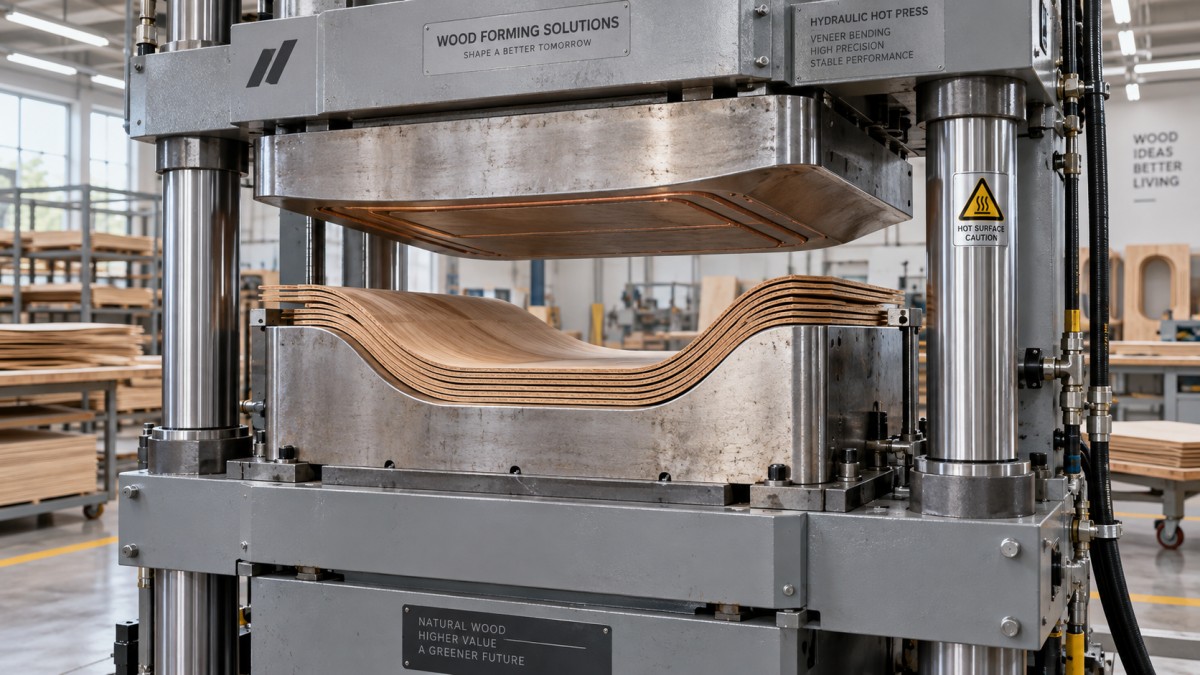
Single-axis closure also deserves scrutiny. Steep sidewalls and return features may require sliding elements, split molds, or another closing sequence. Otherwise, the press can apply substantial vertical force while delivering inadequate normal pressure to part of the bond area—or make the cured part difficult to remove.
Read tonnage as a load-path specification, not a bond-quality guarantee
Total press force divided by projected loaded area is a useful preliminary sizing check. It is not a map of local pressure on a curved tool. Mold slopes, friction, stiffness, contact sequence, and any side-action mechanisms determine how actuator force reaches each surface.
The equipment proposal should state the assumptions behind its force calculation: cavity count, loaded area, adhesive pressure requirement, forming resistance, and tooling arrangement. Hydraulic circuit pressure must not be confused with pressure at the bondline.
Force reserve matters, but excessive pressure is not inherently safer. It can crush wood locally, mark the decorative face, produce excessive squeeze-out, or distort the intended section. Closing position and pressure may both need monitoring, particularly where the mold uses stops. Once stops carry the load, an increased hydraulic reading does not necessarily mean increased consolidation of the veneer.
Frame and platen stiffness should be evaluated under the intended tooling footprint, including eccentric loading. A centrally loaded flat-panel rating may not represent a narrow curved tool mounted off-center. Ask for allowable loading arrangements, tooling mass limits, working daylight, stroke, and access for loading and removal—not just maximum force.
Verify heat at the bondline, especially through thick sections
Platen temperature is not bondline temperature. Heat must pass through the tooling, any release or compliant layers, and the veneer stack before the coldest adhesive layer reaches its required curing condition.
This distinction becomes important when molds have unequal mass, localized thick sections, or heating from only one side. A controller can display the correct setpoint while an internal bondline remains below the necessary temperature. Conversely, raising the setpoint to accelerate internal heating can expose the face veneer or outer adhesive layers to excessive heat.
Heating arrangements should be assessed against the actual tool. Heated platens transferring energy into a removable mold behave differently from molds with integrated electric heaters or thermal-fluid passages. Integrated heating can shorten the heat path, but heater layout, sensor placement, and zone control still determine uniformity.
Application trials should measure temperature at representative bondlines, including the expected slowest-heating location. Sacrificial instrumented layups can establish the relationship between machine readings and internal temperatures. Sensor installation must avoid creating a gap that invalidates the result.
The cycle specification should distinguish mold recovery, layup heating, adhesive cure, and any required restrained cooling. A short timer setting is not meaningful without identifying when timing starts and what temperature the adhesive actually experiences.
Match closure and cure to the adhesive’s working window
Adhesive selection and machine selection are coupled. The relevant requirements include open and closed assembly times, spread rate, curing temperature, pressure, wood moisture range, and suitability for the component’s service conditions.
For a tight bend, sufficient working time is needed to coat, stack, position, and close the layup without premature setting. Contact with a hot mold can shorten that window. If an outer bondline begins to set while the stack still needs to slide, the result may be cracking, wrinkling, or a partially closed mold.
A controlled closing profile can help: an approach movement, a forming phase that permits the required layer movement, and a consolidation stage held for cure. However, staged pressure should be validated with the adhesive supplier’s processing requirements. A prolonged low-pressure stage may leave poor contact or allow the assembly time to expire.
Moisture conditioning also requires a defined range. Increasing moisture to improve flexibility changes heating behavior and can introduce vapor-related defects or dimensional movement. If steaming, wetting, or another preconditioning treatment is necessary, it belongs in the qualified production process; it should not be an undocumented adjustment used only to obtain an acceptable demonstration sample.
Demolding behavior matters as much as curing speed. The adhesive must develop enough strength to resist the stresses released when the tool opens. Depending on the construction, restrained cooling or a secondary fixture may be needed to control shape without occupying the heated press for the entire stabilization period.
Use failure location to distinguish material limits from machine limits
A failed trial is useful only if the defect is linked to its cause. Increasing temperature or pressure without that diagnosis can hide one problem while creating another.
- Cracking on the outside of the bend: investigate tensile strain, veneer defects, grain orientation, individual ply thickness, and whether interlayer slip was restricted.
- Wrinkles or buckling on the inside: examine compression restraint, excess material, closing sequence, and how the tool supports the veneer during forming.
- Open joints near a tight corner: check bridging, mold mismatch, local pressure, and bondline temperature before changing the adhesive formulation.
- Blisters after opening: investigate moisture, vapor release, cure condition, and whether the bond had sufficient strength at demolding.
- Excessive springback: examine layup balance, cure completion, release temperature, and residual forming stresses. Tool compensation should follow a stable process, not replace one.
These distinctions affect equipment decisions. A larger press will not correct a veneer strain limit. Additional heating capacity will not solve membrane bridging. More accurate tooling will not compensate for an adhesive that sets before forming is complete.
Make the purchase decision against a repeatable application trial
The acceptance sample should represent the most demanding production condition: the minimum specified radius, intended face veneer, full layup thickness, and relevant dimensional tolerances. A simplified demonstration with thinner plies, fewer layers, or a more forgiving species proves only that simplified construction.
Before the trial, define acceptance criteria for visible cracking, surface marking, bond integrity, thickness, profile accuracy, and springback. Specify when dimensions will be measured and under what conditioning conditions. An immediate post-demolding measurement cannot establish the shape retained after moisture and temperature stabilize.
Bond evaluation should address the intended service exposure. Destructive examination of sacrificial parts can reveal poorly bonded corners that an external inspection misses. Where a product specification requires a recognized test method, use that method rather than substituting a visual assessment or an unqualified strength claim.
Repeat cycles should cover both startup and thermally stabilized operation. Record material moisture, adhesive spread, assembly time, closing profile, pressure, measured temperatures, cure time, and demolding condition. Include normal material variation within the agreed specification. One acceptable component establishes feasibility; repeatable acceptable components establish a usable process window.
The resulting equipment specification should tie guaranteed performance to that qualified combination of material, tooling, adhesive, and cycle. Include tool-change requirements, temperature and pressure records, calibration access, and safeguards for hot molds and crush zones. The defensible choice is the press that maintains the required contact, thermal history, and shape control across the agreed operating range—not the machine with the highest nominal tonnage or temperature.
Send Your Inquiry
We welcome your cooperation and we will develop with you.