


News & Exhibitions
Latest Factory Updates, Industry Trends & Global Exhibition Information
What Should Distributors Verify Before Partnering with an Edge Banding Machine Exporter?
What Should Distributors Verify Before Partnering with an Edge Banding Machine Exporter?
The purchase price of an edge banding machine is easy to compare. The real cost of representing the wrong supplier is not. A distributor may win an order with an attractive quotation, then lose margin through installation delays, repeat service visits, unavailable wear parts, damaged components, or a customer who discovers that the machine cannot handle the board materials used in daily production.
That is why selecting an edge banding machine exporter should be treated as a channel decision rather than a one-time buying decision. The exporter will affect the distributor’s stock planning, technician workload, warranty exposure, local reputation, and ability to keep end users productive. A machine can look similar on a brochure while being very different in build consistency, electrical configuration, documentation quality, and serviceability.
For distributors serving cabinet shops, furniture plants, and panel-processing businesses, the sensible question is not simply “Which supplier is cheapest?” It is “Which supplier can help us sell, deliver, support, and repeat this business without creating avoidable risk?”
Verify the Factory Behind the Quotation
An exporter may be a manufacturer, a trading company, or a mix of both. Neither model is automatically unsuitable, but the distributor needs clarity. If the supplier manufactures the equipment, ask which processes are completed in-house and which assemblies are sourced. For an edge bander, this matters because alignment, frame rigidity, machining quality, wiring, pneumatic layout, and final testing all influence how the machine behaves after installation.
A useful verification process goes beyond requesting workshop photos. Ask for a live video walk-through that shows assembly areas, testing procedures, finished-machine staging, packaging, and spare-parts storage. During the conversation, ask practical questions: How is a machine tested before packing? Who records final settings? What happens when a unit fails testing? Can the supplier identify the components used in glue, trimming, scraping, buffing, and control systems?
The answers do not need to sound polished. In fact, a supplier that can explain limitations clearly is often easier to work with than one that promises every configuration for every market. Distributors should be cautious when the sales team cannot connect technical details to factory processes or when machine photographs appear inconsistent across quotations.
Qingdao Zhongding Machinery Co., Ltd. presents itself as a woodworking machinery manufacturer and exporter with more than 20 years of industry experience, evolving from a small workshop into a modern manufacturing enterprise. For a potential channel partner, the important next step is still verification: review the actual production capability, the product range, technical communication process, and the support resources available after shipment.
Look Beyond Head Count and Published Specifications
Edge banding machines are often compared by the number of processing units: pre-milling, gluing, end trimming, rough trimming, fine trimming, corner rounding, scraping, and buffing. This is a reasonable starting point, but it is not enough to predict customer satisfaction. The distributor should match the configuration to the real panel materials, edge band type, output volume, operator skill, and finish expectations in the local market.
For example, a small custom cabinet shop may value quick adjustment and reliable processing of common melamine-faced boards more than a highly automated line. A larger furniture producer may need stable feeding, consistent glue application, and dependable unit alignment through longer shifts. A machine that is technically capable of processing PVC, ABS, veneer, or solid-wood edging may still require different settings, tools, adhesives, and operator practices for each material.
Ask the exporter to state what is standard, what is optional, and what needs confirmation before production. This includes panel thickness range, edge thickness range, minimum workpiece dimensions, feed speed, glue system type, electrical requirements, air supply expectations, and whether the stated capacity applies to all functions or only selected operations. Broad claims such as “high speed” or “perfect finish” should lead to more questions, not fewer.
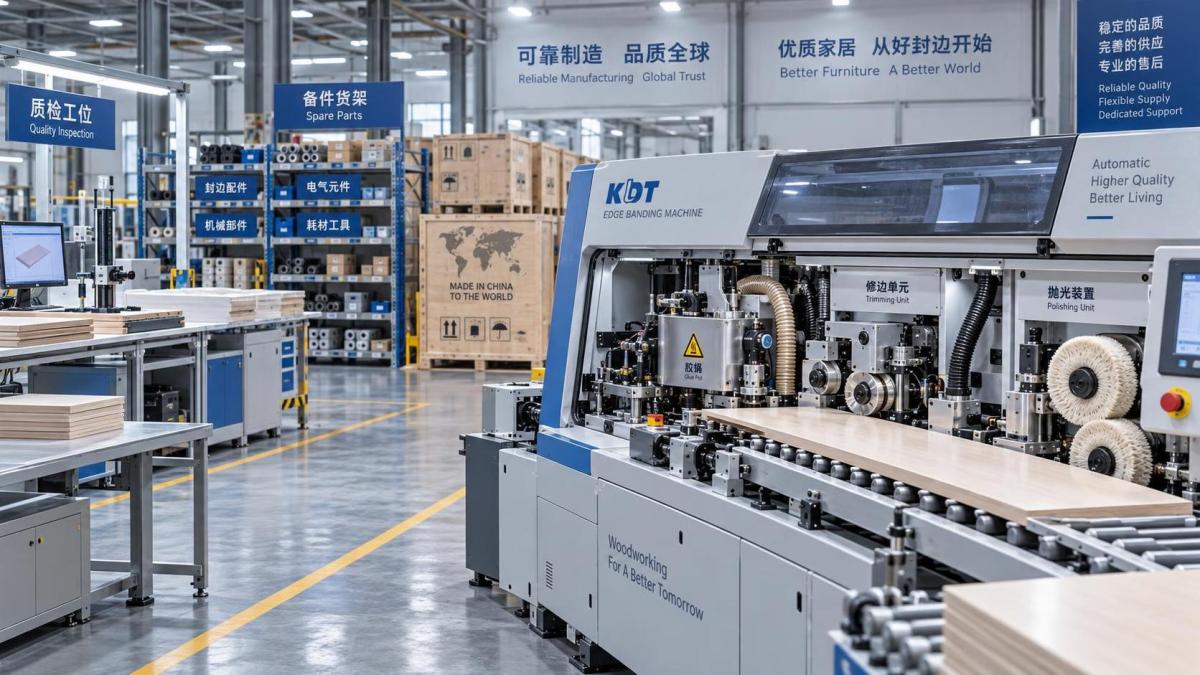
It is also worth verifying the wider product portfolio. A distributor rarely sells edge processing in isolation. Customers may be planning cutting, drilling, edging, and material handling together. A supplier that understands the workflow from panel sizing to final edge finishing can help a distributor avoid recommending equipment that creates a bottleneck elsewhere in the shop.
For instance, a panel-cutting machine should be assessed as part of the same production conversation. The Sliding Table Saw ZD400T is designed for cutting MDF, plywood, solid wood, and other panel materials. Its 3200 × 415 mm sliding table and 3200 mm maximum cutting length may be relevant for furniture factories and cabinet makers preparing panels before edge processing. That does not make it a substitute for an edge bander; it illustrates why distributors should check whether an exporter can discuss compatible upstream equipment rather than sell isolated machines without regard to workflow.
Confirm Quality Control at the Details That Cause Service Calls
Many early field problems do not come from dramatic failures. They come from small issues that consume technician time: loose terminals after transport, poor sensor positioning, uneven glue application, improperly adjusted trimming units, insufficient guarding adjustment, or parts that are difficult to identify. These issues are especially expensive when the distributor has already installed the machine several hours away from its service base.
Before confirming a partnership, request the supplier’s inspection checklist or at least a clear explanation of its pre-shipment testing routine. A useful test should reflect actual operation, not merely power-on confirmation. The exporter should be able to discuss trial processing, function checks, adjustment verification, machine cleaning, protective treatment, and packing inspection.
For the exporter, consistency matters more than a flawless sample machine. A distributor needs confidence that the tenth shipment will match the approved configuration as closely as the first. This is particularly important when machines are sold through dealers, where the end user may judge the distributor—not the overseas factory—when something is wrong.
Treat Spare Parts as a Commercial Issue, Not an After-Sales Detail
A low machine price can be misleading if replacement parts are slow, unclear, or overpriced. Edge banders contain consumable and service-sensitive items such as cutters, scraper blades, belts, chains, bearings, sensors, pneumatic components, heating-related parts, and electrical components. The exact list depends on the configuration, but the distributor should know which items are likely to be needed and whether they can be stocked locally.
Ask the exporter for a recommended initial spare-parts package and distinguish between commissioning spares, fast-moving consumables, and major replacement components. The distributor should also confirm part numbers, photographs, compatibility across models, lead times, packaging, and the process for handling urgent technical requests. If every spare-parts inquiry requires several days of back-and-forth to identify a component, the supplier has transferred service risk downstream.
There is a commercial balance to strike. Carrying too much inventory ties up capital; carrying nothing makes every breakdown an international logistics event. The best opening stock is usually based on the machines the distributor intends to install, the remoteness of the market, and whether local technicians can handle routine replacement work.
Assess Technical Support Before You Need It
Technical support should be tested during the evaluation stage. Send the supplier a realistic question about a possible application, electrical arrangement, board defect, or setup issue. Notice whether the reply is specific, whether it asks for the right operating details, and whether it arrives in a timeframe that would be useful when a customer is waiting.
Good remote support is not simply a promise of “24-hour service.” It usually depends on complete manuals, wiring diagrams, clear fault descriptions, photos or videos from the site, and a technician who can narrow down the issue logically. Language capability also matters. If the distributor’s service team cannot understand the supplier’s instructions, even a technically correct answer may not solve the problem.
The supplier should clarify where its responsibility ends and where the distributor’s responsibility begins. Who handles commissioning? Is training available remotely or on site? What documentation is supplied with the machine? How are warranty claims reviewed? These points should be agreed before the first order, not argued after an end user stops production.
Calculate Landed Cost and Margin Under Real Conditions
The supplier’s FOB or EXW figure is only one part of the commercial picture. Distributors should model freight, insurance where applicable, customs procedures, local taxes and duties, inland delivery, unloading, installation, training, demonstration stock, spare-parts inventory, warranty allowance, and technician travel. The larger and heavier the machine, the more important it is to verify packing dimensions, gross weight, container loading assumptions, and unloading requirements in advance.
Margin should also account for the sales cycle. If your market expects immediate availability, a distributor may need to hold stock. If customers buy only against confirmed projects, a factory-to-order model may be safer but can lengthen delivery time. Neither approach is universally right. The key is ensuring that the exporter’s production schedule, payment terms, and shipment communication fit the way your local buyers actually purchase machinery.
Do not rely on a quotation alone when comparing exporters. Compare the full offer: machine configuration, included accessories, documentation, packing, technical support, spare-parts policy, warranty process, and commercial terms. An apparently higher-priced machine may be the lower-risk option if it reduces field interventions and protects the distributor’s relationship with end users.
Start with a Controlled First Cooperation
Even after careful evaluation, the first order should be structured as a learning process. Choose a configuration that suits a known customer segment rather than ordering the most feature-rich model on paper. Confirm every technical point in writing, review the machine before shipment where practical, and prepare the local installation team before arrival.
A capable edge banding machine exporter is not just a source of equipment. It is a supplier that can maintain configuration discipline, provide usable technical information, support parts planning, and respond when real shop-floor problems arise. For distributors, those capabilities are what turn a machinery line into repeatable business rather than a sequence of costly one-off transactions.
Send Your Inquiry
We welcome your cooperation and we will develop with you.