


News & Exhibitions
Latest Factory Updates, Industry Trends & Global Exhibition Information
Choosing an Edge Banding Machine Supplier for Installation, Parts, and Remote Support
Machine specifications and quoted price are only the starting point when choosing an edge banding machine supplier. A procurement decision can look sound on paper and still create avoidable production losses if the machine arrives without a workable installation plan, common wear parts cannot be obtained quickly, or operators have no practical route to remote technical help.
For furniture plants and workshops, edge banding is tied directly to finished-panel quality, assembly flow, and delivery dates. A machine that stops because of a small sensor, cutter, glue-related component, or adjustment issue can affect far more than one workstation. The supplier should therefore be evaluated as a service partner with a defined support capability, not simply as the seller of a machine.
Start with the support model, not the brochure
A detailed specification sheet can confirm whether a machine has the required processing units, feed arrangement, panel-size range, and edge band compatibility. It does not show whether the supplier can help a production team commission the machine safely and keep it stable after handover.
Before comparing final quotations, ask each supplier to describe what happens from purchase order to regular production. The response should be concrete enough to reveal ownership and sequence. A useful plan normally identifies pre-shipment inspection, utility requirements, delivery documentation, machine placement, installation responsibilities, commissioning steps, operator training, trial production, and the process for closing early technical issues.
Vague assurances such as “installation support available” leave major questions unanswered. Will the supplier provide an installation drawing that includes machine dimensions, access space, electrical connection, compressed-air requirements, extraction interfaces, and material flow? Who checks that the site is ready before shipment? Is support delivered on site, by video, through written instructions, or through a local partner? Which work remains the buyer’s responsibility?
These details matter especially for long or specialized equipment. A machine may fit through the factory door but still be difficult to position, service, or connect once it is inside. Insufficient maintenance clearance around trimming, glue, polishing, or control sections can turn routine work into a disruptive task. Procurement should involve the production manager, maintenance lead, facilities team, and logistics contact early enough to identify these issues before the machine is dispatched.
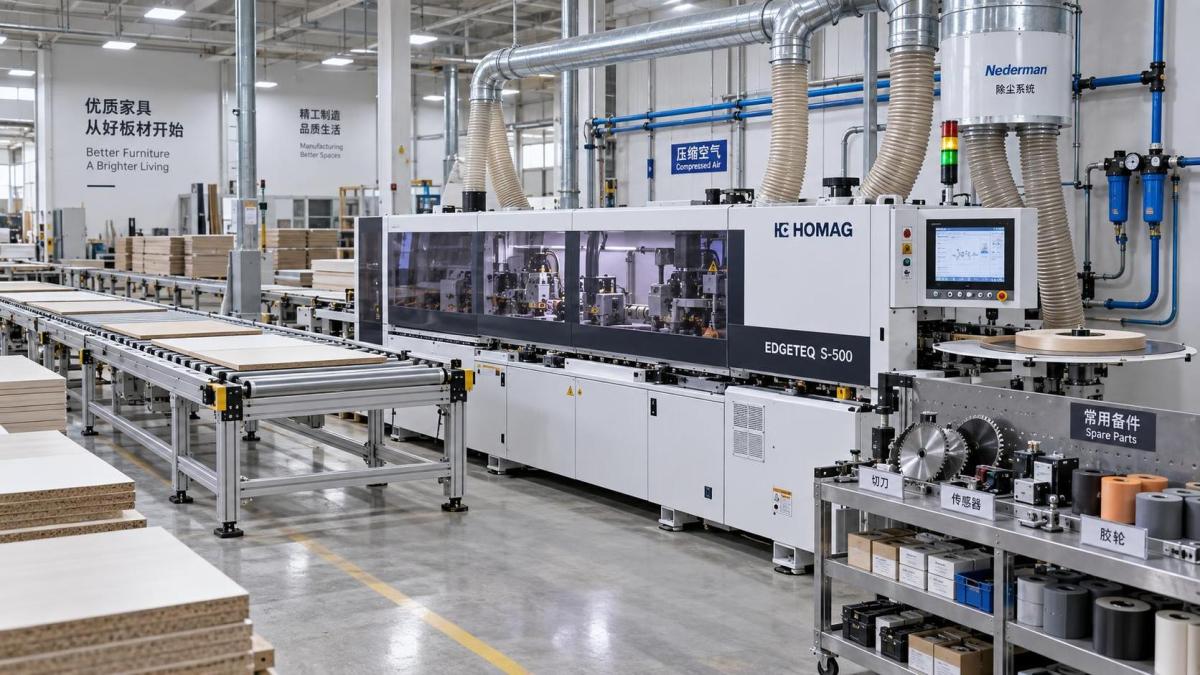
Installation quality affects the machine’s first months of output
Commissioning is more than switching the machine on and confirming that panels move through it. The installation phase establishes baseline settings for the materials, panel geometries, edge bands, adhesives, and finish expectations used by the buyer. If this stage is rushed, operators may spend the following months compensating for setup inconsistencies with manual adjustment and rework.
A capable supplier should be able to discuss the site conditions that influence performance. Compressed air, power supply, dust extraction, floor level, panel handling, adhesive preparation, and ambient conditions can all affect reliability or finish quality. The supplier does not need to take responsibility for every factory utility, but it should state the conditions the equipment requires and flag risks before the equipment reaches the site.
Training also deserves closer scrutiny than it often receives in a purchase comparison. A basic startup demonstration is insufficient for a team that must change edge band materials, adjust processing for different panel thicknesses, identify poor finishing, clean relevant assemblies, and carry out routine maintenance. Ask whether training covers both operators and maintenance personnel, whether it is linked to the buyer’s actual product mix, and whether setup records or parameter guidance will be supplied.
The need for this discipline increases with shaped or soft-forming work. For example, a supplier discussing a solution such as the Soft forming edge banding machine ZD980S should be prepared to review more than its 70.5 kW installed power and 10.8 m overall length. Buyers processing cabinets or customized furniture should also establish whether their straight and oblique panel edges, minimum panel sizes, edge-band profiles, air supply, and available installation space match the machine’s operating envelope. Curved and shaped-panel processing introduces setup and material variables that are less forgiving than routine straight-edge work.
Evaluate spare parts as a supply-chain question
Every edge banding machine contains components that will eventually require replacement or adjustment. The risk is not that parts wear; the risk is discovering after a stoppage that there is no clear part identification, no stock position, no realistic delivery path, or no technical guidance for replacement.
A supplier should be able to separate parts into practical categories. One group includes routine consumables and wear items that the buyer is expected to hold. Another includes service parts that should be available from supplier stock within an agreed process. A third group consists of less frequent components such as drives, control hardware, specialized assemblies, or custom parts that may require a longer lead time. Treating all parts as equally available creates false confidence.
Request a recommended initial spare-parts list that is specific to the proposed configuration. It should include part numbers, descriptions, quantities, and the reason each item is recommended. For a production-critical machine, the list often needs to cover items whose failure would stop the line, not only inexpensive consumables. The buyer can then decide what to keep locally based on production volume, machine redundancy, import lead time, and the cost of downtime.
Parts support should also be checked against documentation control. The machine serial number, electrical drawings, pneumatic diagrams, parts book, software or parameter backup process, and service history should remain accessible to the buyer. When a machine changes shift supervisors or maintenance staff, undocumented knowledge tends to disappear. Clear records make remote troubleshooting and future parts orders materially faster.
Remote support must be designed for diagnosis
Remote technical support is valuable when it helps the production team make the next correct decision quickly. It is less useful when it consists only of general advice after a problem has already become urgent. The purchasing team should ask how a support request is opened, which channels are available, what technical information the supplier expects, and how escalation works when first-line guidance does not resolve the issue.
Video support can be particularly effective for visible issues: edge band alignment, glue application, trimming marks, polishing quality, panel feed behavior, or a mechanical adjustment. Electrical faults and intermittent alarms may require more structured evidence, such as alarm codes, photos of the control screen, wiring references, readings taken by qualified personnel, and a short record of what changed before the issue appeared.
Remote support has limits. It cannot correct an unsuitable factory utility, replace a damaged mechanical assembly, or compensate indefinitely for a machine selected outside its intended application. It also depends on the buyer assigning trained staff who can follow instructions safely and communicate what the machine is doing. Procurement should avoid treating remote assistance as a substitute for proper installation, training, preventive maintenance, and local spare inventory.
Ask suppliers for realistic operating details rather than a broad promise of “online service.” Useful questions include:
- Which support channels are monitored for technical faults?
- What information should an operator provide before a remote session begins?
- Can the supplier support the machine in the buyer’s working language or through clear technical documentation?
- How are urgent line-stoppage issues distinguished from routine setup questions?
- Can parameter backups, electrical documents, and service instructions be shared in a controlled format?
- When remote diagnosis indicates an on-site intervention, who can perform it and what preparation is required?
Compare total operating exposure, not only the purchase price
A lower machine price may still be the more expensive option if commissioning takes longer, training is superficial, parts identification is unclear, or service responses are difficult to obtain across time zones. Conversely, a higher initial quotation needs evidence behind its claimed service value. Buyers should compare the scope of installation, documentation, recommended spares, warranty handling, response process, and post-commissioning support as part of the commercial evaluation.
It helps to convert the supplier review into a weighted decision sheet shared by procurement and operations. Technical fit should remain central: panel sizes, edge materials, product mix, throughput expectations, and available factory utilities must align with the proposed machine. Alongside that score, assess installation readiness, documentation quality, critical-parts strategy, support accessibility, and the supplier’s ability to explain failure handling in plain operational terms.
This approach also exposes a common mistake: assuming that a supplier with a broad product range automatically has strong support for every machine type. The relevant evidence is the supplier’s process for the exact configuration being purchased. Ask configuration-specific questions and look for answers that identify components, conditions, responsibilities, and documents rather than generic service language.
Use the pre-order stage to test how support will work later
The sales process is an early indicator of the service process. A supplier that responds precisely to questions about site requirements, setup boundaries, consumable parts, and fault reporting is demonstrating a useful level of technical organization. A supplier that repeatedly redirects practical questions to broad assurances may create the same uncertainty after delivery.
Before placing the order, document the agreed installation and acceptance scope, the documents to be supplied, the initial spare-parts package, the warranty process, and the remote-support contact route. Define acceptance around the buyer’s relevant panels and finish expectations where possible, rather than around an isolated no-load demonstration.
The strongest edge banding machine supplier is not necessarily the one offering the most features on a quotation. It is the one whose machine fits the production task and whose installation, parts, and remote-support arrangements remain credible when a real production issue needs to be resolved.
Send Your Inquiry
We welcome your cooperation and we will develop with you.