


News & Exhibitions
Latest Factory Updates, Industry Trends & Global Exhibition Information
OEM Capability or Standard Models? Assessing an Edge Banding Machine Manufacturer
A procurement decision for an edge banding machine rarely comes down to feed speed, motor power, or a brochure comparison alone. Those figures matter, but business evaluators also need to ask a more consequential question: is the supplier simply selling a standard machine, or can it act as a manufacturing partner when production requirements become more demanding?
For cabinet producers, furniture factories, and woodworking workshops, edge quality is visible to the end customer. A chipped corner, uneven glue line, or poorly polished bevel can undermine an otherwise well-made panel. At the same time, a machine that performs well during acceptance testing may become a source of delays if spare parts are difficult to obtain, operator settings are unclear, or the equipment cannot accommodate a new panel design.
That is why assessing an edge banding machine manufacturer requires a broader view. The strongest choice is not automatically the supplier offering the longest function list. It is the supplier whose standard platform, OEM flexibility, production discipline, and service approach fit the buyer’s actual operating plan.
Standard Models Solve a Real Need—When the Process Is Stable
Standard edge banding machines are often the practical starting point for buyers with established products and repeatable panel specifications. A proven configuration can reduce engineering lead time, simplify training, and make it easier to compare suppliers on a like-for-like basis. For a factory processing conventional straight cabinet doors or furniture panels in familiar thickness ranges, a standard machine may offer the right balance of capability and budget control.
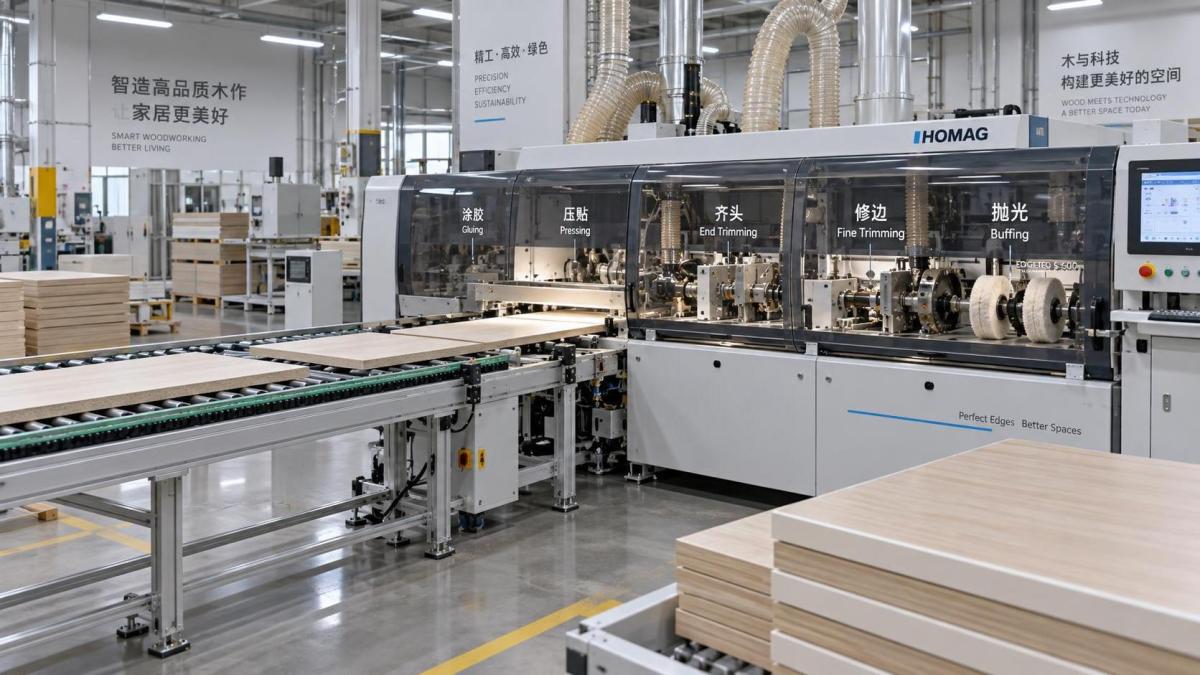
The key word is proven. A standard model should not mean a generic assembly of components with little validation behind it. It should mean that the manufacturer has already tested the machine’s working sequence, glue application, pressure system, cutting, trimming, scraping, and polishing stages as a complete process. Buyers should ask what materials and panel sizes were considered in that validation—not merely whether each station works independently.
Standardization also matters after delivery. When machines share a stable design, service teams can diagnose issues faster, common spare parts can be stocked more sensibly, and operators can learn routines that transfer across similar equipment. This is particularly valuable for purchasers managing several sites or planning gradual capacity expansion.
However, a standard configuration becomes less suitable when the factory’s product mix starts to move beyond routine straight-edge work. Angled panels, bevelled doors, narrow workpieces, special veneer behavior, changing edge-band thicknesses, or plant-specific automation interfaces may expose the limits of an off-the-shelf specification.
OEM Capability Is Not Just a Customized Paint Color
In woodworking machinery procurement, “OEM” is sometimes used too loosely. Adding a logo, changing machine color, or relabeling a control panel does not demonstrate meaningful engineering capability. Genuine OEM capacity is the ability to adapt a machine around a defined production requirement while preserving process reliability, maintainability, and safety.
For an edge banding machine manufacturer, this can involve reviewing panel dimensions, board materials, edge-band types, desired finishing quality, factory utilities, line layout, operator workflow, and expected output. It may also include selecting or adjusting functional stations, changing transfer arrangements, integrating upstream or downstream equipment, adapting electrical standards, or tailoring documentation for the destination market.
The value of this work is not customization for its own sake. It is risk reduction. A factory does not need a machine filled with options that operators rarely use. It needs a configuration that handles its most commercially important panels with repeatable results and does not create unnecessary complexity on the shop floor.
Business evaluators should be cautious of two opposite claims. One is “we can make anything,” without drawings, process discussion, or clear limits. The other is “this is our standard machine,” used to avoid any examination of real application conditions. A credible supplier can explain where a standard platform is appropriate, where modification is sensible, and where a different machine category may be required.
Start the Assessment with Your Own Production Reality
Before comparing manufacturers, create a concise application profile. This makes supplier conversations more concrete and prevents purchasing teams from being impressed by functions that have little relevance to the plant.
- Panel range: Record minimum and maximum length, width, and thickness—not just the average board size.
- Edge material: Clarify whether the operation uses PVC, ABS, veneer, or mixed materials, along with the relevant thickness range.
- Edge geometry: Separate straight-edge work from bevelled or angled-edge requirements. They should not be treated as interchangeable.
- Output pattern: Consider actual shift volume, batch size, product change frequency, and seasonal peaks.
- Quality threshold: Define what an acceptable glue line, corner finish, trimming result, and polish level look like for your market.
- Plant conditions: Confirm compressed-air availability, electrical supply, floor space, material handling routes, and maintenance access.
This profile gives the procurement team a way to judge whether a supplier is listening. A manufacturer that immediately quotes a machine without asking about board dimensions, edge materials, or target finish may be treating a process purchase like a catalogue transaction.
Use a Capability Review Instead of a Feature Checklist
A feature checklist has value, but it can hide the questions that affect lifetime performance. For example, “trimming” is not a complete evaluation point. Buyers should understand how trimming quality is maintained across panel variations, how tool adjustment is handled, what routine maintenance is expected, and whether the design gives technicians workable access.
The same applies to automatic control. Automation can improve consistency and reduce reliance on manual intervention, but it should be assessed in context. Is the control interface understandable for the operators who will use it? Can settings be documented and repeated? Does the supplier provide clear guidance for setup changes and fault diagnosis? A highly capable control system becomes a burden if every adjustment requires remote assistance.
Ask prospective suppliers to walk through the board path from entry to exit. This simple exercise reveals a great deal. They should be able to explain how the workpiece is supported, how edge material is applied, where pressure is controlled, how excess material is removed, and how the final surface is polished. Their explanation should connect mechanical design to the finish the buyer expects to see.
When Straight and Bevelled Work Must Coexist
Factories producing contemporary cabinets and furniture increasingly encounter panel designs that combine conventional straight edges with angled or bevelled elements. Running these applications through separate equipment may be appropriate in high-volume, highly specialized production. Yet for businesses that need versatility within a controlled footprint, a combined process solution can be worth examining closely.
An example is the Straight&Beveling edge banding machine ZD450ZX, designed for straight and bevelled edge banding, automatic edge processing, trimming, and polishing. Its published working range illustrates the kind of detail buyers should compare: straight panel edge thicknesses of 10–60 mm, bevelled panel thicknesses of 15–25 mm, straight feed speeds of 15–20 m/min, and a bevelled feed speed of 15 m/min. It is specified for PVC, ABS, veneer, and wood-panel applications, with straight edge-band thicknesses of 0.4–3.0 mm and oblique edge-band thicknesses of 0.8–1.5 mm.
Those figures are useful only when matched to the buyer’s product list. For instance, minimum panel width differs between straight and oblique processing: the stated requirements are at least 50 mm for straight work and at least 70 mm for oblique work. A purchasing team should not assume that a panel acceptable for one processing mode will automatically run in the other. This is exactly the type of detail that separates informed equipment selection from a decision based on headline capacity.
It is also sensible to consider installation implications. A machine dimension of 10000 × 950 × 1850 mm and a stated working pressure of 0.6 MPa require more than a vacant place on the production floor. Material infeed and outfeed, operator movement, maintenance clearance, dust collection, and utility connections all deserve review before finalizing a layout.
Manufacturing Consistency Matters More Than the Sample Machine
Buyers often inspect a demonstration machine and focus on its visible finish. That is reasonable, but it does not fully answer whether the supplier can manufacture consistently over time. The deeper question is whether production methods support repeatability from one delivered unit to the next.
During evaluation, ask how the manufacturer controls key stages such as fabrication, machining, assembly, wiring, alignment, functional testing, and final inspection. The goal is not to demand confidential factory information. It is to understand whether the company has an organized approach to building equipment rather than relying on individual adjustment at the end of assembly.
A manufacturer with a long operating history may offer practical advantages here, especially when that experience is backed by continued engineering attention rather than simply years in business. Qingdao Zhongding Machinery Co., Ltd. has developed from an early small workshop into a modern woodworking machinery manufacturer with more than 20 years of industry experience. For a buyer, the relevant point is not the company story alone; it is whether that accumulated knowledge translates into machines designed around furniture production realities and supported beyond shipment.
Where possible, request evidence of the acceptance approach that will apply to your machine. This may include confirmation of the agreed configuration, testing against representative materials or dimensions, and a documented review of operating functions before dispatch. If the application is unusual, discuss sample panels early. Ambiguity is much less expensive to resolve before production than after installation.
After-Sales Support Is Part of the Machine Specification
Downtime does not feel like a service issue when a customer delivery is waiting; it feels like a production emergency. That is why service capability should be evaluated during supplier selection, not added as an afterthought once a purchase order is issued.
A useful support discussion covers the practical basics: installation guidance, commissioning scope, operator training, routine maintenance instructions, recommended critical spares, technical communication channels, and the process for identifying replacement parts. Buyers should also ask whether manuals, electrical diagrams, and parts references are sufficiently clear for their maintenance team.
Responsiveness matters, but so does preparedness. A supplier can answer messages quickly and still be unable to resolve a problem if component identification is vague or spare-part supply is poorly organized. Conversely, a well-documented machine with accessible service points can reduce the severity of ordinary interruptions.
For exporters serving global woodworking operations, support must account for distance and different site conditions. Clear remote troubleshooting procedures, dependable spare parts planning, and communication that avoids unnecessary technical ambiguity are often more valuable than broad promises of “lifetime service.”
A Practical Decision Matrix for Business Buyers
Rather than asking whether OEM capability is better than a standard model, score each supplier against the role the machine must play in your business. A standard model may rank highest when products are stable, throughput is predictable, and quick deployment is the priority. OEM adaptation may rank higher when panel geometry, material diversity, layout constraints, or brand-specific furniture designs create a genuine processing gap.
Evaluate the manufacturer across five areas: application fit, process repeatability, customization discipline, service readiness, and total operating practicality. The last category should include energy use, consumable tools, maintenance access, operator skill requirements, and likely disruption during product changes. The lowest purchase price can be misleading when it creates more manual correction, higher reject rates, or difficult recovery after a minor fault.
It is equally important to identify “must-have” and “nice-to-have” requirements. A bevel function may be essential for a growing cabinet range, while a complex automation option may have little return in a low-mix workshop. This distinction helps buyers negotiate with clarity and keeps the final specification focused.
The Better Question to Ask a Manufacturer
The most productive question is not, “Can you customize this machine?” Almost every supplier will answer yes. Ask instead: “How would you validate that this configuration will run our panels, materials, and daily production pattern reliably?” The quality of the response will reveal whether you are speaking with a machine vendor or a partner that understands manufacturing risk.
A dependable edge banding machine manufacturer should be comfortable discussing limits as well as capabilities. It should help the buyer decide when a standard platform is the sensible choice, when adaptation adds operational value, and what needs to be confirmed before production begins. That openness is often the foundation of a better investment: one that protects edge quality today while leaving room for the factory to evolve tomorrow.
Send Your Inquiry
We welcome your cooperation and we will develop with you.