


News & Exhibitions
Latest Factory Updates, Industry Trends & Global Exhibition Information
PVC Edge Banding Machines Compared: Matching Glue Systems to Panel Throughput
A PVC edge banding machine should be selected from the expected panel flow backward, not from the desired edge appearance alone. In a cabinet or furniture line, an edge bander may look acceptable during a short trial yet become the production bottleneck once cut panels arrive continuously from a saw, nesting cell, or drilling station. Glue warm-up delays, slow recovery after door-size parts, frequent color changes, and cleanup time can reduce usable capacity long before the machine reaches its advertised feed speed.
The practical decision is straightforward: EVA is usually the most economical choice for stable, medium-volume production; PUR is justified where moisture, heat, and high bond durability are critical; hot-air systems suit selected zero-joint applications but require disciplined material and process control. The right choice depends on the peak number of panels arriving at the bander, the edge material, the required bond resistance, and the amount of stoppage the line can tolerate.
Start with the panel flow, not the nominal machine speed
Feed speed is only one part of throughput. A machine rated for a certain meters-per-minute range may not sustain that output when operators are loading mixed cabinet components, changing PVC colors, trimming thick edges, or stopping for glue maintenance. Technical evaluation should therefore begin with the actual work pattern:
- How many panels per shift must be edged, including rework and small components?
- What is the average perimeter length per panel?
- Are panels processed in batches by color and thickness, or in highly mixed orders?
- Does the edge bander receive a steady queue, or does upstream cutting create intermittent peaks?
- How much buffer space exists before and after the machine?
A line making repeated kitchen cabinet sides and doors can organize parts by edge color and thickness, allowing a glue pot system to run efficiently for long periods. A custom furniture shop may instead process white, gray, woodgrain, and dark PVC in the same day, with frequent transitions between 0.4 mm backing edge and 1–2 mm impact-resistant edge. In that second situation, the time between jobs can matter more than maximum conveyor speed.
Panel preparation is part of the same throughput calculation. Chips on a melamine edge, poor squareness, or inconsistent panel dimensions force slower feeding and increase the risk of visible glue lines. Upstream cutting equipment such as the BEAM SAW MJ6233 can support a more predictable edge-banding flow when its precise positioning system and air flotation table are used to prepare consistently sized MDF, plywood, particle board, or melamine panels. Its maximum cutting length of 3200 mm and frequency-controlled cutting speed provide useful context when matching cutting output to downstream capacity, but the edge bander still needs sufficient buffering to absorb batch changes and operator handling.
EVA hot-melt: practical for stable production and controlled costs
EVA remains the most common glue system because it is familiar, broadly compatible with standard furniture panels, and comparatively easy to manage. Granules are melted in a glue pot and applied to the panel edge before the PVC strip is pressed into place. It is a sensible baseline for shops producing indoor furniture, office furniture, wardrobes, and cabinet components where normal service conditions apply.
Its main strengths are operational simplicity and manageable consumable cost. EVA systems are available across compact manual-feed machines and more automated production equipment. The adhesive can be selected for different colors, open times, viscosities, and substrate conditions. For a line with predictable batches, an appropriately sized glue pot can maintain a stable application film and support good panel flow.
The limitations become visible when production changes frequently. EVA left in the pot can degrade during extended heating, especially if the machine runs only intermittently. Carbonized residue may affect glue delivery, create inconsistent bond lines, and increase cleaning work. A machine that is switched on early but waits for panels is consuming energy and exposing adhesive to unnecessary heat. Technical evaluators should ask how quickly the glue system reaches operating condition, how the pot is insulated, whether temperature is controlled by zones, and how easily operators can clean the application area.
EVA also has service-environment limits. Its bond can soften under elevated heat, and moisture resistance is lower than a properly processed PUR bond. This does not make EVA unsuitable for most interior panel furniture. It means that the expected end use must be defined clearly. A standard wardrobe carcass and a bathroom vanity should not automatically be assigned the same adhesive specification.
Where EVA capacity is often lost
In routine operation, EVA bottlenecks often come from handling rather than adhesive chemistry. Thin narrow parts may be difficult to guide consistently. Mixed edge thicknesses can require pressure-beam and trimming adjustments. Dark PVC on light panels makes even a small glue-line inconsistency highly visible. When evaluating a PVC edge banding machine, inspect the glue roller, doctor system, pressure rollers, and pre-milling arrangement as a connected process. A clean, square edge with a uniform adhesive film gives the pressure zone a realistic chance of producing a stable bond.
PUR: stronger environmental performance, tighter operating discipline
PUR hot-melt is chosen when the finished panel must withstand more demanding conditions: higher humidity, periodic water exposure, elevated temperatures, or greater long-term stress at the bond line. It is commonly considered for kitchen and bathroom furniture, commercial interiors, and applications where edge durability is a major quality requirement. Once PUR reacts with moisture, it forms a cross-linked bond that offers stronger resistance than conventional EVA.
That benefit comes with a different maintenance burden. PUR is moisture-reactive, so adhesive handling cannot be treated casually. The system should limit exposure to ambient moisture, and unused adhesive management must follow the machine and adhesive supplier’s procedures. Cleaning neglected PUR residue is far more difficult than cleaning ordinary EVA contamination. A production manager may gain better bond performance but lose output if the team lacks a repeatable shutdown, purge, and cleaning routine.
Throughput with PUR should be assessed in terms of usable production time, not just conveyor speed. A sealed cartridge or closed adhesive delivery arrangement can reduce contamination risk and support cleaner changeovers, but it may introduce consumable format constraints. Bulk PUR systems can suit sustained production, yet they require better controls around storage, filling, and maintenance. The best configuration depends on whether the line runs all day with one stable specification or processes shorter batches with extended idle periods.
A PUR decision should also account for curing behavior. Initial edge retention after pressing is not the same as final cross-linked bond performance. Panels should be handled according to the adhesive process requirements before aggressive downstream machining, packing, or environmental exposure. This matters particularly in high-throughput lines where freshly edged panels move rapidly to return conveyors, drilling, or assembly.
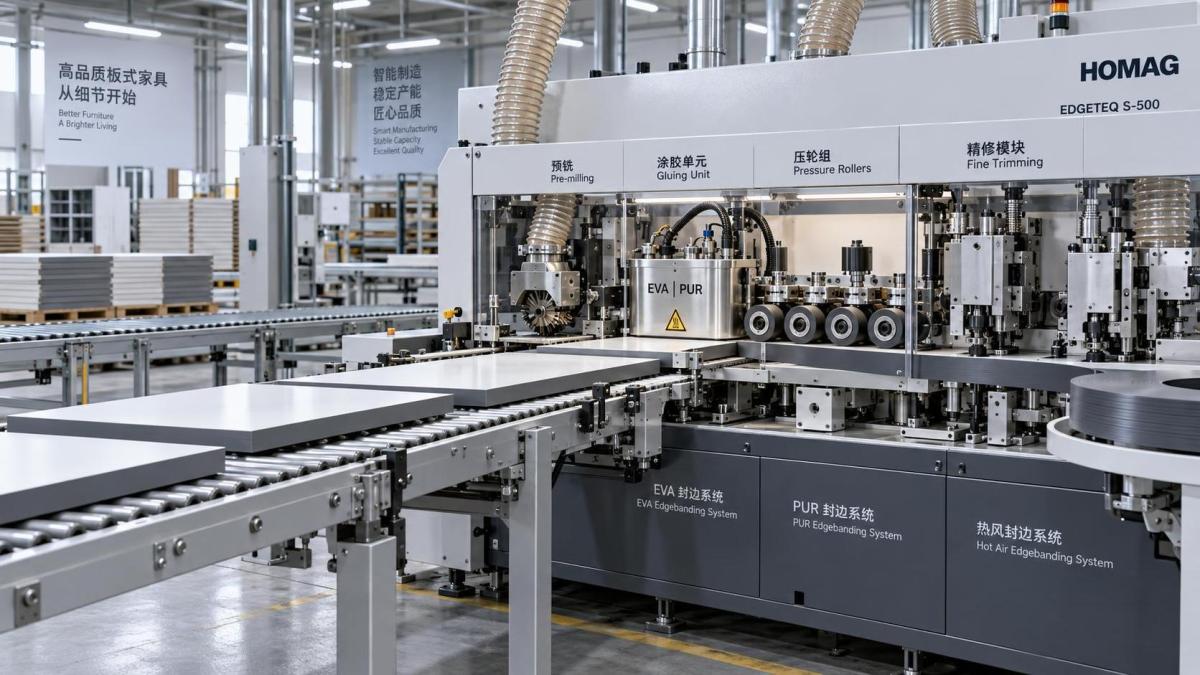
Hot-air bonding and the zero-joint expectation
Hot-air edge banding systems activate a functional layer on compatible edge material rather than applying a separate glue film from a pot. The visible result can be a very narrow or nearly invisible joint, which is attractive for premium cabinet doors, glossy decorative panels, and dark edge-to-panel combinations where an EVA glue line would be more noticeable.
The decision should not be based on appearance alone. Hot-air processing depends on compatible edge tape, stable energy delivery, accurate pressure, and clean panel edges. Material selection is not interchangeable: a PVC edge designed for standard EVA application may not perform correctly in a hot-air process. Evaluators should verify edge-band specification, functional-layer consistency, intended panel substrate, and achievable machine settings before assuming a zero-joint finish is available.
Hot-air systems can reduce glue-pot-related cleaning and eliminate conventional adhesive color matching, but they introduce other sensitivities. Energy input must activate the functional layer without overheating the edge or damaging decorative surfaces. Feed rate, ambient temperature, panel condition, and edge thickness all influence the process window. On a line with a wide mix of panel colors and edge materials, the operational advantage may be significant only when compatible tapes are consistently available and job data is controlled.
For high-volume standard carcass work, the extra capital and material requirements may not improve the finished product enough to justify the change. For visible fronts or projects where joint appearance drives acceptance, hot-air can be the appropriate route. The key is to separate a visual specification from a blanket assumption that every panel requires the same technology.
Machine configuration determines whether the glue system can keep up
Once the adhesive method is selected, machine architecture determines whether it can support the intended panel rate. A compact single-side edge bander may be adequate where operators load parts one at a time and output changes during the day. It becomes less suitable when the saw or nesting cell releases large batches faster than the operator can orient, inspect, and feed them.
Look beyond the glue unit to the modules immediately before and after it. Pre-milling is valuable when saw-cut edges have minor chipping, unevenness, or laminate breakout. It removes a small amount of material to create a more uniform bonding surface, but it also adds tool maintenance and dust extraction requirements. On melamine-faced particle board, a well-set pre-mill can prevent edge defects from being mistaken for an adhesive problem.
Pressure rollers must hold the PVC accurately while the adhesive is still in its working window. End trimming, rough trimming, fine trimming, scraping, and buffing then determine whether the line can release a panel without manual touch-up. A high feed speed is of limited value if parts leave with sharp corners, torn film, chatter marks, or excess adhesive that requires bench correction.
Automation should be matched to variation. Barcode-driven setup, automatic edge thickness adjustment, servo positioning, and recipe storage can reduce error in mixed production. In a stable, repetitive line, these features may mainly reduce labor and setup time. In a custom-order environment, they can prevent wrong-tool positions and inconsistent pressure settings from becoming recurring quality losses. The evaluation question is not whether automation is available, but whether it removes a real source of variation in the current panel mix.
Use a realistic comparison trial
A meaningful trial should include the panels that create the most difficulty, not only clean sample boards. Include the thickest and thinnest planned PVC, light and dark combinations, narrow rails, long cabinet sides, and panels with typical saw-cut edges. Run enough pieces to observe heat stability and adhesive application after the machine has reached normal operating condition.
- Confirm panel thickness, squareness, and edge condition before entering the machine.
- Record the adhesive type, temperature setting, feed speed, edge tape specification, and pressure configuration.
- Inspect the bond immediately after processing, then check for lifting, gaps, squeeze-out, and corner damage after appropriate handling time.
- Measure how much operator intervention is needed for setup, cleanup, and defect correction.
- Compare completed panels per working hour, including interruptions, rather than counting only conveyor travel time.
This approach exposes a frequent purchasing error: selecting a machine based on its best-case speed while ignoring the losses created by real job changes. The preferred PVC edge banding machine is the one that consistently produces acceptable panels at the required production rhythm with a glue process the maintenance team can sustain. EVA, PUR, and hot-air systems each have a valid place, but only when adhesive behavior, panel preparation, material compatibility, and daily operating patterns are evaluated as one production system.
Send Your Inquiry
We welcome your cooperation and we will develop with you.