


News & Exhibitions
Latest Factory Updates, Industry Trends & Global Exhibition Information
Sourcing Edge Banding Machines from China: A Buyer’s Factory Audit Checklist
Sourcing Edge Banding Machines from China: A Buyer’s Factory Audit Checklist
Sourcing an edge banding machine China supplier can improve the economics of a furniture line, especially when local options are limited or replacement machines carry long lead times. But the purchase price is only one part of the decision. A machine that looks comparable in a quotation can differ sharply in frame rigidity, component sourcing, electrical workmanship, commissioning readiness, and the supplier’s ability to support it after shipment.
For a purchasing team, the factory audit is where those differences become visible. It is not simply a visit to confirm that a company has a workshop and several assembled machines on the floor. The useful audit asks whether the supplier can build the configuration promised, control consistency from one order to the next, test the machine with realistic materials, and still answer the phone when a worn roller or control fault interrupts production months later.
This checklist is designed for buyers evaluating Chinese edge banding machine manufacturers for cabinet, panel furniture, and woodworking applications. Some points can be reviewed remotely through live video, documents, and machine test footage; others are much easier to judge during an on-site visit.
Start with the production requirement, not the catalogue model
Before auditing any supplier, define the work the machine must perform in your own plant. “Automatic edge bander” is too broad to be a reliable purchasing specification. A compact machine for a joinery shop has very different priorities from a high-throughput line processing melamine-faced panels for flat-pack furniture.
Ask your production team for the usual board thickness range, narrowest workpiece, edge material types, adhesive preference, daily shift pattern, and expected feed speed. PVC, ABS, veneer, acrylic, and solid wood edging do not behave the same way at the glue station or trimming units. PUR adhesive also changes the conversation: it may offer better moisture and heat resistance, but it requires disciplined glue handling and cleaning. A supplier that immediately recommends a machine without asking these questions is selling a standard model, not assessing the application.
It is also worth separating “must-have” functions from features that sound useful but create unnecessary service exposure. Pre-milling, end trimming, rough and fine trimming, scraping, buffing, corner rounding, and groove cutting can all have a place. The right package depends on your board quality and finish expectations. Buying every available station may increase capital cost and adjustment time without solving the actual bottleneck.
Verify what the factory really makes
Chinese woodworking machinery suppliers vary widely. Some manufacture key structures and assemble machines in-house. Others are trading-oriented businesses that coordinate production from several workshops. Neither model is automatically unacceptable, but the buyer needs to understand which one is being offered. The risk rises when responsibility for fabrication, electrical assembly, testing, and after-sales support is spread across parties with no clear owner.
During the audit, follow the physical flow rather than relying only on a presentation room. Look for incoming materials, machining or fabrication activity, welded frames, paint preparation, assembly stations, electrical cabinet work, testing space, finished-machine storage, and packing. A factory does not need to perform every process itself, but outsourced work should be identified clearly and controlled through drawings, inspection criteria, and traceability.
Pay close attention to the machine base. Edge banding accuracy depends on stable reference surfaces and aligned stations. Inspect weld appearance, paint coverage inside exposed areas, access panels, cable routing, and the practical ability to reach adjustment points. These details are not cosmetic. A poorly finished cabinet may signal equally casual work behind the guard covers.
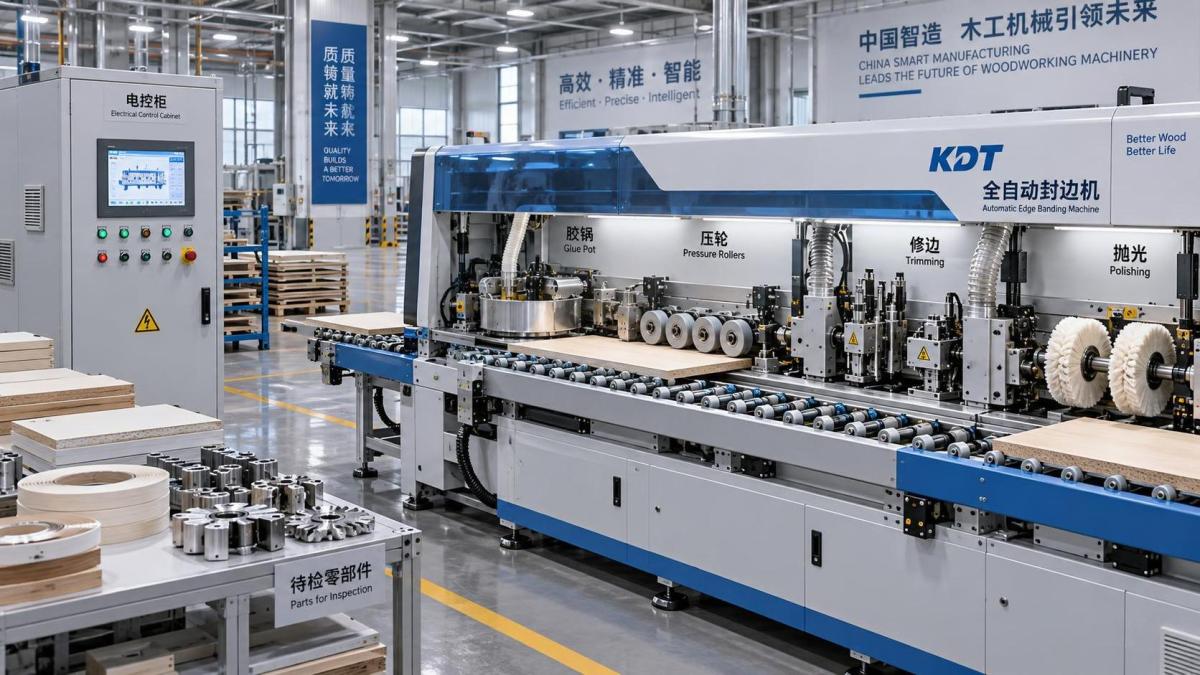
Ask to see a machine at more than one stage of build. A completed unit demonstrates appearance; an unfinished unit reveals how the supplier handles internal wiring, piping, brackets, and station alignment. If every machine on the floor is fully wrapped for delivery, request archived assembly and test records for a recent order rather than accepting a broad assurance that all machines are “fully checked.”
Audit the components that drive uptime
A quotation may list the number of motors and processing units, yet omit the component details that determine maintenance cost. Request a component schedule before finalizing the order. It should identify motors, reducers, inverters, PLC or controller, HMI, pneumatic valves, electrical protection devices, bearings, glue-pot heating elements, and sensors. Brand names are useful, but a brand list alone is not enough; confirm the exact series or specification where it affects compatibility and replacement planning.
The buyer should also ask a blunt but necessary question: can any named component be substituted during production? A supplier may need flexibility when supply chains move, but substitutions should require written approval if they affect electrical compatibility, performance, or spare-parts commonality. “Equivalent” is not a specification.
Check whether the electrical cabinet is built with service in mind. Wiring should be labelled, terminals orderly, heat-generating devices reasonably arranged, and the cabinet documentation matched to the delivered configuration. For export projects, verify voltage, frequency, plug or connection requirements, control-language needs, and any machine safety expectations applicable in the destination market. The supplier should not guess at local compliance requirements; these need to be agreed in the contract and confirmed against the project’s actual requirements.
Do not accept a no-load demonstration as proof of performance
A machine running without boards proves very little beyond basic motion. The meaningful factory acceptance test uses materials close to your production conditions. Send representative panels and edge tape where practical, or agree in advance on thickness, surface type, edge material, adhesive, and sample dimensions. A glossy panel, a thin strip, and a standard cabinet side can expose different setup weaknesses.
Watch the entire process, not only the final sample held up for the camera. Is glue applied evenly near the leading and trailing ends? Does the pressure section hold the band firmly without crushing it? Are trimming and scraping results consistent across several pieces? Does the machine maintain its result after adjustments and repeated runs? Look at glue lines under normal lighting and inspect corners closely. A clean sample produced after lengthy hand tuning may not represent a stable production setting.
The test protocol should be written into the purchase agreement. It can define the agreed configuration, sample materials, functions to be demonstrated, visual acceptance criteria, video or inspection documentation, and the procedure if the machine does not pass. This is more useful than vague wording such as “good quality” or “working normally.”
Ask capacity questions that reveal operational maturity
Many sourcing problems are not caused by a bad machine design. They arise because a supplier takes more orders than its engineering, assembly, or testing resources can absorb. Ask how many machines are typically assembled at the same time, who controls the production plan, and how long the machine remains in the test area before packing. The answer does not need to be impressive; it needs to be specific and credible.
Request the proposed lead time in stages: drawing confirmation, component preparation, assembly, testing, customer inspection, packing, and shipment readiness. This makes delays easier to identify early. For customized machinery, confirm who approves the layout drawing and electrical details. A changed panel width, special conveyor height, or different electrical standard can affect more than one station, so informal revisions over messaging apps are a common source of later disagreement.
Suppliers with broader woodworking equipment experience can sometimes be easier to evaluate because they understand the upstream and downstream process. Qingdao Zhongding Machinery Co., Ltd., for example, has developed from a small workshop into a manufacturer and exporter focused on woodworking machinery and complete processing solutions. For a buyer, the relevant question is not the company story alone, but whether that experience translates into practical support for line integration, technical communication, spare parts, and long-term maintenance.
Check service capability before discussing the final discount
The lowest purchase price can become expensive when a small failure stops a cabinet line. Ask the supplier to show its spare-parts storage and provide a recommended start-up spare-parts list. For an edge bander, the list may include wear items, cutters or tooling where applicable, sensors, belts, pneumatic parts, heating-related items, and commonly replaced electrical components. The exact list should match the machine configuration rather than being a generic accessory sheet.
Clarify how technical support is actually delivered. Is remote diagnosis available through video and messaging? Are electrical diagrams, pneumatic diagrams, operation manuals, and maintenance schedules supplied in a usable format? Who owns the issue if the machine is installed by a local contractor? A supplier does not need to promise an engineer in every country to provide solid support, but it should state realistic response channels and responsibilities.
Consider the machinery around the edge bander as well. Furniture and panel producers often evaluate pressing, veneering, cutting, and edging capacity together because a weak link upstream will show up later as poor edge quality. For veneer and panel processing, a heavy press may be part of the same investment discussion. The 200 Ton Hydraulic Hot Press Machine, for instance, is configured with four 3000 × 2100 × 42 mm hot plates across three working layers, electric heating with heat-transfer oil, and a stated maximum temperature of 150°C. Its 200-ton nominal pressure and heavy steel frame are relevant where uniform bonding and panel stability matter. That does not make it an automatic fit; buyers still need to check panel size, utility capacity, floor loading, and workflow against their own production plan.
Turn the audit into a contract, not a memory
The strongest factory visit loses value if the agreed details remain in email threads or verbal notes. Attach a technical specification to the contract that covers machine model and configuration, workpiece range, utility requirements, component schedule, drawings, test criteria, manuals, spare parts, packing method, warranty scope, and delivery terms. If installation assistance is expected, define whether travel, visas, local labour, lifting equipment, and commissioning consumables are included or excluded.
Use staged payment terms that leave a meaningful inspection point before shipment when possible. A pre-shipment inspection can be performed by your own team or an independent party, but the inspector needs the agreed test criteria in hand. Merely confirming that the machine exists and powers on is not enough.
When sourcing an edge banding machine China manufacturer, the practical goal is not to find a supplier that says yes to every request. It is to find one that can explain limits, document choices, demonstrate the machine on appropriate materials, and remain accountable after the container has left the factory. That is usually a better indicator of total cost than an attractive quotation line alone.
Send Your Inquiry
We welcome your cooperation and we will develop with you.