


News & Exhibitions
Latest Factory Updates, Industry Trends & Global Exhibition Information
When does an industrial edge bander justify its higher output capacity?
When Does an Industrial Edge Bander Justify Its Higher Output Capacity?
For procurement professionals, choosing an Industrial Edge Bander is not simply a question of buying more capacity. Higher output only becomes worthwhile when production volumes, labor costs, finish expectations, and delivery commitments make slower edge processing an operating constraint. A machine that appears expensive on the quotation sheet can be economical over its working life; equally, a high-speed line can become an underused asset if the factory’s actual workflow cannot feed it consistently.
The useful question is not “How many panels per minute can the machine process?” It is “What does constrained edge processing cost the factory today, and will the proposed machine remove that constraint without introducing a new one elsewhere?” That shifts the purchasing discussion from headline capacity to usable throughput, labor dependency, quality risk, maintenance exposure, and the value of reliable delivery.
Capacity matters when edging has become the bottleneck
In panel furniture production, edging rarely operates in isolation. Cutting, drilling, sorting, assembly, packing, and dispatch all depend on a predictable flow of finished parts. If panels leave the saw or nesting cell faster than they can be edged, work-in-progress builds up. Operators begin prioritizing urgent orders, batches are split, and material handling increases. The apparent problem may be late delivery, but the underlying cause is often a constrained edge-banding stage.
An industrial machine becomes easier to justify when the existing equipment is regularly scheduled at or near its realistic operating limit rather than its theoretical maximum. That distinction is important. Nameplate feed speed assumes suitable panel conditions, stable material supply, normal changeovers, properly prepared adhesive, and no interruption from defects or downstream congestion. Actual output includes setup time, glue warm-up, tape changes, cleaning, rework, breaks, and short production runs.
A buyer should therefore review at least several weeks of production records before treating speed as the answer. Look for recurring overtime at the edging station, delayed release of cut panels, frequent order resequencing, or a backlog that returns as soon as demand rises. Those are stronger investment signals than a single peak-period complaint. If the bottleneck is caused mainly by poor planning, inconsistent panel quality, or shortages of edge tape, a larger machine alone will not resolve it.
High output capacity is especially relevant where panel designs are repeatable and order flow is steady: cabinet components, modular furniture, office furniture, contract projects, and production lines with standardized carcass parts. In these settings, a continuous industrial process can reduce the time each panel spends waiting between operations. Factories focused on highly customized one-off furniture may need a different balance. Flexibility, rapid adjustment, and low setup burden can matter more than maximum feed speed.
The financial case is broader than labor savings
It is tempting to calculate return on investment by comparing the number of operators before and after installation. Labor is relevant, but it is rarely the only source of value. An Industrial Edge Bander can justify its higher capital cost when it allows the plant to produce more saleable panels within normal shift hours, reduces rework, stabilizes finish quality, and protects delivery performance during busy periods.
The cost model should include the full operating picture: purchase price, freight, installation, electrical and dust-extraction preparation, commissioning, operator training, consumables, spare parts, scheduled maintenance, and expected downtime. It should also recognize savings or avoided costs that are often left out of a basic machine comparison. These may include overtime, temporary labor, manual trimming, rejected panels, repeated handling, expedited shipping caused by late completion, and the floor space occupied by queued work.
One practical method is to calculate the contribution lost when edging limits daily output. The calculation does not require invented industry benchmarks. Use the factory’s own average panel mix, normal shifts, current good-output rate, margin structure, and order backlog. Then test several scenarios: ordinary demand, seasonal demand, and a period when one operator is absent or a lower-capacity machine requires repair. A proposal that only works in the most optimistic scenario deserves caution.
Output is only useful when quality remains stable
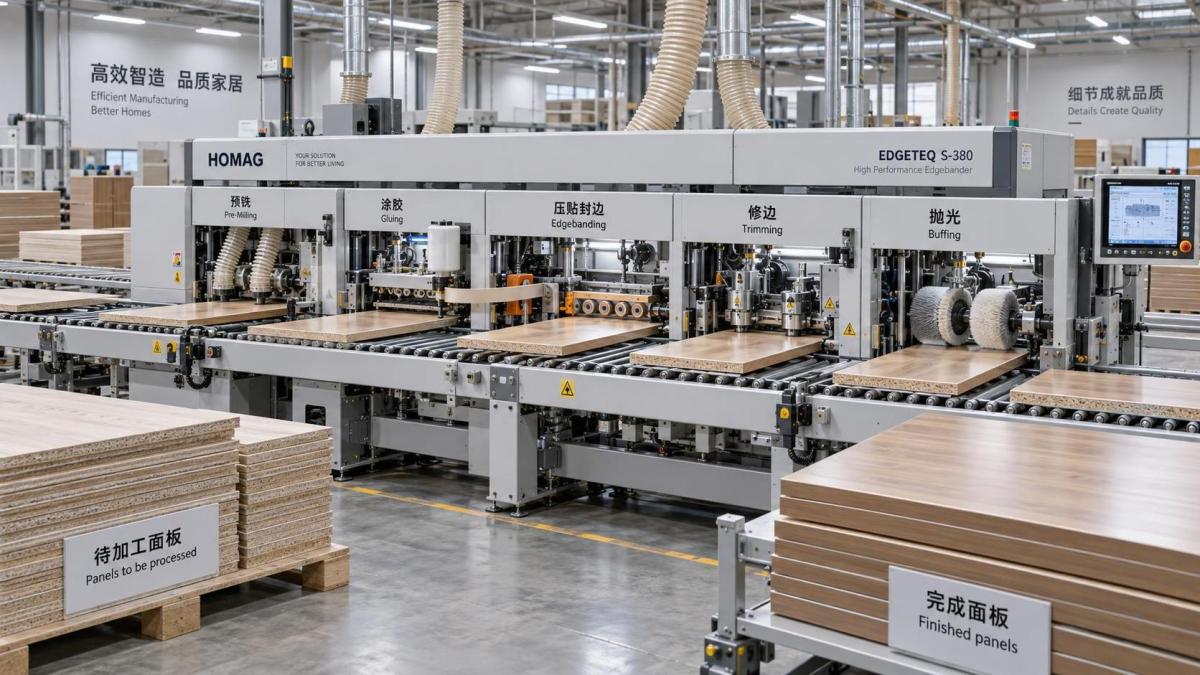
A higher-capacity edge bander is not merely a faster conveyor. Its value often lies in the consistency of the process around the conveyor: panel pre-milling, adhesive application, pressure control, end trimming, top and bottom trimming, corner rounding, scraping, and buffing. The required configuration depends on the board material, edge banding material, product appearance, and quality standard promised to the end customer.
For example, a factory producing visible cabinet fronts may find that imperfect joint lines, chipped corners, adhesive residue, or inconsistent radiusing lead to disproportionate inspection and rework costs. Faster production is not useful if operators must later touch up every batch. Conversely, a plant making internal components with less demanding finish requirements may not need every available processing unit. The right specification should follow the product mix, not an assumption that a more complex configuration is always better.
Buyers should ask suppliers to explain performance boundaries rather than only nominal capabilities. Which panel thicknesses and edge materials are expected in normal production? How do short, narrow, or irregularly shaped parts affect processing? What adjustment is required when changing from one edge material to another? How is adhesive temperature managed, and what cleaning routine is needed? These questions reveal whether the selected solution is designed for the factory’s real work rather than for an ideal demonstration panel.
Automation can reduce variability, but it also raises integration requirements
The most convincing reason to move into industrial capacity is often process stability. Automated positioning, controlled machining units, and repeatable operating settings can reduce dependence on individual operator judgment. That matters where skilled labor is difficult to retain or where different shifts currently produce visibly different results. A more automated machine can make output more predictable, provided the factory maintains it properly and operators understand the setup logic.
However, automation should not be purchased in isolation. A fast line needs organized panel identification, material staging, tape availability, dust extraction, power supply, and an exit strategy for finished parts. If operators must repeatedly stop the machine to find the next batch, clear offcuts, or wait for a trolley, the investment will not reach its planned utilization. In a connected production environment, the availability of compatible software, barcode workflows, return conveyors, or loading solutions may also require evaluation, but only where the expected volume supports that additional complexity.
Floor layout deserves the same attention as the machine specification. Procurement teams should confirm the full footprint, including access for maintenance, adhesive handling, infeed and outfeed space, panel buffering, dust-collection connections, and safe movement around the line. It is much less costly to resolve these issues before shipment than after installation.
Reliability has a direct purchasing value
When one high-output machine becomes a central production point, downtime becomes more expensive. This does not mean a buyer should avoid industrial equipment; it means serviceability must be included in the selection criteria. The availability of wear parts, clarity of maintenance instructions, access to technical support, and the ability to diagnose common issues all influence total cost of ownership.
Procurement should distinguish between routine consumables and parts that may interrupt production if unavailable. Ask which items should be held on site, what preventive-maintenance intervals are recommended, and how remote support is handled for export installations. It is also sensible to clarify commissioning responsibilities, training scope, documentation language, electrical requirements, and the procedure for technical questions after handover.
Qingdao Zhongding Machinery Co., Ltd. has worked in woodworking machinery for more than 20 years, evolving from a small workshop into a manufacturer and exporter serving furniture factories, woodworking workshops, and industrial production lines. For buyers, the relevant point is not the company history alone. It is whether a supplier can discuss the operating conditions behind the specification, provide practical technical support, maintain a sensible spare-parts approach, and remain responsive after the machine is installed. Those capabilities can materially affect the economics of a production asset over time.
Signs that the higher-capacity option is premature
A larger Industrial Edge Bander may be difficult to justify when production is irregular, average utilization is low, and the factory frequently changes between small batches that require substantial setup. The same is true when the current limitation is upstream cutting accuracy, inconsistent board supply, lack of trained staff, or insufficient demand. Purchasing capacity to solve a planning problem can lock capital into equipment that sits idle.
There is also a risk in comparing machines only by feed speed or the number of processing stations. A configuration with unnecessary functions increases initial cost, training needs, maintenance obligations, and fault points. The best procurement decision may be a robust mid-range machine with the essential units for the product range, especially if it can be upgraded later. Capacity should match a credible production plan, not an aspiration unsupported by orders, staffing, and plant readiness.
Make the decision from a production map, not a brochure
Before issuing a final purchase order, map the current route from cut panel to packed product. Record actual output, waiting time, rework causes, changeover patterns, staffing, and points where urgent orders disrupt normal flow. Then share representative panel sizes, board types, edge materials, daily volume, shift arrangements, and finish expectations with shortlisted suppliers. This gives them enough information to propose a configuration that can be assessed on operational grounds.
A higher-output solution earns its place when it removes a proven bottleneck, produces the required finish consistently, fits the plant’s supporting systems, and can be maintained without excessive production risk. If those conditions are present, the purchase is not simply an upgrade in speed. It is a decision to make capacity, quality, and delivery performance more dependable. If they are not, a disciplined buyer should resolve the underlying constraints before paying for output that the factory cannot yet use.
Send Your Inquiry
We welcome your cooperation and we will develop with you.