


A woodworking machine can leave the factory undamaged yet arrive unusable when its crate cannot support concentrated loads or allow stable forklift handling.
For procurement teams, woodworking machine plywood crate packaging deserves careful review because base construction, machine restraint, and fork access directly affect delivery condition.
The central purchasing rule is straightforward: approve packaging against the actual machine, transport route, and unloading equipment, rather than relying on plywood thickness alone.
This guide explains which specifications to request, how to assess supplier proposals, and where packaging decisions can prevent expensive unloading delays or machine damage.
Start with three questions: what is the complete shipping weight, where does that weight enter the crate base, and how will handlers lift it?
A crate that supports a machine on a warehouse floor may behave differently when suspended on forks, especially with an offset center of gravity.
Likewise, a generous load rating offers little reassurance when receiving personnel cannot insert their forks fully or identify the approved lifting direction before unloading.
What Actually Determines a Plywood Crate’s Load Capacity?
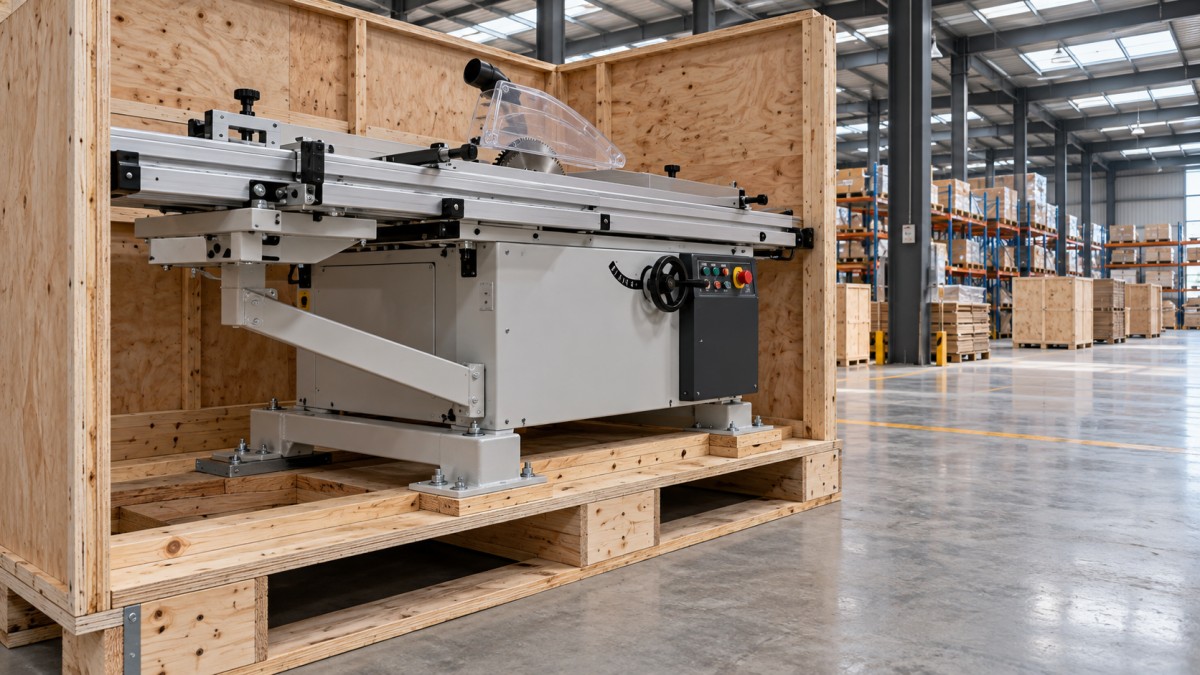
For heavy woodworking machinery, the structural base normally carries the equipment, while plywood panels provide enclosure and contribute only as allowed by the design.
Increasing panel thickness does not automatically increase safe lifting capacity. Runners, crossmembers, joints, fasteners, and their relationship to machine feet require separate assessment.
Ask suppliers to identify the complete gross shipping mass, including the machine, crate, accessories, tooling, protective materials, and any fluids remaining during shipment.
For example, a machine weighing 1,800 kilograms plus 250 kilograms of packaging and accessories creates a 2,050 kilogram shipment before any handling allowance.
That figure establishes the lifted mass; it does not prove the crate is adequate or mean every forklift rated above it can handle the shipment.
Next, examine how the machine distributes its weight. Four small leveling feet can create demanding local loads even when the overall footprint appears generous.
Base members should support those load paths directly, with suitable bearing areas and connections. Unsupported plywood beneath a heavy foot can deform or fail.
Do not assume each foot carries one quarter of the machine weight. Motors, castings, tables, and attached units can shift reactions substantially across supports.
Request the packaging designer’s allowable load and its stated conditions. Clarify whether the assessment covers stationary storage, forklift lifting, transport forces, and any permitted stacking.
There is no universal plywood thickness or safety factor suitable for every machine. Required strength depends on geometry, materials, connections, handling conditions, and applicable requirements.
Will the Crate Fit Your Forklift—and Remain Stable?
Forklift access requires more than visible openings beneath the crate. Procurement teams need entry dimensions, permitted approach directions, and the required fork engagement length.
Confirm clear opening height and width after assembly, accounting for fasteners, braces, and other obstructions. Nominal runner spacing alone does not establish usable clearance.
The openings must accommodate the intended fork thickness, width, and adjustable spacing. Include practical clearance for alignment without allowing forks to strike structural members.
Specify how far forks must enter and which base members they must support. Short engagement can overload the base or leave the load unstable.
A long crate may require longer forks or an approved attachment. Fork extensions do not automatically resolve capacity, engagement, or stability limitations during handling.
Check the forklift’s capacity plate for the actual load center, lift height, and attachment configuration. A nominal truck rating is insufficient for this decision.
As a simplified illustration, a 2,050 kilogram shipment centered 900 millimeters forward produces a greater load moment than the same mass centered 600 millimeters forward.
This comparison explains the concern but does not establish allowable forklift capacity. Obtain the applicable capacity information from the truck manufacturer or authorized provider.
Two-way entry can be practical when the handling route is controlled. Four-way entry offers flexibility, but every permitted direction needs adequate structural support.
Ask for center-of-gravity markings and approved fork-entry labels on accessible faces. An offset center of gravity should influence both packaging design and unloading arrangements.
How Should the Machine Be Anchored Inside the Crate?
A strong crate base cannot protect machinery that moves independently inside it. Anchoring should transfer transport forces through suitable machine mounting points into structural members.
Request details of bolts, brackets, blocking, and connections beneath the base. Fastening a heavy machine only to plywood sheathing usually provides inadequate structural assurance.
Anchoring arrangements should accommodate the expected transport conditions without damaging the machine frame. The machine manufacturer should identify suitable mounting locations and sensitive areas.
Moving assemblies also need attention. Sliding tables, fences, guards, and other projecting components may require dedicated restraints or separate packing according to manufacturer instructions.
Avoid accepting improvised restraints against precision surfaces or unsupported covers. A tight strap can still damage alignment, deform sheet metal, or mark finished components.
Ask suppliers to record how shipping restraints are removed. Clear instructions help installation teams avoid operating machinery with transport brackets or locking devices still fitted.
Which Shipping Conditions Need Separate Packaging Decisions?
Packaging specifications should reflect the actual route. Container transport, terminal transfers, truck delivery, and temporary storage can expose the same shipment to different handling conditions.
Container compatibility includes door clearance and loading access, not simply internal dimensions. A crate may fit inside yet remain difficult to position or extract.
For sea transport, review corrosion protection alongside structural protection. Plywood enclosure alone does not control condensation or protect exposed machined surfaces throughout the journey.
Depending on the route and machine, suitable measures may include protective coatings, sealed barrier materials, and correctly selected desiccants within a defined moisture-control system.
Separate crate anchoring from vehicle or container securing. The machine must be secured inside its packaging, and the packaged unit must be secured for transport.
Clarify stacking permissions explicitly. Unless stacking has been designed and approved, communicate that restriction to logistics providers rather than leaving interpretation to warehouse personnel.
For international shipments, plywood made using glue, heat, or pressure is generally outside ISPM 15 requirements, but solid-wood packaging components may remain regulated.
If runners, blocks, or braces use regulated solid wood, confirm applicable treatment and marking requirements. Check destination rules and current guidance before approving dispatch.
What Should Procurement Put in the Packaging Specification?
A useful specification connects design assumptions with measurable acceptance criteria. It should let purchasing staff, the supplier, and receiving personnel review the same information.
Include the following requirements in the quotation or purchase order, adjusting them to the machine and route rather than copying dimensions from previous shipments.
For repeat purchases, agree on a documented packaging design for each machine configuration. Recheck it when accessories, machine weight, dimensions, or shipping arrangements change.
When evaluating woodworking machine plywood crate packaging, compare quotations against that specification. A lower packaging price may exclude reinforcement, restraints, or protection another supplier includes.
Qingdao Zhongding Machinery Co., Ltd. manufactures and exports woodworking machinery, with more than 20 years of industry experience serving workshops, furniture manufacturers, and industrial producers.
When discussing an order with Zhongding, provide the destination, unloading equipment, and site restrictions early. Request machine-specific packaging details as part of the quotation review.
How Can Buyers Verify Packaging Before Dispatch and at Delivery?
Before closure, request photographs showing machine supports, anchors, base construction, and protected components. Exterior photographs cannot reveal whether critical internal restraints were installed correctly.
Compare those images with the approved drawing and packing list. For higher-risk shipments, consider an agreed inspection or witnessed handling check under controlled conditions.
A successful lift can reveal access or balance problems, but it does not by itself validate resistance to every force encountered during the transport route.
Before arrival, give the receiving team gross weight, crate dimensions, handling instructions, and center-of-gravity information. Confirm suitable equipment and space before booking the unloading slot.
At delivery, inspect for crushed runners, broken panels, leaning, moisture exposure, or shifted contents. Record visible damage promptly before unpacking, following contractual and carrier procedures.
If structural damage or instability is suspected, arrange competent assessment before lifting. Preserve packaging and records when damage may require investigation or a claim.
Choose Packaging You Can Verify
The best purchasing decision comes from matching the crate to the machine’s actual load paths and matching forklift access to the planned handling equipment.
Approve the order when weight, structural support, restraint, fork engagement, and receiving arrangements are documented. Resolve missing information before dispatch, while corrective work remains practical.
For procurement teams, that discipline makes packaging quality measurable and helps protect delivery schedules, installation readiness, and the value of the woodworking machinery investment.