


News & Exhibitions
Latest Factory Updates, Industry Trends & Global Exhibition Information
How to assess a woodworking machinery packing supplier's crating
A woodworking machine can leave the factory correctly aligned and arrive with bent guards, corroded tables, or damaged controls because its packaging failed during handling. To assess a woodworking machinery packing supplier, look beyond the crate walls: verify the load-bearing base, machine restraints, lifting arrangements, moisture protection, and export-packaging compliance before approving shipment.
The strongest evidence is a machine-specific packing drawing supported by material specifications and inspection records. A photograph of a closed wooden box proves very little. Ask the supplier to show how the machine’s weight reaches the skid, how movement is prevented, and how vulnerable components remain protected throughout the agreed transport route. Those details determine whether a cheaper packing quotation represents a saving or an avoidable production delay.
Start with the shipping conditions, not the timber thickness
Crating cannot be assessed properly without knowing what it must withstand. A CNC router with an extended gantry presents different risks from a compact thickness planer. Long sliding tables, protruding control cabinets, and top-heavy assemblies can change the packing arrangement even when the total machine weight is similar.
Give each bidder the same information so that quotations are comparable:
- Machine details: model, packed configuration, weight, dimensions, center of gravity where available, and manufacturer-approved support and anchoring points.
- Transport route: containerized sea freight, air freight, road transport, consolidation, and expected transfers between handling facilities.
- Storage conditions: anticipated transit duration, warehouse exposure, and whether temporary outdoor storage is possible.
- Handling limits: available forklift capacity, fork dimensions, crane access, doorway clearances, and unloading restrictions at the destination.
- Protection priorities: machined surfaces, electrical equipment, precision guides, removable accessories, and parts requiring transport locks.
Ask the supplier to identify missing information rather than quietly assume it. An unknown center of gravity or an unconfirmed unloading method should become a clarification item, not a guess hidden inside the quotation.
Inspect the load path beneath the machine
The base carries the machine; the side panels mainly enclose and protect it unless the crate has been specifically engineered otherwise. Thick plywood walls cannot compensate for weak runners or unsupported machine feet. Request a drawing showing support locations, crossmembers, skid runners, joints, and the connection between the machine and the base.
Support must match the machine frame
Each support should transfer load through a suitable part of the machine structure. Placing blocking beneath sheet-metal covers, dust outlets, leveling screws, or unsupported extensions can cause damage before transport begins. Where leveling feet are removed or retracted, the replacement support arrangement should be confirmed with the machine manufacturer.
Look for concentrated loads. A heavy machine standing on a few small contact points may require local reinforcement rather than simply a thicker deck. Ask how the base design accounts for the packed weight and expected handling loads, and request engineering review where the equipment is heavy, unusually shaped, or difficult to support.
Restraints must prevent movement without distorting the frame
Machine anchoring and crate bracing perform different jobs. Bolts, brackets, and suitable blocking restrain the machine; braces stabilize the crate. Strapping across a painted cover is not an acceptable substitute for a defined anchoring arrangement.
Request details of fastener locations, bearing plates or washers, blocking contact surfaces, and tightening instructions where relevant. Restraints should control sliding and overturning without bending the frame or loading precision assemblies. Axes, gantries, sliding tables, and other moving parts need manufacturer-approved transport restraints, not improvised pressure against sensitive components.
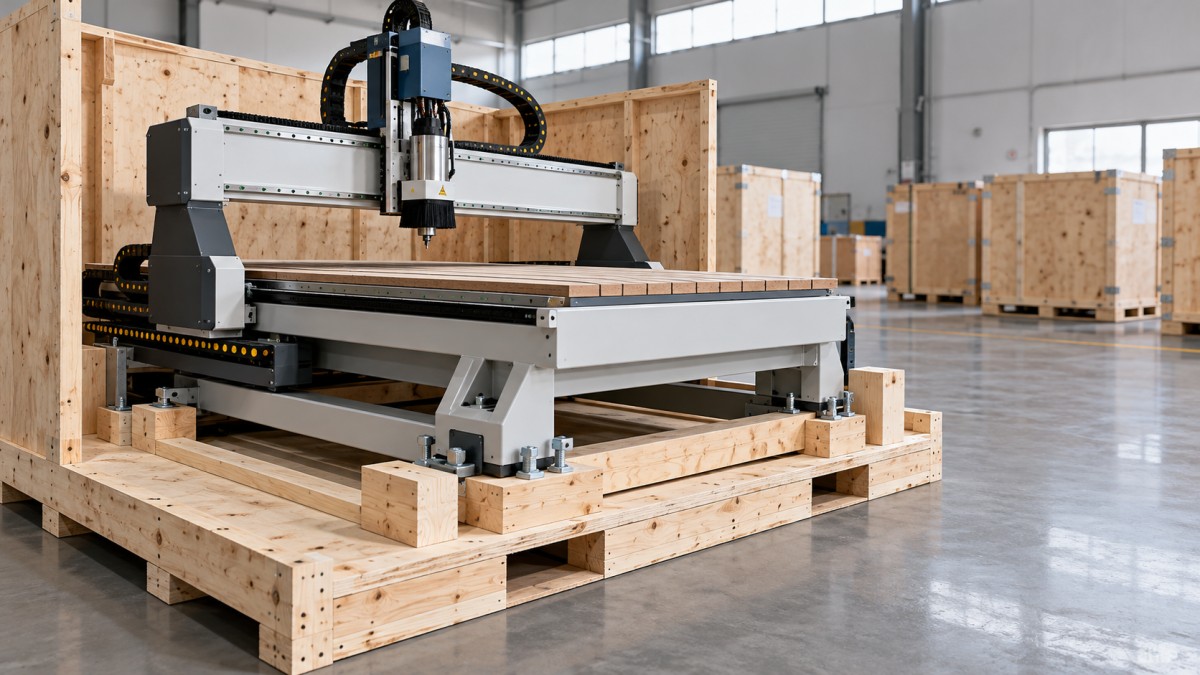
A useful inspection photograph shows the uncovered machine on its completed base, with anchoring points and blocking visible. Once the walls are fitted, those details become difficult to verify without reopening the crate.
Check whether the crate can actually be handled as marked
A “forklift here” symbol does not establish that a crate is safe to lift. The fork-entry arrangement must match the lifting equipment, provide adequate engagement, and avoid interference with the machine or anchoring hardware. For long or offset loads, the supplier should explain the permitted lifting direction and balance requirements.
Crane handling needs a defined method too. Confirm whether lifting is through engineered crate lifting points, beneath designated base members, or by another approved arrangement. Sling pressure can crush walls or press them against projecting machine parts. Any required spreader arrangement or restricted sling path should appear in the handling instructions.
Crate anchoring also differs from securing the packed unit inside a container or vehicle. Establish who provides that blocking and lashing, which attachment points may be used, and who records the completed arrangement. A sound crate can still shift if the freight unit is inadequately secured.
Demand a moisture-protection method, not just “waterproof packing”
Sea transport and temperature changes can expose machinery to condensation even when rain never reaches it. Wood and other packing materials may also introduce moisture. A supplier should distinguish weather shielding from corrosion protection and explain the purpose of each packaging layer.
For exposed cast-iron tables, guideways, shafts, and other vulnerable metal surfaces, ask which preservative will be applied and how it is removed before commissioning. Compatibility matters: an unsuitable product can affect belts, seals, coatings, or electrical components. Protection instructions should follow the machine manufacturer’s requirements.
A sealed moisture-barrier system needs more than a loose plastic cover. Ask about barrier material, seam closure, puncture protection, and how anchors or projections are accommodated. Desiccant selection should reflect the enclosed volume, barrier performance, packing materials, and expected exposure period; an unexplained handful of sachets is not a documented method.
Ventilated packaging and sealed barrier packaging use different moisture-control strategies. Neither is automatically correct for every shipment. Request a clear rationale, including whether timber and cushioning are dry before enclosure. Moisture indicators can support inspection, but they do not replace proper preparation and sealing.
Separate export compliance from protective performance
Compliant timber does not prove that a crate can support a machine. Equally, a structurally strong crate may face border problems if its wood packaging does not meet applicable destination requirements. Review these as separate approval items.
For international shipments using regulated solid-wood packaging, confirm the applicable ISPM 15 requirements with the supplier and relevant import guidance. Ask how treatment and marking compliance will be demonstrated for the actual crate, including solid-wood blocking and dunnage. Processed wood products may be treated differently, so avoid accepting a blanket claim that every wooden component either requires treatment or is automatically exempt.
Check that required marks remain visible and that repairs or replacement components do not undermine compliance. A treatment document, where provided, should relate to the packaging concerned; it should not be treated as a substitute for required markings. Destination-specific requirements should be checked before packing is finalized.
Compare the full packing scope before comparing prices
A low quotation often excludes work that another supplier has included. Break the price into defined deliverables rather than comparing a single “export crate” line. The objective is not to buy the heaviest crate, but to pay for protection matched to the machine and route.
Request separate confirmation of base construction, enclosure, anchoring, transport locks, corrosion protection, accessory packing, markings, inspection photographs, and container securing where applicable. Include dismantling and reassembly instructions if parts must be removed to reduce shipping dimensions.
Then examine the freight consequences. Larger external dimensions can increase transport and handling costs. Removing a projecting assembly may reduce packed size but add reinstallation, alignment, and commissioning work. An open-sided crate may suit some controlled routes yet leave sensitive equipment exposed during consolidation or storage.
Use the same packed dimensions, gross weight, handling assumptions, and protection scope when comparing offers. Ask bidders to explain exclusions and proposed savings explicitly. A lighter design is credible when supported by a clear load path and suitable materials; “we always pack this way” is not equivalent evidence.
Make inspection a release condition
Approve the packing concept before fabrication, then verify the completed work before dispatch. Otherwise, photographs may arrive only after the container has been sealed, when correcting an omitted anchor or damaged barrier becomes expensive.
- Review the design: confirm the packed configuration, base drawing, restraint method, lifting instructions, moisture protection, and compliance responsibilities.
- Inspect before closure: obtain identifiable photographs of supports, anchors, transport locks, protected surfaces, and separately secured accessories.
- Verify the completed crate: check external dimensions, gross weight, markings, fork openings, and visible workmanship against approved documents.
- Record loading where included: retain photographs of crate condition and the completed container or vehicle securing arrangement.
Photographs should identify the shipment and show enough context to locate each detail. Close-ups alone can conceal missing supports elsewhere. For valuable, heavy, or unfamiliar equipment, a physical inspection may be justified, especially when critical features cannot be verified remotely. Any trial handling should follow an approved lifting method rather than improvisation.
Put correction and approval responsibilities into the purchase order. State who may authorize material substitutions, what happens when the packed dimensions change, and which defects prevent release. Missing anchors, unsupported load-bearing points, damaged barriers, or unresolved lifting arrangements should trigger correction before shipment.
Also agree how the receiver will open the crate. Provide an accessible packing list, an opening sequence, and instructions for removing restraints and preservatives. Hidden fasteners and unsecured accessories can create damage during unpacking even after a successful journey.
Choose the supplier whose evidence matches the proposed construction and whose responsibilities are explicit. If two quotations remain close, resolve the highest-consequence uncertainty first—such as unsupported machine feet, undocumented stacking capability, or an unverified moisture barrier—rather than negotiating a discount on an incomplete specification.
Send Your Inquiry
We welcome your cooperation and we will develop with you.