


News & Exhibitions
Latest Factory Updates, Industry Trends & Global Exhibition Information
ATC CNC Router Selection: Matching Spindle Power and Tool Capacity to the Job
Selecting an ATC CNC router machine starts with two linked decisions: whether the spindle can sustain the required cuts at the intended operating speed, and whether the tool magazine can hold the tools needed for an uninterrupted production run. A higher power rating or a larger magazine earns its place only when it removes a production constraint.
For technical evaluators, a useful starting position is to size the spindle around demanding, recurring operations and size tool capacity around the longest production sequence that should run without intervention. Occasional heavy cuts may justify a separate machining strategy. Frequently repeated tool changes, however, deserve close attention because their time accumulates across every batch.
Define the production job before comparing machine specifications
A description such as “furniture production” leaves too much unresolved. Cutting nested cabinet components from laminated panels places different demands on a router than machining deep pockets in hardwood or producing shaped furniture parts with several profiles. Even within one material category, cutter diameter, engagement, finish requirements, and workholding can change the required machine capability.
Build a representative job set that includes normal production, the most demanding recurring operation, and a realistic mixed batch. For each job, record material and thickness, cutter type and diameter, cutting depth and width, intended feed rate, spindle speed, finish requirements, and expected batch size. Include drilling, engraving, profiling, and secondary operations wherever they affect the tooling sequence.
Separate requirements that must be achieved in one pass from those that can tolerate multiple passes. A full-depth cut may reduce machining time, but only if the cutter, spindle, machine structure, extraction, and workholding can support it. If small nested parts move before the spindle reaches its useful cutting capacity, additional power will provide little benefit for that operation.
The resulting job set gives suppliers a concrete basis for proposing a configuration. It also prevents a selection exercise from drifting toward whichever specification looks strongest on a quotation.
Read spindle power together with speed, torque, and duty
The spindle’s advertised power is only part of its capability. Obtain the power and torque curves, the rated operating range, and the conditions attached to the rating. Establish whether the quoted figure represents continuous output or a temporary overload capability, and how cooling and the drive configuration affect sustained operation.
Torque matters because cutters encounter resistance at the spindle shaft. For a given mechanical power, available torque decreases as rotational speed increases. The relationship can be expressed as torque in newton-metres approximately equal to 9,550 multiplied by power in kilowatts, divided by speed in revolutions per minute. This relationship helps interpret a specification, but it does not establish what a particular spindle can deliver across its entire speed range.
A spindle that reaches its rated power at high speed may provide less useful output at the lower speed required by a larger cutter. Compare the intended cutting speed with the manufacturer’s operating curves. Also verify permitted tool diameter, tool mass, balance requirements, and any speed restrictions associated with the toolholder and cutter assembly.
Material names alone cannot determine the correct power rating. Deep hardwood pocketing, broad surfacing cuts, and heavy edge profiling can create substantial loads. Panel nesting with smaller cutters may require higher rotational speed and sustained feed, while a fine finishing pass can demand relatively little power but expose runout or vibration. Evaluate the operation and its engagement conditions.
Keep feed rate, chip load, and available power connected
Feed rate should follow the cutter’s intended chip load and cutting conditions. As a starting relationship, feed rate equals spindle speed multiplied by the number of cutting edges and chip load per tooth. The tooling supplier’s recommendations must then be considered alongside material, tool geometry, engagement, rigidity, and chip evacuation.
Reducing feed whenever spindle load rises can create another problem: the cutter may spend more time rubbing, generating heat and degrading the edge or finish. An appropriate adjustment may involve reducing cutting depth or radial engagement, changing the toolpath, or selecting a different cutter. The spindle needs enough capacity to support a workable cutting strategy.
Conversely, additional power cannot force a machine to achieve its programmed feed through tight corners or short features. Acceleration, control settings, and geometry may keep actual cutting speed below the requested value. When comparing machines, assess completed cycle time and part quality alongside spindle loading.
Allow operating reserve for predictable variation such as cutter wear, changes in material, and longer periods of sustained engagement. That reserve should follow the expected workload and the spindle’s continuous capability. An unexplained percentage added to an already uncertain estimate offers little assurance.
Count the tools required to keep production moving
Magazine capacity should come from a tooling schedule for the intended production window. Count the tools needed between planned operator interventions, including changes between different parts. A machine may have enough positions for every individual program and still require repeated manual loading when those programs run as a mixed batch.
List each distinct tool assembly by function, diameter, geometry, cutting length, and holder requirement. Two cutters with the same diameter may serve different purposes: a compression cutter for panel edges and a finishing cutter for a specific profile are separate requirements. Group tools only where one assembly can satisfy both operations without unacceptable compromises.
A practical capacity assessment includes:
- Core production tools: assemblies needed for the recurring cutting, drilling, pocketing, and profiling sequence.
- Material-specific tools: cutters needed when the production window includes different substrates or finish requirements.
- Duplicate tools: replacements intended to support continued production after a defined wear limit or tool-life event.
- Setup and maintenance tools: assemblies such as a spoilboard surfacing cutter, where keeping them loaded provides a useful operational benefit.
Duplicate tools require more than spare positions. The control and production process must support tool-life tracking, sister-tool selection, or another defined replacement procedure. Establish how the replacement receives its offsets and how the machine determines that it is suitable to continue the job.
Nominal magazine capacity can also differ from usable capacity. Large-diameter tools may require adjacent positions to remain empty. Tool length, weight, pocket clearance, and changer limits can restrict which assemblies fit and how they can be arranged. Ask for confirmation using the actual proposed tooling list.
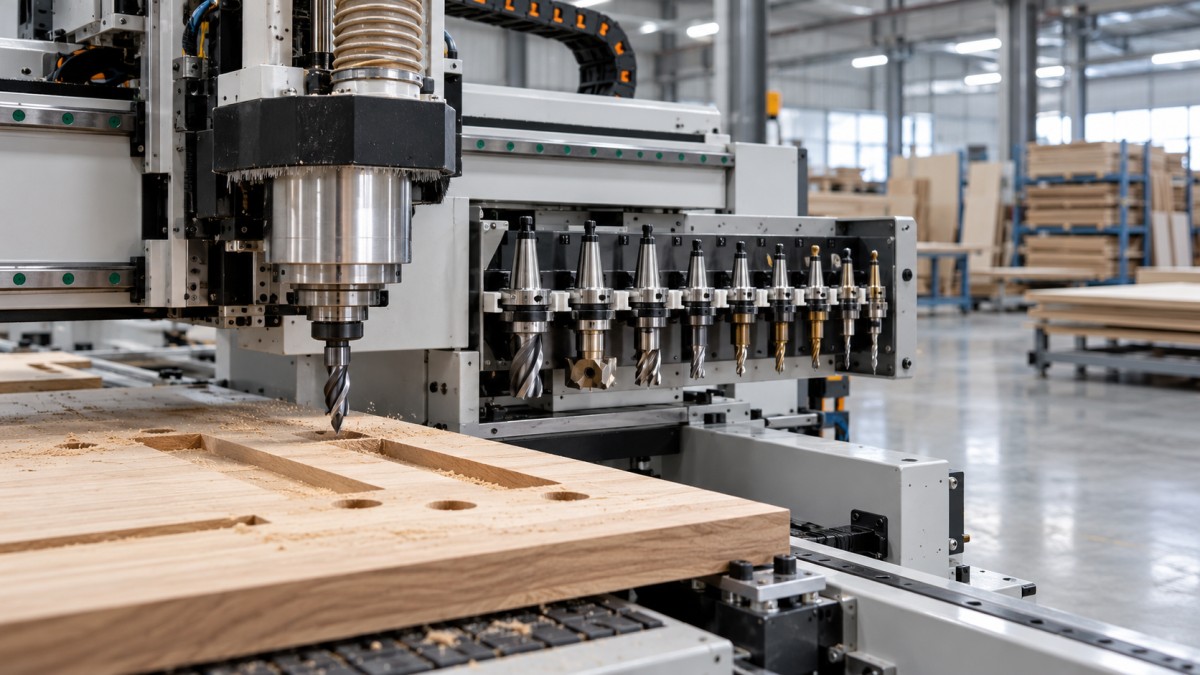
Leave room for credible changes in the product mix, especially where new profiles or drilling requirements are already anticipated. Avoid sizing around an undefined future in which every possible tool must stay loaded. Extra positions have value when they remove identifiable setup work or support a planned process.
Evaluate the changer through the complete machining cycle
Tool capacity and tool-change speed solve different problems. Capacity determines which sequences can run without reloading. Change time affects the duration of those sequences. A larger magazine can reduce manual intervention while offering little cycle-time improvement if the job uses few tools.
Compare complete tool-change events under the proposed program. Include travel to the change location, spindle deceleration, exchange, acceleration, any required tool measurement, and travel back to the work. A quoted mechanical exchange time may cover only part of this interval.
Magazine layout matters through its effect on movement and accessibility. A fixed rack may introduce travel that varies with the cutting position. A magazine carried with a moving assembly may shorten some movements while adding moving mass and mechanical complexity. Assess either arrangement within the machine’s complete performance and maintenance requirements.
For short machining cycles with many operations, these differences can materially affect output. During long roughing passes, spindle capability and cutting strategy may dominate. Use the expected number and sequence of changes per part or batch to judge their importance.
Check how CAM software and the controller manage operation order. Grouping operations by tool can reduce changes, but machining sequence may be constrained by part stability, reference surfaces, or the need to retain material around small components. A fast simulated sequence has limited value if it undermines reliable workholding.
Match the configuration to the production pattern
In repeat cabinet nesting, the loaded tool set may remain relatively stable. Give priority to sustained cutting performance, reliable edge quality, drilling requirements, and enough positions for the working set plus justified replacements. Verify whether the proposed drilling arrangement requires spindle-held tools or uses a separate drilling unit, since this changes both magazine demand and cycle time.
Mixed custom furniture work places greater value on tool variety and convenient setup. Different profiles, pocket depths, and materials can make magazine capacity more useful than an increase in spindle power. The power requirement still needs to cover recurring solid-wood operations, particularly where larger cutters operate within a restricted speed range.
For deep machining or heavy material removal, investigate torque, tool overhang, holder suitability, and machine rigidity together. A powerful spindle on a system that cannot control vibration may fail to deliver the intended finish or removal rate. Longer tools can become the limiting element even when motor capacity remains available.
These patterns are starting points for evaluation. A useful specification should explain which production constraint each selected feature addresses and what evidence supports the choice.
Make the acceptance trial answer the purchasing question
A representative cutting trial should demonstrate the proposed spindle, tooling, magazine arrangement, and program working together. Use relevant material, thickness, tool engagement, and workholding. A light demonstration cut cannot establish performance for sustained production, while a single demanding pass says little about a mixed batch requiring repeated changes.
Agree on acceptance criteria before the trial. These should cover completed cycle time, dimensional requirements, edge and surface quality, tool-change reliability, and the number of operator interventions. Observe spindle loading and thermal behavior over a meaningful production sequence, using the machine manufacturer’s permitted operating limits as the reference.
Record any adjustments needed to achieve the result. Reduced depth per pass, a different cutter, additional finishing operations, or manual tool replacement may all be reasonable process choices, but they change the production calculation. Evaluate the resulting process as it will actually run.
Finally, compare the cost of configurations against the constraints demonstrated in that process. Additional spindle power is justified when it supports a required cutting load and improves usable output. Additional magazine positions are justified when they remove recurring reloads, accommodate necessary tool variety, or enable a defined replacement strategy. The specification becomes defensible when the supplier can show the representative job meeting its quality and output targets with the proposed tools loaded and the intended level of operator attendance.
Send Your Inquiry
We welcome your cooperation and we will develop with you.