


News & Exhibitions
Latest Factory Updates, Industry Trends & Global Exhibition Information
What Should a Woodworking Machine Export Packaging Quote Include?
A low packaging price can become expensive when a woodworking machine arrives with corroded tables, damaged controls, or a crate that cannot be unloaded safely. Before approving a woodworking machine export packaging service quote, require a defined scope: machine preparation, crate or skid construction, moisture and corrosion protection, applicable wood-packaging compliance, loading and securing, documentation, and clearly stated exclusions.
The practical test is whether another supplier could price the same specification without guessing. A line reading “export wooden packing” is not enough. The quote should identify what will be protected, how the package will be built and handled, who performs each operation, and which charges remain outside the quoted amount.
Start with the machine configuration and shipping conditions
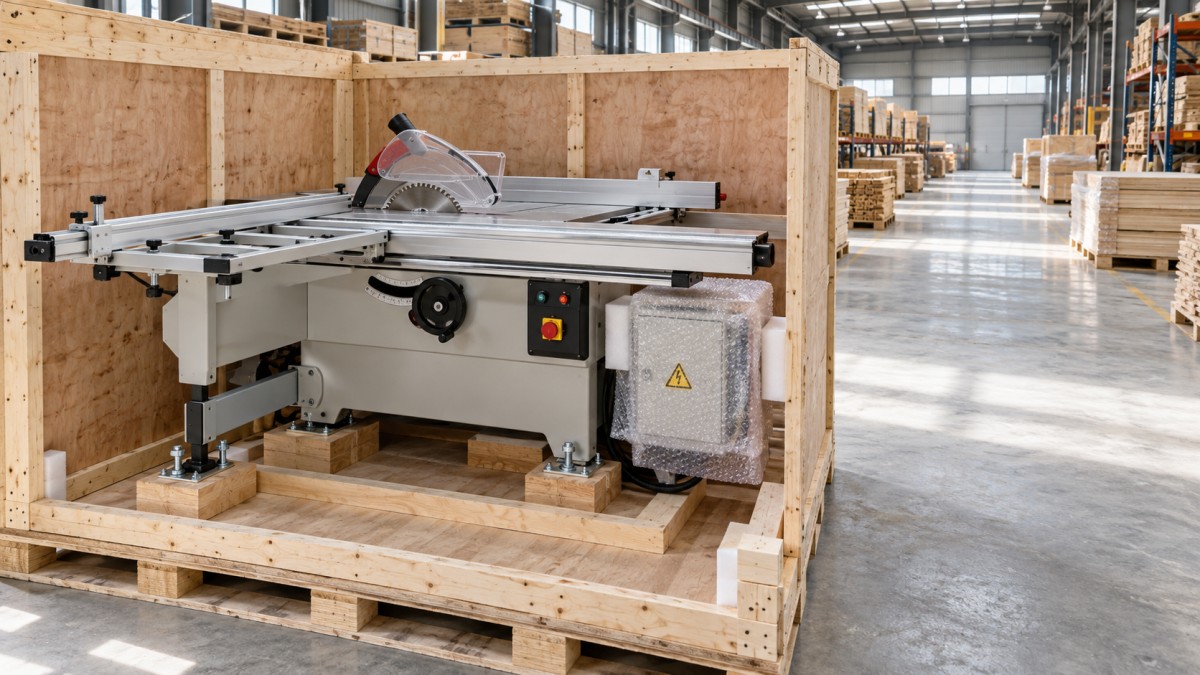
Packaging costs depend on the equipment actually being shipped, not just its model name. A panel saw with an extended sliding table, for example, presents different packing requirements from the same machine with that assembly removed. Separate packages may reduce overall dimensions, but they also introduce dismantling, identification, and reassembly work.
Ask the supplier to base its quote on an agreed packing schedule containing:
- Machine model, quantity, configuration, and included accessories.
- Machine dimensions and weight, with preliminary packed dimensions and gross weight for each package.
- Components to be removed, shipped separately, or secured in their operating positions.
- Transport mode, expected transfers, destination, and any anticipated outdoor storage.
- Loading and unloading methods, including forklift or crane access requirements.
Mark preliminary figures as estimates and request final measurements before freight booking. Changes in packed height or width can affect container suitability, handling arrangements, and freight cost. Where the packaging design is not yet final, the quote should explain when dimensions become firm and what changes could trigger repricing.
Specify protection from the machine outward
A strong outer crate does not compensate for unsupported components inside it. The quote should describe machine preparation and internal restraint before it describes the enclosure.
Preparation, dismantling, and restraint
Confirm whether cleaning, drying, accessory removal, and transport locking are included. Exposed cast-iron tables, guideways, shafts, and other corrosion-sensitive surfaces need treatment appropriate to their materials and the journey. Loose tools, guards, manuals, and spare parts should be identified and packed so they cannot strike the machine.
For CNC routers, sliding-table saws, edge banders, and similar equipment, ask which moving assemblies require approved transport restraints. Loads should be transferred through suitable structural points rather than control cabinets, covers, precision rails, or protruding fittings. Any dismantling should follow the machine manufacturer’s instructions and identify the reassembly work required at destination.
Where parts are removed, the price should include labeling, hardware retention, and a packing list that connects each item to its machine. Clarify whether recommissioning or alignment assistance is excluded; packing labor does not automatically include installation support.
Base, crate, and internal supports
The quotation should distinguish an open skid, a partially enclosed frame, and a fully enclosed crate. These are different scopes, even when all three are described as export packaging.
Request the proposed base construction, enclosure material, internal blocking, fixing method, and relevant load assumptions. A heavy machine needs a base and connection arrangement suited to its weight distribution and handling route. Panel thickness alone cannot establish packaging strength: base members, joints, bracing, and the way the machine is attached also matter.
Stackability must be explicit. If stacking is permitted, require the allowable loading conditions and supporting design basis. Otherwise, the package should be treated and marked as non-stackable, with the resulting freight implications considered before booking.
Make moisture and corrosion protection a separate line item
“Waterproof packing” is too vague to compare. Rain exposure, humid air, and condensation inside a package are different risks. A plastic cover may shed splashes while offering little control over trapped moisture.
A useful quote identifies the protection system rather than promising a dry arrival. Depending on the route and equipment, this may include surface corrosion protection, a sealed moisture-barrier bag, compatible vapor corrosion inhibitor materials, desiccant, humidity indicators, and protection for electrical cabinets. The supplier should explain the selected combination and its intended storage and transport conditions.
Ask how desiccant quantity will be determined, how the barrier will be sealed, and whether sharp edges will receive padding to prevent punctures. Packing a damp machine inside a sealed barrier can trap moisture; preparation and sealing conditions therefore belong in the work scope.
Also establish the protection period and its limits. A specification intended for normal transit should not be assumed suitable for indefinite outdoor storage after arrival. If destination storage is uncertain, obtain a separate option and instructions covering inspection, barrier opening, and any subsequent repacking.
Clarify wood-packaging compliance without paying for vague certificates
ISPM 15 requirements generally concern regulated raw-wood packaging used in international trade, including relevant solid-wood crates, skids, blocking, and dunnage. Processed wood materials such as plywood are generally exempt, but a plywood enclosure can still contain regulated solid-wood base members.
The quote should identify which components require treatment and marking, the applicable treatment arrangement, and who is responsible for ensuring compliance. Do not accept “plywood crate” as confirmation that every wooden component is exempt.
For regulated wood, confirm that compliant material and the required IPPC marks are included. An invoice statement or a generic treatment certificate is not a substitute for required marks on the packaging. If additional treatment records or destination-specific documents are requested, specify them separately and verify the requirement with the relevant authorities or customs representative.
Have the supplier distinguish packaging compliance from machinery import requirements. A correctly marked crate does not establish that the machine itself satisfies destination electrical, safety, or import rules.
Separate packing work from loading and freight responsibilities
A machine may be securely bolted inside its crate while the crate itself remains inadequately restrained in the container. Internal securing and container securing are separate tasks, and the quote should assign both.
Ask for package lifting points, forklift entry positions, center-of-gravity markings where relevant, and handling restrictions. These details must reflect the actual packed load. A lifting symbol painted on a crate is not evidence that the crate is designed for slinging.
The commercial delivery term should include the named place and applicable Incoterms version. However, an Incoterm does not replace a detailed packaging specification or task allocation. Identify the party responsible for loading, securing, and recording package condition at each relevant handover.
Require evidence that can be checked before dispatch
Once the crate is closed, important details become difficult to inspect. Include a staged photographic record in the quotation, especially for high-value machinery or shipments with multiple packages.
Useful photographs show the machine before wrapping, protected surfaces, transport restraints, attachment to the base, separately packed accessories, the barrier before closure, and the completed package. Where container loading is included, request photographs of positioning and securing before the doors are closed.
The documentation package should contain a package-numbered packing list, final dimensions, net and gross weights, handling instructions, and relevant wood-treatment information. Serial numbers should link machines to their packages where applicable. Sensitive unpacking steps, such as removing transport locks before operating an axis, should be clearly identified.
Agree on the inspection hold point: who reviews the evidence, how long approval may take, and whether the supplier can close or dispatch the packages before release. If an independent packing inspection is required, price the access and coordination separately rather than assuming they are included.
Compare the total scope, not just the packaging subtotal
Request an itemized commercial breakdown that makes differences visible. This need not expose every nail or labor hour, but it should separate the main cost drivers: machine preparation, base and enclosure, preservation materials, regulated wood treatment where applicable, loading, container securing, and documentation or inspection services.
Additional charges should have a stated basis. Oversized dimensions, changes in machine configuration, storage beyond the agreed period, rehandling, and repacking after an inspection can affect cost. The quote should state its currency, validity, taxes where applicable, payment terms, lead time, and the approval process for variations.
Compare packaging cost alongside its effect on freight. A compact arrangement may reduce shipping volume but require more dismantling and destination labor. A larger crate may preserve alignment or simplify unloading, yet increase transport cost. Ask suppliers to explain such trade-offs against the same machine configuration and delivery requirements.
Do not treat cargo insurance as an automatic inclusion. Where insurance is offered, request the coverage terms, exclusions, deductible, claim procedure, and party arranging it. Packaging responsibility and insurance coverage are separate issues; one does not remove the need to define the other.
Turn unclear wording into approval conditions
Before placing the order, return unresolved items as specific questions rather than accepting “standard export packing.” For example: Does the price include a sealed barrier or only stretch film? Are solid-wood supports treated and marked where required? Who secures the crates inside the container? Are final packed dimensions subject to a price adjustment?
Record the answers in the revised quotation or an attached packing specification referenced by the purchase order. Define how packaging nonconformities will be reported, who must authorize corrective work, and which condition records must be preserved if damage is discovered.
Approve the packaging price only when its remaining assumptions are visible. If the route, storage duration, or unloading method is still unknown, request a clearly bounded base scope and separately priced alternatives. That keeps an unresolved transport decision from becoming an unpriced packaging obligation after the machine is ready to ship.
Send Your Inquiry
We welcome your cooperation and we will develop with you.