


News & Exhibitions
Latest Factory Updates, Industry Trends & Global Exhibition Information
Who Handles What When Shipping Woodworking Machinery? A Handover Checklist
Who Handles What When Shipping Woodworking Machinery? A Handover Checklist
When woodworking machinery crosses borders, unclear handovers can turn a planned installation into costly downtime. Who confirms packing requirements, checks shipping documents, coordinates customs clearance, and arranges unloading at your site? A reliable woodworking machinery shipment support service starts with clearly assigned responsibilities—not just a departure date.
The difficult gaps usually sit between companies. The forwarder books transport using preliminary dimensions. The receiving team assumes a forklift will be available. The manufacturer packs an accessory separately, but nobody tells the installer where it is. Each party may complete its own task while the overall handover still fails.
Before approving dispatch, build one shared record covering contractual obligations, physical handling, documents, and site readiness. The aim is simple: every critical task needs an owner, a deadline, and evidence that it is complete.
Start with the delivery term—but do not stop there
“Shipping included” is not a usable scope of work. The sales contract should identify the agreed Incoterms rule, its version, and the named place or port precisely. Delivery to a destination port is very different from delivery to a factory receiving bay.
Incoterms allocate specified delivery obligations, costs, and risks. They do not replace agreements about installation, commissioning, payment, ownership transfer, or technical acceptance. Also, the party paying the freight is not necessarily the party bearing transit risk throughout the journey.
Two distinctions deserve particular attention:
- EXW versus FCA at the seller’s premises: under EXW, the seller generally makes the goods available without loading the collecting vehicle or undertaking export clearance. Under FCA at the seller’s premises, the seller loads the buyer-arranged vehicle and handles export clearance. Check the actual contract before assigning either task.
- DAP versus DPU: DAP delivery is ready for unloading; DPU delivery includes unloading at the named destination. Neither should be treated as a promise to position, level, connect, or commission the machine.
For containerized machinery, discuss whether FCA better matches the intended handover than a casually specified FOB term. If DDP is proposed, confirm that the seller can lawfully and practically arrange import clearance in the destination country. These decisions need agreement before booking, not clarification after arrival.
Assign owners at the points where the shipment changes hands
The following checklist is a coordination baseline, not a substitute for the sales contract. One company may perform several roles, but each handover still needs an identified contact.
The buyer’s project manager should maintain the master record even when transport is seller-arranged. That does not transfer contractual liability to the buyer; it keeps dependencies visible. A missed delivery appointment can affect riggers, electricians, installers, and production schedules at once.
Freeze the packing and handling data before booking
An unpacked machine footprint is not a shipping dimension. Crates, skids, protective structures, and detached assemblies change the transport envelope. The forwarder needs final package-level measurements and weights, not a catalogue specification.
Woodworking machines also have components that should not carry lifting or securing loads. Depending on the model, these may include sliding tables, feed assemblies, guards, control consoles, and projecting rails. The manufacturer should identify approved lifting points, forklift access, transport restraints, and any relevant centre-of-gravity information. The handling contractor must then select a suitable method and equipment.
For example, a forklift may have adequate nominal capacity yet be unsuitable at the required load centre. Likewise, a machine that fits through the receiving door may not turn safely inside the building. These are handling-plan questions, not problems to leave for the delivery driver.
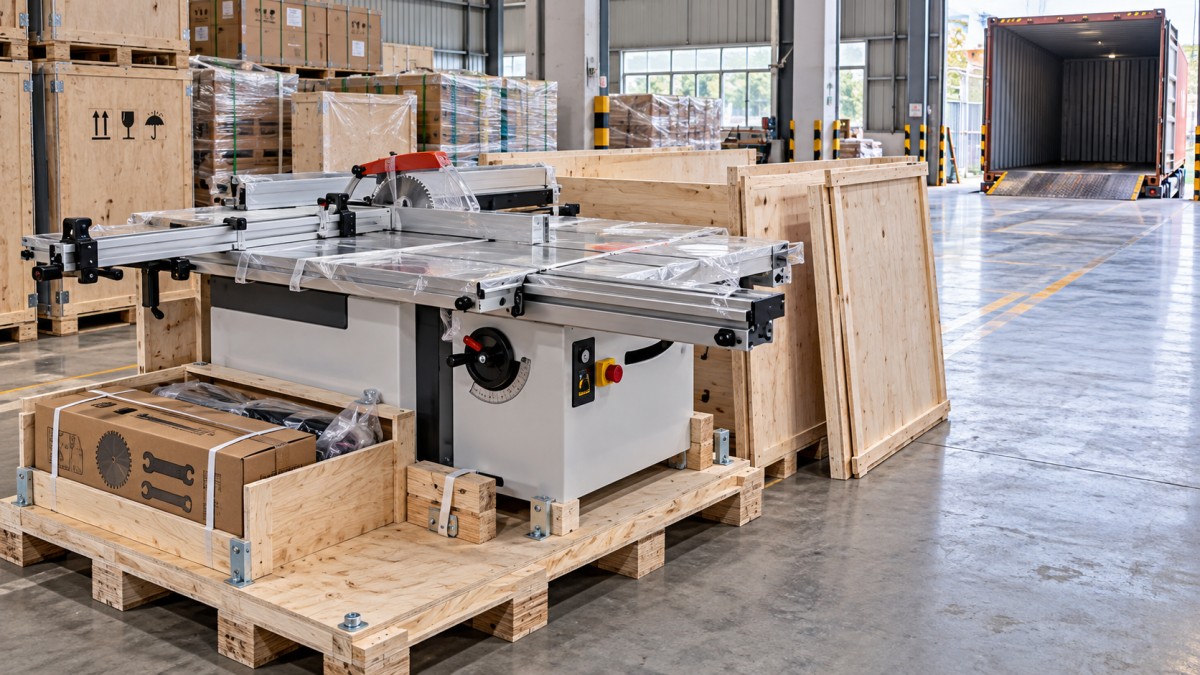
Agree how corrosion-sensitive surfaces, electrical cabinets, and loose components will be protected for the expected route and storage period. A longer journey or delayed installation may require a different preservation approach. Where regulated solid-wood packaging is used, confirm applicable ISPM 15 treatment and marking requirements with the relevant parties; do not assume every wooden packaging material is treated identically.
Request photographs before closure and after securing. Package labels should connect each crate to the packing list, while detached accessories should have identifiable locations. “Included somewhere in the container” is not sufficient for installation planning.
Check documents while errors are still easy to correct
Document checking works best before cargo collection. The manufacturer normally supplies machine descriptions and commercial information; the forwarder prepares or coordinates transport documents; the importer and broker verify destination clearance requirements. Exact responsibilities depend on the contract and local arrangements.
Cross-check the commercial invoice, packing list, and draft transport document for consistent party names, package counts, weights, and descriptions. Include model and serial identifiers where appropriate. Do not casually describe a multi-package machine as several complete machines, or combine unrelated accessories under an unclear description.
Tariff classification deserves a separate conversation. A supplier’s suggested HS code can support the review, but destination classification and any national extensions should be confirmed by the importer with qualified advice where needed. Import conformity requirements must also be checked for the particular machine and destination; a certificate used in one market is not automatic permission for another.
The project file should identify who supplies any required origin documents, who authorizes cargo release, and who monitors clearance progress. If cargo insurance is arranged, record the insured transit scope, coverage terms, exclusions, and claims contact. Do not assume a carrier’s liability provides equivalent protection.
Treat site delivery as an engineering activity
“The truck can reach our factory” is only the beginning. The receiving lead should verify the vehicle approach, gate restrictions, unloading area, overhead clearance, floor condition, and route to the machine’s intended position. Check whether the quoted delivery includes container unloading, devanning, or only arrival of the vehicle.
For container deliveries, establish how machinery will be removed safely. A crate accessible from a loading dock presents a different problem from a heavy skid positioned deep inside a container. The appointed handling contractor should approve the method using actual cargo information.
Keep receipt separate from commissioning readiness. Electrical supply, extraction, compressed air, foundations where required, and installation access must match the machine’s technical documentation. If these are unfinished, arrange suitable storage and preserve transport protection until the manufacturer’s instructions allow removal.
Someone also needs authority to manage delays and approve additional costs. Waiting time, storage, demurrage, and detention can arise under different arrangements. Ask the logistics provider to explain the applicable free time, charging triggers, and notification process before arrival.
Inspect before signing an unqualified receipt
At delivery, compare package counts and identifiers with the transport paperwork. Photograph visible damage, wet packaging, shifted loads, or damaged seals where applicable. Record specific exceptions on the receipt and notify the responsible transport and insurance contacts promptly, following their procedures.
A delivery signature is not technical acceptance of machine performance. Equally, an apparently intact crate does not establish that concealed components are undamaged. Agree an unpacking inspection process, retain relevant packaging if damage is found, and avoid operating suspect equipment before receiving technical guidance.
Compare support offers by deliverables, not reassurance
When comparing a woodworking machinery shipment support service, ask what the quoted fee actually buys. A lower price may cover freight booking alone. Another proposal may include packing review, document coordination, milestone reporting, and destination delivery planning. Neither scope should be inferred from the word “support.”
Ask prospective suppliers for a sample handover document and an escalation route. Can their shipping contact obtain technical answers about lifting and preservation? Who responds if customs requests a clearer machine description? Who helps identify a missing accessory during unpacking? Those answers reveal more than a general promise of door-to-door service.
Qingdao Zhongding Machinery Co., Ltd. brings more than 20 years of experience manufacturing and exporting woodworking machinery, alongside technical support, spare parts supply, and after-sales service. For a specific purchase, define how those capabilities connect to shipment and installation: which records accompany the machine, who answers receiving questions, and how unresolved issues reach the technical team.
Before authorizing dispatch, hold a short release review with the manufacturer, logistics contact, broker, and receiving lead. Confirm final cargo data, document readiness, delivery arrangements, and open exceptions. If nobody owns an unresolved unloading method or clearance requirement, settle it before collection. A departure date is useful only when the next team is ready to take over.
Send Your Inquiry
We welcome your cooperation and we will develop with you.