


News & Exhibitions
Latest Factory Updates, Industry Trends & Global Exhibition Information
How Much Does Furniture Manufacturing Machinery Cost?
How Much Does Furniture Manufacturing Machinery Cost?
How much does furniture manufacturing machinery cost? The honest answer is that the investment can range from a modest budget for a few standalone woodworking machines to a major capital project for a linked, automated production line. A small cabinet workshop may begin with basic cutting, edging, drilling, and sanding equipment. A factory producing volume panel furniture, kitchen cabinets, doors, or custom joinery may need CNC processing centers, automatic material handling, labeling, dust collection, and production software integration.
The purchase price matters, but it is only one part of the decision. Machine uptime, labor requirements, board utilization, finish quality, installation conditions, spare-parts availability, and service response can affect the real cost of ownership far more than a lower initial quotation. For this reason, manufacturers should evaluate machinery as a production system rather than a list of individual machines.
The Cost Range Depends on What You Are Actually Building
Furniture production covers very different processes. Solid wood chair production, flat-pack cabinet manufacturing, upholstered furniture assembly, and high-end custom millwork do not require the same equipment or budget. Even two companies making kitchen cabinets may reach different conclusions: one may prioritize flexible, operator-led production, while another may need automated nesting and edgebanding to support repeatable, high-volume output.
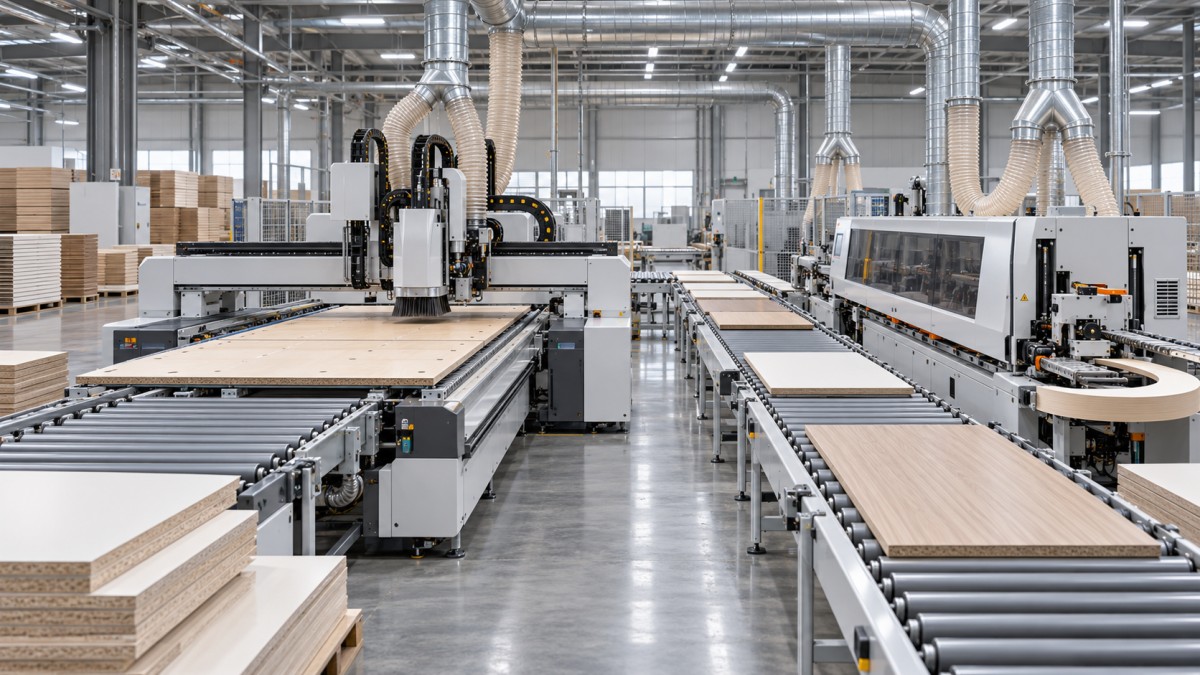
As a broad planning guide, basic standalone woodworking machines generally involve a lower entry investment than CNC and automated equipment. Manual or semi-automatic panel saws, edge banders, drilling machines, and conventional sanders are often selected by growing workshops. CNC routers, beam saws, automatic edge banders, machining centers, intelligent storage systems, and return conveyors sit at a higher investment level because they combine more complex mechanics, controls, safety systems, and integration work.
It is possible to find very low advertised prices online, especially for basic machines. However, a published figure may exclude tooling, freight, export packing, commissioning, electrical adaptation, dust extraction connections, operator training, or optional safety and automation features. Comparing only the machine headline price can create an unrealistic project budget.
Why Similar Machines Can Have Very Different Prices
Two machines with the same name can be fundamentally different in daily use. Take an edge bander as an example. A basic unit may be suitable for intermittent work with a limited range of edge materials. A more advanced configuration may add pre-milling, corner rounding, scraping, glue management, automatic adjustment, faster feeding, and a return conveyor. These additions affect both price and the consistency of the finished panel edge.
The same principle applies to CNC equipment. The useful comparison is not simply “CNC router versus CNC router.” Buyers should look at working area, spindle type, drilling configuration, vacuum zoning, loading and unloading method, controller, nesting software compatibility, tool-changing capacity, and the machine’s ability to handle their actual board materials. A low-cost CNC machine that creates bottlenecks in loading, labeling, or secondary drilling may not reduce labor as expected.
Build quality also changes the equation. Frame rigidity, linear guides, drive components, electrical cabinet design, pneumatic parts, wiring quality, and assembly accuracy are not always obvious in a quotation. Yet they influence vibration, repeatability, maintenance demands, and how reliably a machine performs over time. The lowest-priced option can be appropriate for low-volume work, but it should not be judged by the same standard as equipment expected to run continuously across multiple shifts.
The Machinery Price Is Not the Total Project Cost
A realistic furniture machinery budget should include the equipment itself and the conditions required to use it well. This is where many purchasing plans become too optimistic. A machine can arrive on schedule and still remain unproductive if the facility is not ready for power supply, compressed air, dust extraction, material flow, operator training, or software setup.
Common project costs that should be clarified before ordering include:
- Freight, insurance, import duties, and local customs-related expenses.
- Crating, container loading requirements, unloading equipment, and access into the factory.
- Electrical supply, voltage and frequency compatibility, grounding, compressed air, and dust collection.
- Cutters, saw blades, drill bits, glue systems, abrasives, and other consumables.
- Installation, commissioning, operator instruction, and production trial time.
- Spare parts inventory and the practical process for obtaining technical support after delivery.
For automated lines, layout work deserves particular attention. Material may travel efficiently through a machine sequence on paper but become difficult to manage in a crowded workshop. Offcuts, finished panels, rejected parts, and rework areas all need a place. The best machine configuration is not necessarily the one with the most functions; it is the one that fits the available space, order pattern, labor capability, and material flow.
Automation Should Solve a Bottleneck, Not Just Add Features
Automation is frequently discussed as though it automatically lowers manufacturing cost. It can, but only when it addresses a real constraint. If a factory loses time because operators repeatedly handle panels after edgebanding, a return conveyor may make sense. If the primary issue is inaccurate cutting lists or unstable incoming board quality, a more automated machine alone may not fix the problem.
Before selecting an automated solution, map the production route of several actual orders. Include standard products, small custom orders, and the jobs that usually cause delays. Count not only machine cycle time but also loading, unloading, searching for parts, labeling, setup changes, rework, and waiting between processes. This exercise often reveals that the most valuable upgrade is not the largest machine in the catalog.
High-mix, low-volume manufacturers usually need flexibility and quick changeovers. Larger producers with repeatable formats may gain more from linked equipment and automatic handling. Neither path is universally better. The right investment depends on the order profile and the operating discipline needed to support the equipment.
Questions That Make a Machinery Quotation More Useful
A supplier can only recommend a sound configuration when the production requirement is clear. Instead of asking for a general “best price,” provide information that exposes the practical constraints of the project: panel sizes and thicknesses, board types, edge materials, expected shift pattern, daily output expectations, available floor space, power conditions, and whether the factory produces standard or custom furniture.
It is also worth asking what is included in the quoted configuration. Is the machine fitted with the required tooling? Which functions are standard and which are options? What technical documents are supplied? How are remote troubleshooting, spare parts, and installation support handled? If a market has specific safety, electrical, or import requirements, these should be discussed early rather than after equipment has been built.
For buyers comparing several proposals, request a process-based comparison rather than a list of model names. The meaningful question is whether each proposal can produce the same part, finish level, output target, and degree of operator involvement. If the answers differ, the prices are not directly comparable.
A Practical Way to Decide What to Spend
Start with the production problem, then work backward to the machine specification. A workshop struggling with panel accuracy may need a different solution from one struggling with edge quality. A company outsourcing drilling may benefit from a compact CNC drilling machine before investing in a full automated line. In some situations, upgrading one critical process and retaining reliable existing equipment is financially wiser than replacing everything at once.
Qingdao Zhongding Machinery Co., Ltd. has developed from a small workshop into a manufacturer and exporter focused on woodworking machinery and complete solutions for furniture production, workshops, and industrial lines. More than 20 years in the field has reinforced a simple lesson: equipment selection should account for what happens after shipment. Precision engineering matters, but so do technical communication, parts planning, operator support, and a configuration that can be maintained in the customer’s real production environment.
The right answer to “How much does furniture manufacturing machinery cost?” is therefore not a single number. It is a defined investment scope tied to capacity, product mix, factory conditions, and the cost of keeping production moving. A detailed requirement list, a workable layout, and a clear statement of included services will usually produce a more dependable decision than choosing the lowest initial quotation.
Send Your Inquiry
We welcome your cooperation and we will develop with you.