


News & Exhibitions
Latest Factory Updates, Industry Trends & Global Exhibition Information
How Should Buyers Compare Industrial Woodworking Machinery Suppliers?
Comparing industrial woodworking machinery suppliers starts with a question that is more useful than “Which quotation is lowest?”: Will the proposed machine produce the required result reliably in the actual production environment? A low purchase price can lose its advantage quickly when setup takes too long, panels require rework, replacement parts are difficult to obtain, or technical questions stop a line from running. The supplier comparison should therefore connect machine capability, manufacturing quality, application fit, and long-term support.
Begin with the workpiece rather than the supplier brochure. Solid wood, plywood, MDF, particleboard, veneered panels, laminated board, and coated materials place different demands on cutting, feeding, dust extraction, clamping, and tooling. A machine that performs well on stable cabinet panels may need different settings, scoring arrangements, or feed control when processing fragile veneer or narrow solid-wood components. The comparison becomes clearer when every supplier receives the same production information: material type and thickness range, panel dimensions, finished part tolerances, edge quality expectations, daily output, available floor space, electrical supply, and the sequence of surrounding equipment.
Compare the Machine Behind the Specification Sheet
Published specifications are useful, but they do not tell the whole story. Two panel saws may list similar cutting lengths and motor power while differing substantially in frame rigidity, guide construction, spindle quality, pressure beam design, control accuracy, and ease of adjustment. The same applies to edge banders, CNC routers, wide belt sanders, drilling machines, and four-side moulders. Capacity figures should be read alongside the construction that allows those figures to be sustained.
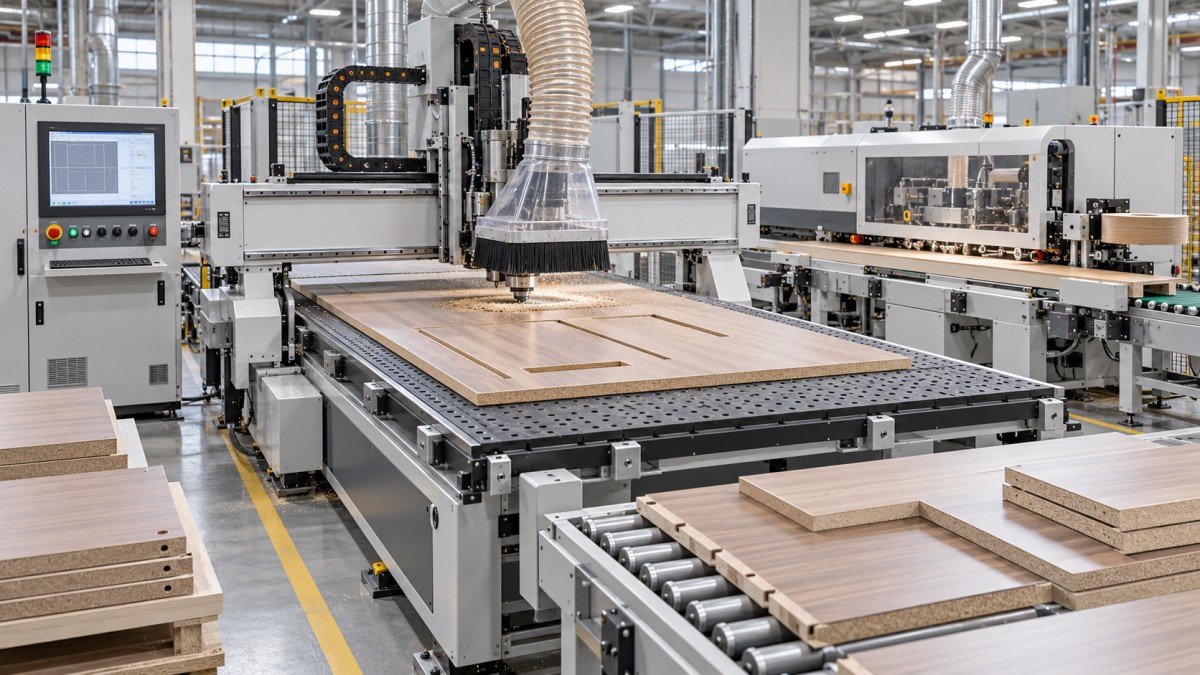
Ask for details that reveal how the equipment is built and adjusted. For a CNC router, relevant questions include the table structure, vacuum zoning, spindle configuration, drive system, tool changing arrangement, dust hood coverage, and how the machine references the panel. For an edge banding machine, examine the feeding track, glue application method, pressure rollers, end trimming, scraping, buffing, and the accessibility of each adjustment point. A supplier that can explain the relationship between these components and the proposed application is offering more useful evidence than one that simply repeats catalog ratings.
Precision claims also need context. Positioning repeatability, finished-part accuracy, and surface quality are related but not interchangeable. A machine may position an axis consistently while a warped panel, worn cutter, weak vacuum hold, incorrect feed rate, or unsuitable fixture causes variation in the finished workpiece. Request the measurement basis for any stated tolerance and ask what material, tooling, cycle, and operating conditions were used. This prevents a common mistake: comparing a controlled demonstration result with the tolerance that can realistically be maintained through normal production.
Look for Evidence of Manufacturing Discipline
Manufacturing experience matters when it appears in visible processes, not merely in a statement about years in business. Useful signs include orderly assembly procedures, component traceability, documented inspection points, clear wiring identification, protected pneumatic routing, accessible lubrication locations, and test records for the machine functions that affect production. These details influence commissioning and later fault finding.
Factory inspection should focus on the configuration being quoted. It is reasonable to ask whether the machine will be run and tested before shipment, what functions are included in that test, and what evidence can be supplied. For equipment with programmable motion, the test should cover representative operations rather than only axis movement without a workpiece. For a panel saw, this could include cutting and scoring alignment. For a CNC machining center, it could include tool change behavior, workholding, machining reference points, and a sample program appropriate to the configuration.
Component selection deserves careful attention, especially where a failure would interrupt the entire line. Motors, inverters, controllers, bearings, pneumatic valves, sensors, gearboxes, vacuum pumps, electrical protection devices, and linear motion components do not need to be identical across all machines. They do need to be appropriate for the duty cycle and supported by a clear parts identification system. A quotation that names critical components is easier to evaluate than one that uses broad descriptions such as “high-quality electrical parts.”
Product Range Can Matter, but Only When It Matches the Process
A broad product range is valuable when the production flow includes several connected operations. Panel cutting, nesting, drilling, edge banding, sanding, and material handling affect one another. A supplier familiar with the full sequence is more likely to identify a mismatch such as a sanding machine becoming the bottleneck after a faster CNC router is installed, or an edge bander lacking the trimming functions required by the selected edge material.
That does not mean every item in a workshop must come from one source. A narrow specialist may be the stronger choice for a technically demanding process, provided interface responsibilities are clear. The important comparison point is whether each supplier understands where its machine begins and ends within the production flow. Machine footprint, loading direction, discharge height, dust duct position, compressed-air connection, electrical cabinet access, and service clearance are practical details that are often overlooked until installation.
Read Quotations for Scope, Not Just Total Price
A meaningful quotation separates the base machine from the items required to put it into production. Tooling, spare parts, loading devices, discharge conveyors, dust connections, software options, safety accessories, installation assistance, packing, freight, and commissioning arrangements may be treated differently by different suppliers. A missing item is not automatically a problem, but it should be visible before the order is placed.
Configuration descriptions should be specific enough to prevent later disagreement. “Automatic edge banding machine” is too broad when the required process includes pre-milling, corner rounding, scraping, grooving, PUR glue handling, or processing narrow workpieces. “CNC router” does not establish whether the package includes the spindle power, drill bank, tool magazine, vacuum system, nesting support, or software postprocessor needed for the intended work. The more the process relies on a particular function, the more clearly that function should appear in the technical offer.
Transport and delivery terms deserve the same attention. Industrial machinery may arrive as one unit, several modules, or separately packed accessories. Ask how the equipment is protected, whether fragile assemblies are secured for transit, which items are removed for shipping, and what lifting equipment is needed at the destination. A supplier should be able to provide machine dimensions, shipping dimensions, approximate handling requirements, and a list of site preparations without treating those matters as secondary.
Test Support Before It Is Needed
After-sales service is easiest to judge before a purchase, when technical questions reveal the quality of communication. Provide a realistic question about material, tooling, installation, or machine settings and observe the response. A useful reply identifies the missing information, explains the likely cause, and gives a practical next action. A generic assurance of support does not show how a production interruption will be handled.
Technical documentation should be reviewed as part of the comparison. Operating manuals, electrical diagrams, pneumatic diagrams where applicable, maintenance schedules, parts lists, alarm references, and setup instructions should match the supplied configuration. Clear documentation reduces dependence on memory and makes it easier for maintenance personnel to trace a fault. It also matters when machinery changes hands internally or when a new technician joins the workshop.
Spare parts support should distinguish between routine consumables and downtime-critical components. Saw blades, belts, cutters, sanding abrasives, glue pots, pressure rollers, and filters have predictable replacement patterns. Sensors, drives, control modules, vacuum components, and specialized mechanical assemblies may be less frequently required but can stop production immediately. Ask how parts are referenced, what information is required to identify them, whether recommended startup spares are available, and how technical diagnosis is handled before a replacement is dispatched.
Use Demonstrations to Expose Application Gaps
A demonstration is most valuable when it uses representative work, not an idealized sample selected by the supplier. Provide drawings or sample parts that include the difficult features: narrow rails, small holes near an edge, long grooves, fragile laminated surfaces, heavy panels, profiled pieces, or repeated drilling patterns. The goal is not to create an unrealistic test; it is to see whether the machine configuration and operating method suit the work that will actually be produced.
During the demonstration, watch the complete cycle. Notice how material is loaded and referenced, whether clamps or vacuum zones hold it securely, where chips accumulate, how quickly settings change, and whether the finished part requires manual correction. Examine chip-out, edge quality, joint appearance, sanding consistency, hole position, and repeatability across several pieces. A single acceptable sample has limited value if adjustments are complicated or the result changes after the machine warms up.
Output should be assessed as a process rate rather than a headline speed. A machine running quickly with frequent interruptions for cleaning, glue adjustment, tool replacement, programming correction, or material repositioning may not suit a varied order mix. Conversely, a machine with a lower maximum rate may deliver steadier results when it is easier to set, maintain, and integrate with upstream and downstream work.
Compare Technical Communication and Project Control
The quality of pre-order communication often predicts the quality of later coordination. Clear suppliers ask for drawings, process requirements, electrical conditions, layout limitations, and material details because those factors affect machine selection. They should also identify assumptions instead of leaving them hidden in a proposal. When a requirement falls outside the standard configuration, the technical consequence should be described plainly: added equipment, altered cycle time, additional tooling, changed utility demand, or a different production method.
For larger equipment or several connected machines, establish a single written record of scope before manufacture begins. It should identify model numbers, included functions, utility requirements, supplied accessories, interface points, documentation, acceptance expectations, packing arrangement, and service contacts. This is not unnecessary paperwork. It prevents a common source of frustration: each side assuming that an accessory, connection, or operating function was included because it appeared in an earlier discussion or promotional image.
Comparison becomes more reliable when every offer is measured against the same application brief and the same acceptance criteria. The strongest supplier is not necessarily the one with the longest list of optional features. It is the one whose equipment, technical explanations, delivery scope, and support arrangements remain consistent when examined against the real workpiece, production rhythm, and installation conditions.
Send Your Inquiry
We welcome your cooperation and we will develop with you.