


News & Exhibitions
Latest Factory Updates, Industry Trends & Global Exhibition Information
Does a plywood edge banding machine need a pre-milling unit?
No, not every Plywood Edge Banding Machine needs a pre-milling unit. The right choice depends on the condition of your incoming panels, the finish your customers expect, and the cost of keeping those results consistent. A well-cut plywood edge may be ready for adhesive and edge tape without additional machining. An edge with saw marks or shallow breakout may benefit considerably from pre-milling.
For procurement teams, the difficult part is deciding whether that benefit justifies the extra investment. A longer specification sheet does not automatically mean a better purchase. The useful question is: will pre-milling solve a recurring production problem, or duplicate work your cutting process already does well?
What pre-milling changes before the glue is applied
A pre-milling unit removes a controlled amount of material from the panel edge immediately before the gluing station. Its purpose is to produce a fresh, straight bonding surface by removing minor cutting defects and surface irregularities.
Many systems use two cutters arranged to reduce breakout at the leading and trailing corners. The actual result depends on cutter geometry, spindle arrangement, tool condition, panel support, and machine setup—not simply the presence of two motors.
On plywood, this operation needs particular care. Unlike a uniform board material, plywood contains alternating veneer layers, and its machining behavior varies with species, core construction, adhesive, and manufacturing quality. A setting that works well on one batch may expose splintering on another.
Pre-milling can improve edge preparation, but it is not a repair process for defective plywood. Deep core voids, loose veneers, delamination, and major dimensional errors require attention upstream or rejection of the affected panels.
Start with the edge you actually produce
Before comparing machine quotations, collect panels from normal production. Include material cut near the end of a saw blade’s service interval, not just freshly cut samples prepared for a supplier demonstration. Examine several thicknesses and plywood grades if your purchasing mix varies.
The following distinctions are more useful than a general claim that an edge looks “rough.”
Check the edge under good lighting and compare its squareness to the panel faces. Inspect both corners as well as the middle. A surface that feels smooth can still have defects that become obvious after thin edge tape is applied.
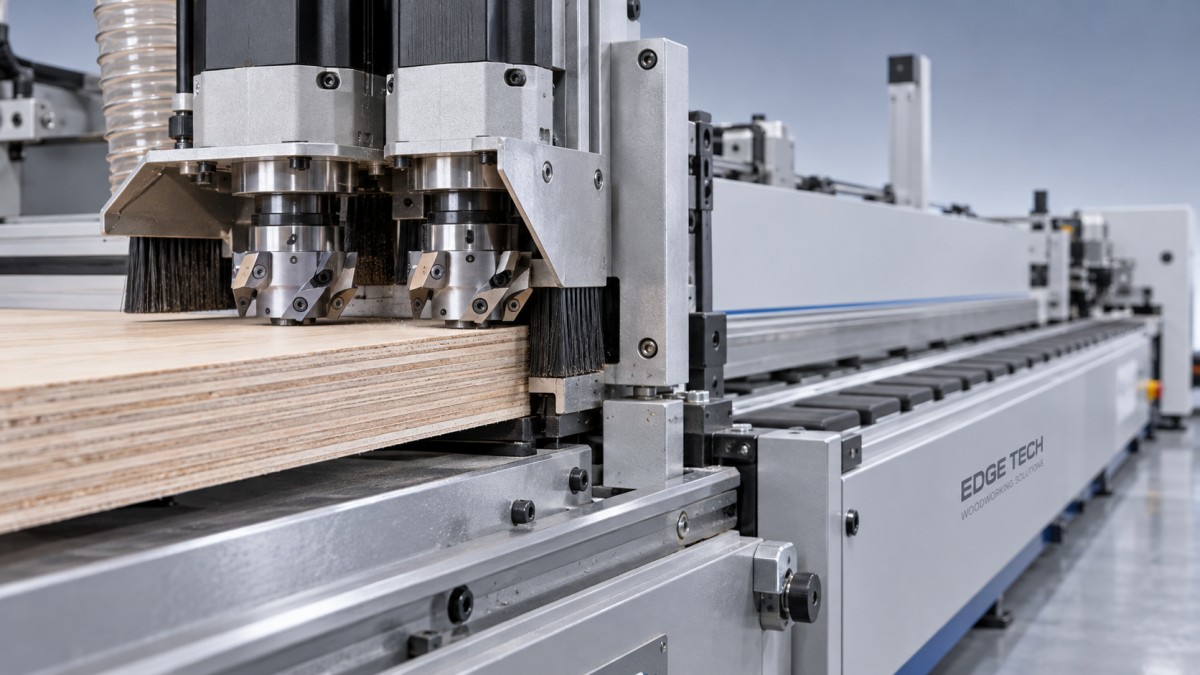
When a Plywood Edge Banding Machine benefits most from pre-milling
Appearance standards leave little room for variation
For visible cabinet components, shelving, and furniture panels, small edge defects can become a finishing problem rather than merely a machining issue. Thin edge materials are particularly sensitive to the substrate beneath them, although thicker banding also needs reliable contact and support.
Pre-milling may help produce a more consistent edge line when incoming cut quality fluctuates. It does not, by itself, guarantee an invisible joint. Adhesive selection, application temperature, glue quantity, pressure, tape quality, and trimming settings remain important.
Panels arrive from several cutting sources
A factory using one well-maintained sizing line may have stable edge quality. A workshop receiving panels from multiple suppliers, saws, or CNC routers faces a different situation. Even when nominal dimensions match, surface finish and corner quality can vary.
Here, pre-milling can provide an additional controlled preparation stage before gluing. That consistency may be valuable when operators currently spend time sorting panels or correcting edges manually. However, the unit still needs a defined material allowance; it cannot accommodate unlimited variation.
Rework is consuming more than its visible labor cost
Rejects affect more than the person repairing them. They interrupt assembly, consume replacement tape and adhesive, and can delay an otherwise complete order. If edge preparation is a documented cause of those problems, pre-milling deserves serious consideration.
The key word is “documented.” Poor adhesion caused by dust, unsuitable adhesive settings, or low panel temperature should not automatically be blamed on the absence of pre-milling.
When the additional unit may not earn its place
A machine without pre-milling can be a sensible choice when accurately sized plywood consistently produces acceptable bonded edges. This is especially relevant where production volumes are modest, material specifications are stable, and the finish standard is already achieved without manual edge correction.
For a smaller workshop, extra equipment also means extra responsibilities: cutter maintenance, extraction demand, setup checks, and spare-parts planning. Buying a feature that operators rarely need can tie up funds better spent on cutting accuracy, dust control, or adhesive-process stability.
There is also a middle ground. You may choose pre-milling for future production flexibility even if current work does not always require it. In that case, ask whether the proposed machine supports operation with the unit disengaged, how settings are changed, and whether switching modes affects panel sizing. Do not assume every configuration provides the same flexibility.
The hidden purchasing issue: machining allowance
Pre-milling removes material, so the panel-sizing plan must account for it. This is easy to overlook when the cutting department and machine supplier discuss dimensions separately.
Clarify how the specified panel size relates to the machined substrate and the finished component, including edge-band thickness. Where opposite edges are machined, both passes must be considered. The correct allowance depends on the chosen removal amount and the production sequence; there is no universal setting suitable for every plywood job.
Too little removal may leave existing damage behind. Excessive removal wastes material, increases cutter load, and can create dimensional errors. Ask the supplier to demonstrate adjustment, repeatability, and the usable removal range on your intended materials.
Also confirm the machine’s minimum panel dimensions, supported thickness range, and handling requirements. A configuration that performs well on large cabinet sides may need closer evaluation for narrow rails or small components.
Compare the whole cost, not just the option price
The financial case should compare the additional annual ownership cost with the avoidable cost of edge-related defects and preparation work.
Potential savings: reduced manual preparation, fewer rejects, less re-banding, and fewer interruptions attributable to poor incoming edge quality.
Additional costs: the pre-milling option, tooling, sharpening or replacement, energy, extraction capacity, maintenance time, and material removed during machining.
Use your own production records rather than a supplier’s general productivity estimate. If you do not record edge-related rework separately, track it over representative production runs before making the decision.
Cycle time also needs evidence. An integrated pre-milling station may operate within the machine’s normal feed process, but actual throughput depends on the complete configuration, panel spacing, handling, and operating conditions. Neither a guaranteed speed increase nor an unavoidable slowdown should be assumed.
What to ask during a supplier trial
A convincing demonstration should resemble your workshop on an ordinary working day—not a carefully selected run on unusually easy material. Send representative plywood, the edge materials you intend to use, and your acceptance criteria before the test.
- Compare equivalent samples. Where the configuration permits, evaluate panels with and without pre-milling under otherwise comparable conditions.
- Inspect the machined plywood before gluing. Look for remaining saw marks, veneer breakout, exposed voids, and corner damage.
- Check finished dimensions. Confirm that removal settings and edging produce the intended component size.
- Assess the completed joint. Review appearance, corner quality, tape support, and bonding after the adhesive has developed strength under its specified conditions.
- Run more than one panel. Include different thicknesses and batches, with enough repetition to reveal handling or adjustment problems.
- Review routine access. Ask the operator to demonstrate cutter inspection, cleaning, adjustment, and safe maintenance procedures.
Request a written record of the tooling, adhesive, feed settings, and removal allowance used. A good sample matters, but a reproducible process matters more.
Do not separate edge quality from the rest of the panel process
For veneered furniture components, edge banding is only one stage in a longer manufacturing sequence. Face lamination quality, panel flatness, adhesive curing, and final sizing all influence what reaches the edge bander.
Where veneer lamination is performed in-house, a Wood Veneer Hot Press Machine applies controlled heat and hydraulic pressure to bond natural veneer onto plywood and other wood-based substrates. Its role is face lamination, not edge preparation. Coordinating that operation with conditioning, sizing, and edge banding helps avoid expecting a pre-milling unit to compensate for upstream panel problems.
This broader process view is useful when comparing suppliers. Qingdao Zhongding Machinery Co., Ltd., a woodworking machinery manufacturer and exporter with more than 20 years of industry experience, offers machinery alongside technical support, spare parts supply, and after-sales service. For procurement teams, those support arrangements should be evaluated as carefully as the machine configuration—particularly where tooling availability or service delays could interrupt production.
A practical buying recommendation
Choose pre-milling when recurring, removable edge defects are preventing consistent results and the expected reduction in rework justifies its ownership cost. Give it particular attention when appearance requirements are demanding or incoming cut quality varies.
Consider a machine without it when your plywood is consistently well cut, bonding trials meet your standards, and the additional station offers little measurable benefit. In either case, correct poor cutting practices and reject defective material rather than relying on downstream machining to hide them.
The best Plywood Edge Banding Machine is not necessarily the one with the most stations. It is the configuration that turns your actual plywood into acceptable finished components, repeatedly, at a cost your production can support.
Send Your Inquiry
We welcome your cooperation and we will develop with you.