


News & Exhibitions
Latest Factory Updates, Industry Trends & Global Exhibition Information
Curved Edge Banding Machine Selection for Irregular Cabinet Parts
Selecting a Curved Edge Banding Machine for irregular cabinet parts requires more than matching a machine to an edge material. The critical question is whether it can bond the most demanding part consistently at the required production rate.
Technical evaluators must consider minimum processing radius, panel thickness, feed control, adhesive application, and bonding consistency along complex profiles. These factors should be tested together because a machine’s stated limits may not apply simultaneously.
This guide explains how to compare equipment against actual part geometry, edge materials, quality expectations, and operating costs. It also provides a practical acceptance process for supplier demonstrations.
Start With the Parts That Define Your Machine Requirements
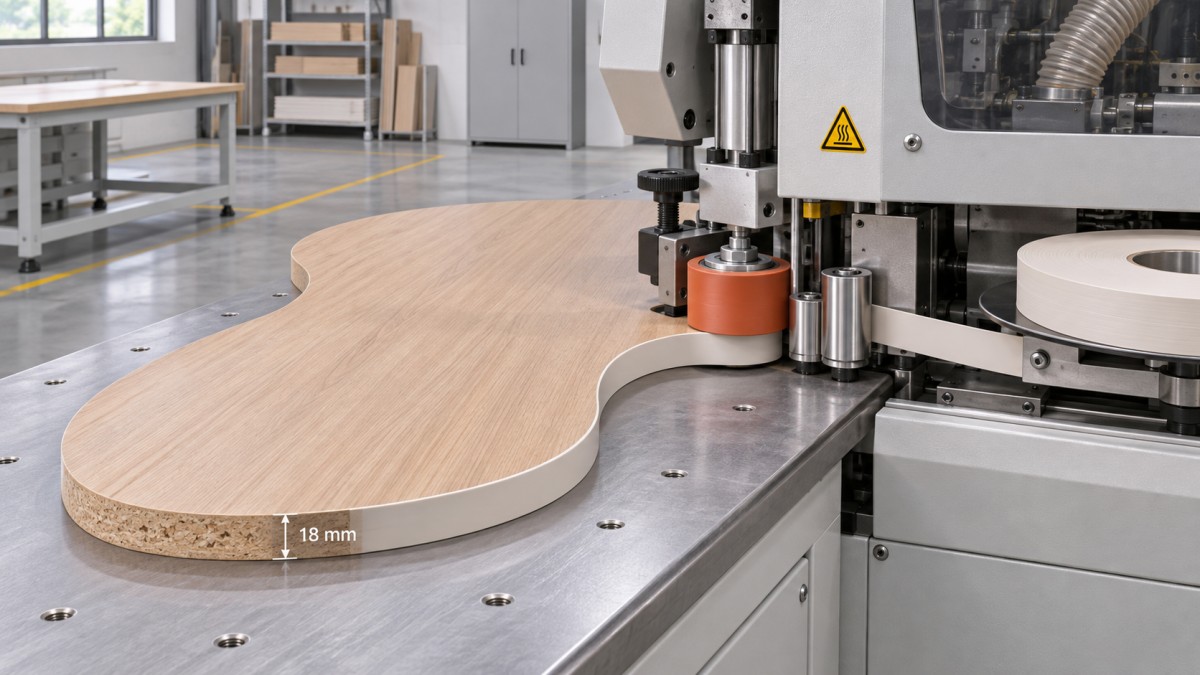
Build a representative part list before reviewing machine specifications. Include cabinet doors, shelves, end panels, and shaped components, with dimensions, substrate materials, edge types, and expected quantities.
Identify the most difficult features on each part: tight internal curves, small external radii, short straight sections, narrow necks, and transitions between curves and straight edges.
Measure the finished edge length as well as overall panel dimensions. A compact part may be difficult to control even when its dimensions fall within the machine’s advertised capacity.
Record the smallest internal and external radii separately. Internal curves can restrict roller access and edge movement differently from external curves, so one minimum radius figure rarely tells the whole story.
Include the thickest, thinnest, largest, and smallest parts in your evaluation. If production includes both large panels and small shaped pieces, confirm that supports and workholding accommodate both.
Finally, rank parts by annual volume and quality sensitivity. The ideal machine should handle difficult work, but its everyday setup and output should suit the parts that generate most production hours.
Can the Machine Follow Your Tightest Curves?
Minimum processing radius is a starting point, not a guarantee of performance. Ask the supplier whether the figure applies to internal curves, external curves, or both.
Also ask which edge material, edge thickness, panel thickness, adhesive, and operating conditions were used to establish the rating. A thicker edge may resist bending around a radius that thinner tape can follow.
For internal curves, examine whether the pressure roller and application head can physically enter the profile. Interference may prevent proper contact even when the nominal radius appears acceptable.
For external curves, check whether the band stays flat and pressed against the substrate without lifting, stretching, or forming visible gaps. Difficult transitions deserve particular attention.
Request a demonstration using your smallest radius and your actual edge material. Inspect the complete curve after bonding and again after the adhesive has cooled or cured.
If a machine meets the radius only with slower feeding, thinner tape, or manual assistance, document those conditions. They affect both production planning and the validity of the comparison.
Check Panel and Edge Material Compatibility Together
Confirm the machine’s supported panel thickness range against the actual finished thickness of your parts. Include variations from laminates, veneers, and normal manufacturing tolerances.
Review the permitted edge thickness and height for every material in use, such as PVC, ABS, veneer, or melamine. Compatibility also depends on flexibility and backing characteristics.
Edge height should allow the required trimming allowance without exceeding machine limits. Too little overhang can expose the panel edge; excessive overhang may complicate trimming and increase waste.
Ask whether coils and precut strips are both supported if your product mix requires them. For closed shapes, check how the machine handles the meeting point between leading and trailing ends.
Substrate matters as much as the edging. Particleboard, MDF, plywood, and solid wood can differ in porosity, surface consistency, and edge preparation, affecting adhesive wetting and bond quality.
Supply actual production materials for trials whenever possible. A successful test on a smooth sample board does not establish performance on a porous or inconsistently machined cabinet component.
Choose Feed and Workholding for Your Part Mix
Curved edge banding equipment may use manual guidance, assisted feeding, or programmed movement. The right arrangement depends on part geometry, batch size, operator availability, and repeatability requirements.
Manual or assisted machines can be practical for varied, low-volume parts. However, the operator’s ability to maintain steady contact and speed can influence the appearance of difficult profiles.
Programmed systems can improve repeatability for suitable recurring parts, but their value depends on programming time, fixture design, changeovers, and the accuracy of the incoming panel.
Evaluate how the panel is supported throughout its path. Large overhangs, unstable small pieces, and changing contact points can cause uneven pressure or make a part difficult to guide safely.
Check whether fixtures, vacuum cups, stops, or support tables are needed. Include their cost and setup time, and confirm that they do not obstruct the edge application path.
Observe feed behavior at tight corners and transitions. A controllable reduction in speed may improve consistency, but excessive slowing can affect adhesive temperature and reduce practical throughput.
When comparing automation levels, run a representative batch rather than timing a single part. Include loading, orientation, edge preparation, changeover, unloading, and any required intervention.
Evaluate Adhesive Application and Bonding Control
A sound bond requires the correct adhesive, application temperature, coating amount, open time, and pressure for the chosen materials. Confirm how the machine controls each relevant variable.
Ask whether adhesive is applied to the panel edge or the banding material, and how the application system maintains coverage through changes in speed and direction.
Inspect for continuous coverage on tight curves and at the start and end of the joint. Too little adhesive can cause gaps; excess can produce squeeze-out and extra cleaning.
Common hot-melt adhesive options include EVA and PUR, but availability varies by machine. Compare compatibility, operating requirements, cleaning procedures, and supplier recommendations before specifying an adhesive system.
PUR can offer higher resistance to moisture and heat in suitable applications, but it also requires appropriate handling and maintenance. Confirm the complete process with the adhesive supplier.
Check temperature controls, warm-up time, and the machine’s response during pauses. A long idle period or repeated stops may change adhesive behavior and affect the first parts after restarting.
Pressure matters along the full edge, especially where the profile changes. Ask how rollers or other pressure devices maintain contact on both internal and external curves.
Define bond acceptance criteria with your team before testing. Consider visible gaps, edge lift, glue-line appearance, and an agreed adhesion test after the specified cooling or curing period.
Understand What Finishing Work Remains
Do not assume that a curved edge banding machine completes every finishing operation. Depending on its configuration, end cutting, flush trimming, scraping, or polishing may require separate equipment or manual work.
Ask the supplier to identify which operations are included in the quotation and which parts of your profile each operation can reach. Internal curves may present particular access limitations.
Inspect the joint where the band ends meet. A visible gap, overlap, or uneven cut can be unacceptable on exposed cabinet components even when the rest of the bond is sound.
Check top and bottom overhang after trimming, particularly on curved transitions. Look for chipped surfaces, inconsistent flushness, cutter marks, and damage to decorative faces.
If secondary finishing is required, measure its labor and equipment needs during the trial. A lower purchase price can be offset by repeated hand trimming or rework.
Compare Throughput Using a Complete Production Cycle
Published feed speed describes movement during part of the process; it does not establish finished output. Calculate throughput from completed, acceptable parts over a representative operating period.
Include adhesive warm-up, loading, positioning, feeding, cutting, finishing, inspection, and unloading. Add fixture changes and material changes at the frequency expected in normal production.
For a comparison, divide the available production time by the measured average cycle time, then adjust for observed setup, stoppages, and rejected parts. Use the same assumptions for each machine.
Test more than one operator if the process relies on manual guidance. Differences in results can reveal training requirements or sensitivity that a supplier’s experienced demonstrator may otherwise mask.
For high-mix work, compare output across a realistic sequence of part types. A machine that excels on one repeated shape may lose its advantage when fixtures change frequently.
What Should You Verify During a Supplier Trial?
Provide the supplier with drawings, panel samples, edging, adhesive requirements, and a written test plan. Agree on the number of parts and pass criteria before the demonstration.
Include the tightest internal and external curves, the largest and smallest panels, and the edge materials that represent your production. Record any sample preparation outside normal practice.
Ask the operator to demonstrate routine setup, temperature adjustment, material loading, and changeover. Note the tools, skills, and time required for each step.
During production, observe whether the operator must stop, reposition the part, alter the feed, or manually press the edge. These interventions should be reflected in your cycle-time estimate.
Inspect parts immediately and after the adhesive supplier’s specified cooling or curing period. Record visible defects, joint quality, adhesion test results, and the number of acceptable parts.
Repeat the trial after a normal pause or material change when these events are common in your operation. Consistency after restarting can be as important as initial performance.
Keep a written record of settings, consumables, operator actions, and limitations. This makes competing demonstrations comparable and provides a useful basis for later commissioning.
Calculate Ownership Cost and Check Service Support
Compare the complete installed cost, including required fixtures, finishing equipment, freight, installation, training, and any facility modifications. Clarify which items are included in each quotation.
Estimate recurring costs for adhesive, edging waste, cutters, cleaning materials, maintenance, and labor. Use measured cycle times and observed reject rates where available.
Consider the cost of downtime as well as spare parts pricing. Ask which wear items should be stocked locally and how the supplier identifies and delivers replacement components.
Confirm the required electrical supply, compressed air, dust extraction, and available floor space against your site conditions. Installation constraints can affect both project timing and total cost.
Review training, remote troubleshooting, documentation, warranty terms, and service response arrangements. For exported equipment, clarify language support, shipping responsibilities, and expected access to technical assistance.
Qingdao Zhongding Machinery Co., Ltd. supplies woodworking machinery and offers technical support, spare parts, and after-sales service. Evaluators should confirm the specifications and support terms for the proposed configuration.
Make the Selection Against Verified Production Requirements
The best choice is the machine that consistently processes your required geometry and materials at an acceptable total cost. Start with the difficult parts, then verify routine production performance.
Give the greatest weight to demonstrated curve access, bond quality, repeatability, and complete cycle time. Treat catalog limits as useful screening data until they are confirmed under your conditions.
Before purchasing, document the tested configuration, acceptance criteria, included equipment, and support commitments. A clear specification helps both your team and the supplier commission a machine that meets the intended application.
Send Your Inquiry
We welcome your cooperation and we will develop with you.