


News & Exhibitions
Latest Factory Updates, Industry Trends & Global Exhibition Information
Buying an Automatic Beam Saw: What to Ask Suppliers About Support
Buying an automatic beam saw involves more than comparing cutting speed and purchase price. For procurement teams, the supplier’s ability to provide installation guidance, operator training, spare parts, and responsive technical support can have a lasting impact on uptime and production costs. Before placing an order, it pays to ask how support is delivered, what is included, and how quickly help is available.
These questions become especially important when the saw is expected to feed a busy furniture production line. A machine that looks economical on the quotation may become expensive if commissioning takes longer than planned or a small component is difficult to replace. The aim is not to find the supplier with the longest list of promises, but to understand what those promises mean in practice.
Start With the Support Plan, Not Just the Specification Sheet
Suppliers will usually be ready to discuss cutting dimensions, motor power, control systems, and production capacity. Ask for the same level of detail about what happens after the machine leaves the factory. Request a written support plan that covers delivery preparation, installation, training, warranty, troubleshooting, and parts supply.
It helps to describe your own operation before asking for a proposal. Explain the materials and panel sizes you process, the expected workload, the experience of your operators, and whether the saw must work with existing equipment or production software. Support needs for a standalone machine in a small workshop may differ considerably from those of a saw integrated into a larger production line.
Ask each shortlisted supplier:
- Who will be our main contact during installation and after acceptance?
- Which services are included in the quoted price, and which are charged separately?
- Can support be delivered in our location and working language?
- What information will you need from us to diagnose a problem?
- How are urgent production-stopping faults handled?
Compare the answers in writing. “Technical support available” is a useful starting point, but it does not establish service hours, contact methods, responsibilities, or costs.
What Does Installation and Commissioning Actually Include?
Installation support can mean remote guidance, an on-site visit, or a combination of both. Clarify the proposed approach before committing to a delivery schedule. If a technician will travel to your factory, ask who pays for travel, accommodation, local transport, and any additional days if site preparation is incomplete.
Request a site preparation checklist early. Depending on the machine configuration, it may cover floor space, foundations, electrical supply, compressed air, dust extraction, material handling, and network connections. Your maintenance and production teams should review it alongside the supplier’s drawings. A purchasing team can negotiate a good deal, but it cannot commission a machine on a floor that is not ready for it.
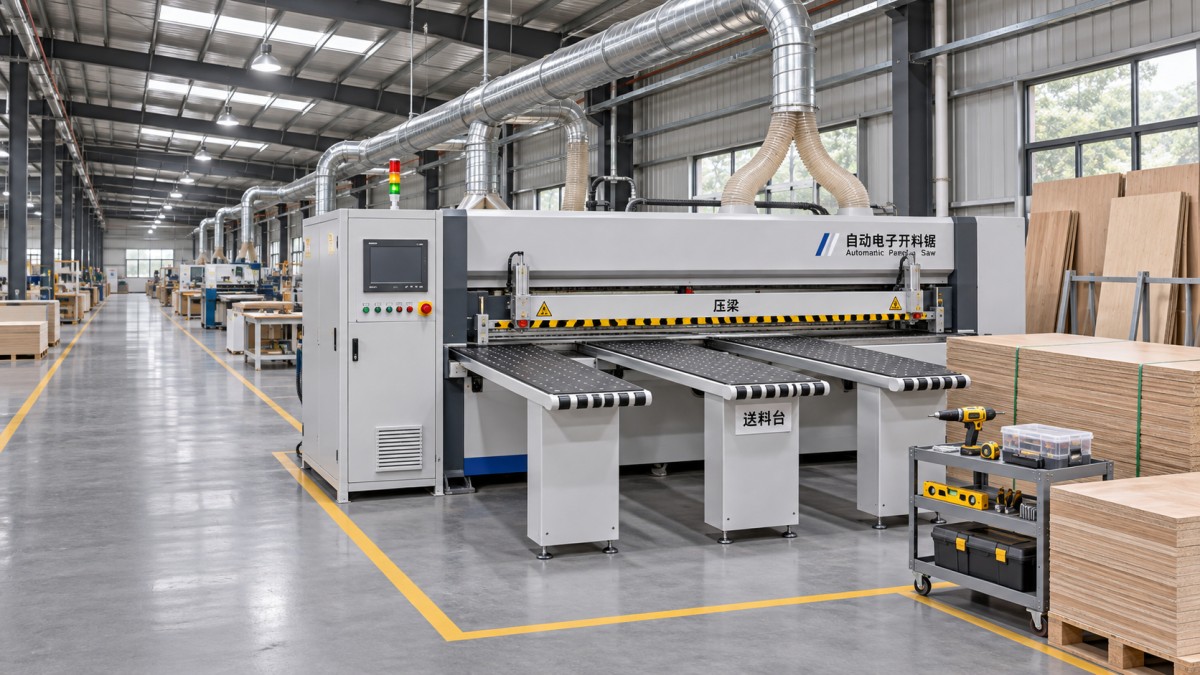
Also distinguish between installation and commissioning. Positioning and connecting the saw is not necessarily the same as proving it can perform the agreed work. Ask whether commissioning includes checking safety functions, verifying cutting accuracy, testing material handling, and running representative panels through the machine.
Agree on acceptance criteria before shipment. These should reflect the configuration purchased and the conditions under which testing will take place, including material, panel dimensions, measurement method, and operator involvement. Document how any unresolved items will be recorded and closed. This gives both parties a practical reference if the machine requires adjustment after startup.
Can Your Team Operate and Maintain the Saw After Training?
Training is often described as a single line on a quotation, yet the difference between a brief demonstration and a structured handover can be substantial. Ask how many people can attend, how long training is expected to take, where it will happen, and whether it is included in the machine price.
For operators, the training should address normal startup and shutdown, loading procedures, selecting cutting programs, safe working practices, and responding to common alarms. Depending on the saw’s configuration, it may also need to cover cutting optimization, label printing, or transferring production files.
Maintenance staff need a different level of detail. Ask whether the supplier will cover routine inspection, cleaning, lubrication where applicable, blade replacement procedures, adjustment points, and basic electrical or pneumatic fault checks. Work involving hazardous energy should follow the machine documentation and your site’s lockout procedures.
Do not overlook staff turnover. Find out whether manuals, electrical drawings, maintenance schedules, and training materials will be supplied in a language your team can use. Ask if refresher training is available later and how it is priced. A useful test is whether a new operator could find the correct procedure months after the supplier’s technician has left.
How Will the Supplier Diagnose a Production-Stopping Fault?
Imagine the saw displays an unfamiliar alarm during a shift. Your team needs to know whom to contact, what to send, and what happens next—not begin searching through old email threads.
Ask the supplier to explain the support process from the first report through resolution. Can your team contact a technician directly, or does every request pass through a sales representative? Are video calls, photographs, alarm codes, or remote controller access used for diagnosis? If remote access is possible, confirm what network connection is needed and how access is authorized under your company’s cybersecurity rules.
Request defined service hours, time zones, and target response times for different levels of urgency. A response time is not necessarily a repair time: an acknowledgement that a message was received is different from a technician beginning diagnosis. Ask what happens if a problem cannot be solved remotely and an on-site visit is needed.
It is reasonable to seek references or examples of the supplier’s support process, while recognizing that resolution depends on the fault, available parts, local conditions, and access to the machine. The key is clarity about escalation, not an unrealistic promise that every issue will be fixed immediately.
Spare Parts: Ask About Identification, Availability, and Delivery
A beam saw can be stopped by a component that costs much less than the production time lost while waiting for it. Before purchase, ask for a recommended spare parts list tailored to the quoted configuration. It may include wear items, sensors, pneumatic components, electrical parts, and other components the supplier considers relevant to your operating conditions.
For each important item, request its part number, description, expected source, and indicative lead time. Check whether parts are shipped from the manufacturer, a local distributor, or another location. International delivery can involve customs clearance, import charges, and transport delays, so ask who is responsible for each step.
Discuss which parts are sensible to keep on site. The decision depends on the likelihood and consequence of failure, the cost of holding stock, and how quickly replacements can reach your factory. For a saw that is central to daily output, a modest stock of critical items may be easier to justify than it would be for a machine with a readily available backup.
Finally, ask how long the supplier expects to support the machine model and what happens if a component or controller becomes obsolete. No supplier can eliminate future changes, but it should be able to explain its approach to replacement parts, compatible alternatives, and technical documentation.
Read the Warranty Alongside the Quotation
A warranty is valuable only when its scope is understood. Ask when coverage starts: on shipment, arrival, commissioning, or acceptance. Check the duration, covered components, exclusions, and the process for submitting a claim. Wear parts and damage associated with misuse or inadequate maintenance may be treated differently from manufacturing defects, so avoid assuming that every replacement is covered.
Pay particular attention to the costs around a warranty repair. A replacement part may be covered while freight, customs, travel, or labor is not. Confirm whether remote diagnosis is required before a part is dispatched and whether failed components must be returned.
Keep the final quotation, machine configuration, support terms, warranty conditions, and agreed acceptance criteria together. If a sales discussion produces an important commitment, ask for it to be added to the purchase documentation rather than relying on a verbal understanding.
Compare the Cost of Ownership, Not Only the Initial Price
When offers arrive in different formats, normalize them before making a recommendation. One quotation may include commissioning and training; another may list only the machine and make those services optional. The lower number is not automatically the lower-cost purchase.
Some costs will remain estimates. That is acceptable if the assumptions are visible. For example, compare the cost of an optional on-site commissioning visit against the potential disruption if your team must resolve startup issues remotely. Equally, calculate the carrying cost of critical spares against the possible impact of waiting for an international shipment. The purpose is not to predict every fault, but to make the financial trade-offs explicit.
Putting Supplier Answers to Work
Bring production, maintenance, IT, and purchasing into the evaluation before the order is finalized. Production can assess whether the proposed training and acceptance tests reflect actual panel-cutting work. Maintenance can review drawings and spare parts. IT can check any network or software requirements. Purchasing can then turn the agreed expectations into comparable commercial terms.
For buyers reviewing manufacturers and exporters, Qingdao Zhongding Machinery Co., Ltd. supplies woodworking machinery and complete woodworking solutions, with technical support, spare parts supply, and after-sales service forming part of its stated offering. As with any potential supplier, ask for the support arrangements applicable to your specific machine, destination, and production needs, and confirm them in the quotation.
An automatic beam saw is a long-term production asset. The strongest purchasing decision is one your team can operate, maintain, and support with confidence after the initial excitement of installation has passed. Clear questions now make it easier to compare suppliers—and easier to manage the machine throughout its working life.
Send Your Inquiry
We welcome your cooperation and we will develop with you.