


News & Exhibitions
Latest Factory Updates, Industry Trends & Global Exhibition Information
How to budget for installing furniture panel drilling equipment
A realistic budget for installing furniture panel drilling equipment starts with the cost of getting the machine ready to produce acceptable parts, not just the price on the quotation. Freight, unloading, electrical work, compressed air, tooling, programming, training, and production downtime can all affect the amount that must be approved before the first production run.
Separate costs into three groups: the equipment purchase, the work required to commission it, and the ongoing cost of using it. Then record which amounts are quoted, which require a site assessment, and which remain allowances. This makes it easier to compare proposals and prevents an attractive machine price from concealing an incomplete installation scope.
Define the production requirement before pricing the machine
The drilling work determines the specification, and the specification determines much of the budget. Record panel materials and thicknesses, part dimensions, hole diameters and depths, drilling patterns, required accuracy, and the expected mix of repeat orders and short runs. Include edge drilling, hinge-cup boring, or hardware insertion only when those operations are actually required.
A machine configured for a small number of repeated hole patterns has different tooling, programming, and setup requirements from a CNC drilling center handling frequent design changes. Comparing their purchase prices without accounting for changeover time or programming effort can produce a misleading cost comparison. Conversely, paying for capabilities that will remain unused ties up capital without necessarily reducing production cost.
Throughput figures also need context. A stated drilling cycle may exclude loading, unloading, panel positioning, barcode reading, program changes, or handling rejected parts. Estimate output using the complete process for representative panels. If the proposed capacity assumes an automatic loading system, include that system and its installation in the same budget.
Build the installed cost from the quotation outward
Ask for an itemized quotation that identifies the machine configuration and the services included. A useful comparison follows each cost until the equipment is operating at the intended site:
- Machine and options: drilling heads, spindles, clamps, positioning devices, control software, and any automatic feeding equipment.
- Delivery: packing, freight, insurance, import charges where applicable, and transport from the receiving point to the installation area.
- Site work: electrical distribution, compressed-air connections, dust extraction, floor preparation, and physical protection around the machine.
- Commissioning: assembly, alignment, initial settings, travel and accommodation for service personnel, test material, and training.
- Production readiness: initial drill bits, tool holders, spare wear parts, program setup, and time allocated to trial parts.
These headings are a way to assign costs, not a substitute for reading the supplier's scope. For example, “installation included” could cover mechanical assembly while leaving power cabling, air piping, lifting equipment, or travel expenses outside the quoted price. Request explicit boundaries and identify the party responsible for each connection and task.
Taxes and import charges should be evaluated for the actual transaction and destination. Record the delivery terms and transfer of risk alongside the price, because a quote delivered to a port is not directly comparable with one delivered to the factory floor.
Site preparation can change the decision
Obtain a layout drawing showing the machine footprint, maintenance access, material flow, and utility connection points. Include space for loading and unloading the longest panel in the intended range. A compact machine can still require substantial clear space if panels enter from one side and exit from another, or if access doors and electrical cabinets need to open fully.
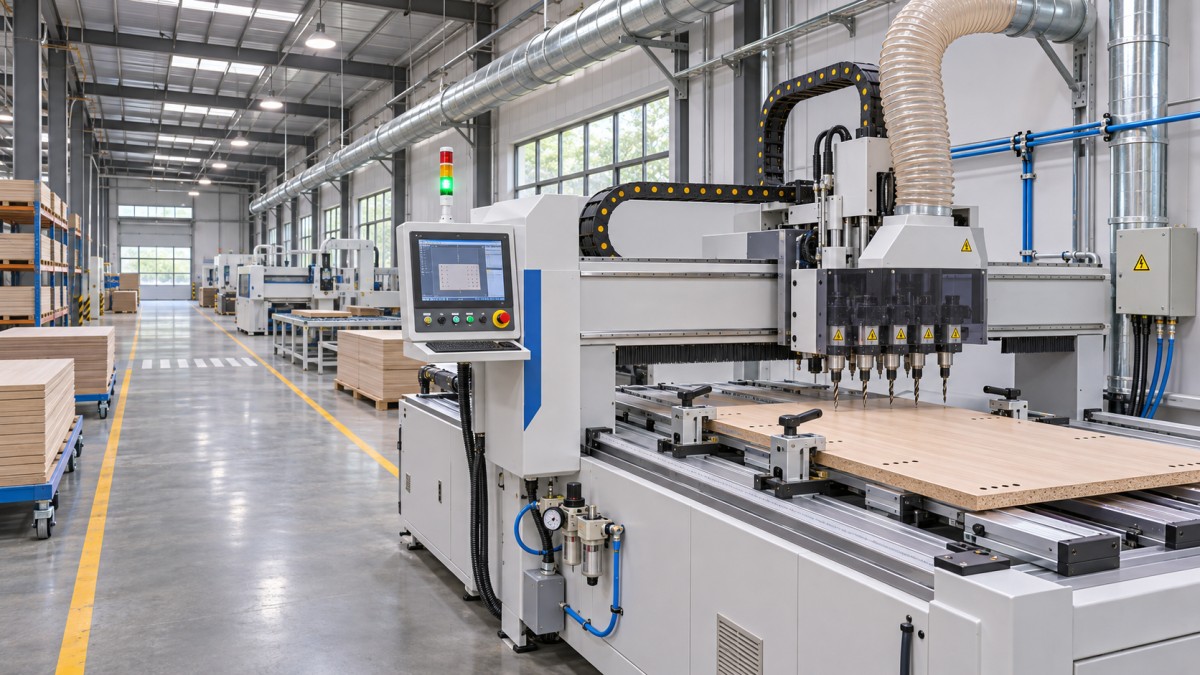
Compare the required electrical supply with the supply available at the proposed location. The connection cost depends on the distance to a suitable distribution point, available capacity, protection, and local installation requirements. The machine's connected power is useful for sizing the supply, but it should not be treated as its constant electricity consumption. Request operating-load information or measurements under representative work if energy cost is material to the investment.
Compressed air deserves the same scrutiny. Confirm both the pressure and air demand at the machine, including intermittent peaks from clamps or other pneumatic devices. An existing compressor is not necessarily sufficient if it already serves other equipment. Account for piping, filtration, and any compressor upgrade identified during the site assessment.
For dust extraction, establish the required connection size and airflow with the equipment supplier, then assess the capacity of the existing system. Long duct runs and multiple machines operating together can change the available extraction at the new connection. A line item for ducting alone does not establish whether the system will perform adequately.
Floor condition, access routes, door openings, and lifting points should be checked before delivery. The machine's packed dimensions and weight determine whether a forklift, crane, or specialist mover is needed. If equipment must pass through a restricted opening or be placed around existing machinery, rigging and temporary relocation may be significant costs.
Budget for integration, not just placement
A drilling machine rarely operates in isolation. The cost of connecting it to the existing workflow depends on how panel data, physical parts, and schedules reach the machine. Establish whether drilling programs will be created at the machine, transferred as files, or generated from existing design or production software. Verify file formats, licenses, interfaces, and any configuration or testing charges before assuming that current data will transfer directly.
Panel identification is another practical issue. If parts arrive with labels, confirm that their contents and placement work with the proposed reading process. If labels do not exist, include the cost of generating and applying them, as well as the time needed to establish a reliable handoff between cutting and drilling.
Adjacent processes affect the investment as well. For example, the PUR&EVA Straight Edge Banding Machine ZD450G1P1 is an edge-banding machine with separate PUR and EVA glue pots, not drilling equipment. Its stated dimensions of 7,985 × 900 × 1,590 mm illustrate why existing line layouts and panel-transfer space need to be considered when a drilling machine is added nearby. Any relocation or handling equipment belongs in the drilling project's budget only if the installation requires it.
Define the handoff between suppliers and site contractors. A technician arriving to commission the machine cannot complete the work efficiently if power, air, extraction, network access, or lifting equipment is unavailable. Agree on readiness requirements and dates in advance; repeated visits or rescheduling can add costs that are absent from the original equipment quotation.
Commissioning and acceptance deserve their own allowance
Installation is complete for budgeting purposes when the machine has been tested against an agreed scope, not merely positioned on the floor. Set out the representative panel materials, dimensions, drilling patterns, and tolerances to be used for acceptance. Include samples with the hole depths and edge distances required by the intended hardware, along with any relevant face and edge drilling operations.
Specify who supplies test panels, drill bits, measuring tools, programs, and labor. Trial production consumes material and time; complex programs or unfamiliar software can extend the period before normal output is reached. Establish how defects are recorded and corrected, and distinguish machine adjustment from changes to the panel design or source data.
Training should cover the work that will actually occur after handover: loading and referencing panels, selecting or creating programs, changing tools, setting drilling depth, responding to alarms, and carrying out routine maintenance. Confirm the number of sessions, language, location, and whether follow-up support is included. Training that is limited to a brief demonstration leaves an unpriced learning period in the production schedule.
Link payment milestones to clear deliverables where the contract permits. Delivery, mechanical completion, commissioning, and acceptance are different events. Documenting them separately helps keep the remaining obligations visible if the machine arrives before the site or production data is ready.
Estimate production interruption and running costs
Installation affects cash flow even when the machine is intended to reduce processing costs. Identify the work that must stop while the area is prepared, utilities are connected, or an existing machine is moved. Estimate the contribution lost from displaced production or the cost of outsourcing affected work, avoiding double counting if both figures describe the same shortfall.
Allow for a ramp-up period based on the complexity of the parts and the experience available on site. Early output can be constrained by program correction, measurement, tool adjustments, and slower material handling. Treat the assumed ramp-up as an estimate to be tested during commissioning rather than as a guaranteed period in a supplier quotation.
For ongoing costs, use a representative production mix. Include drill-bit consumption and sharpening, replacement clamps or other wear parts, routine maintenance, compressed air, dust extraction, electricity, software fees where applicable, and labor for setup and handling. Keep scheduled maintenance and unexpected repairs as separate estimates; a warranty does not automatically cover wear items, travel, or production losses.
Maintenance access and spare-parts availability also affect the cost of an interruption. Ask which components are expected to wear, which spare parts are recommended on site, and what support is included after commissioning. The initial spare-parts purchase should be visible in the capital request or the operating budget, rather than omitted from both.
Compare the investment on a consistent basis
Calculate the total initial commitment by adding the equipment price, delivery, site preparation, integration, commissioning, training, initial tooling, and an explicitly identified allowance for unresolved items. Keep recoverable taxes separate where the applicable accounting treatment requires it. Do not add an allowance for a risk that is already fully covered by a firm quotation.
For the operating comparison, estimate the annual cost of the current process and the proposed process using the same production volume and product mix. Include labor time, consumables, maintenance, energy, outsourced work, and the cost of scrap or rework where reliable figures exist. Exclude savings that would require a separate investment unless that investment is included in the proposal.
A simple payback calculation divides the initial investment by the estimated annual net cash benefit. It is useful as a screening measure, but it does not reflect the timing of cash flows, financing costs, residual value, or variations in production. Where those factors influence approval, use a discounted cash-flow assessment consistent with the organization's accounting assumptions.
Test the result against a lower production volume, a longer ramp-up, and higher installation costs. These changes do not need to occur together to reveal a weak assumption. If the investment only works at the machine's quoted maximum throughput, revisit the handling time, order mix, and available production hours before approving the budget.
Before committing funds, replace the largest provisional allowances with site-specific quotations and retain a record of the assumptions that remain open. The resulting budget should show both the amount required to start production and the conditions under which the expected return is achievable.
Send Your Inquiry
We welcome your cooperation and we will develop with you.