


News & Exhibitions
Latest Factory Updates, Industry Trends & Global Exhibition Information
What Power, Space and Capacity Does a Joinery Combination Machine Really Need?
A joinery combination machine looks like an easy win on paper. One machine does the work of a saw, a planer, a thicknesser, a spindle moulder and often a mortiser, so it saves floor space and money compared with buying five separate machines. That is true, up to a point. The trouble starts when the workshop has to live with it every day.
Power, space and capacity have to be checked together. A machine that fits the floor but trips the breaker every time the planer starts is not a bargain. A machine with enough power but no room to feed a 2.4-metre board is not productive either. And a machine that cuts beautifully but needs twenty minutes of changeover between jobs will miss its daily target. This guide is about getting those three numbers right before you order.
Start with the job, not the spec sheet
Most buyers start by comparing maximum cutting width, maximum planing width and spindle diameter. Those numbers matter, but they say little about a working day. A project manager needs different questions first. What is the longest board you will actually feed through it? And how often will you switch from sawing to planing to moulding?
A small joinery shop making doors and fitted wardrobes has a very different day from a furniture factory running batches of table legs and cabinet parts: the first needs flexibility and quick changeovers, the second steady throughput on repeat work. Both might buy a machine with a similar-looking specification, but they will use it very differently, and that changes what power and space are really needed.
It also helps to be honest about who will run it. Several functions share one frame and one set of tables, so one operator does the changeovers. If that same person is also handling material, checking drawings and clearing offcuts, real capacity is lower than the cutting speed suggests. That is not a fault of the machine; it is how combination work is organised.
Power: add up what actually runs together
The first mistake is to look only at the largest motor. On a typical joinery combination machine, the saw, planer and spindle moulder each have their own motor, or share motors depending on the design. The nameplate total can look high, but those motors rarely all run at full load at once. What matters is the realistic running load in your normal work, plus starting current under load.
In practice, many workshop-sized machines sit at roughly 4 to 7 kW total installed power, mid-range furniture-shop models often sit around 7 to 12 kW, and larger production-oriented versions can go higher. Those are broad ranges, not a specification for a particular model: the exact figure depends on the configuration, the motor arrangement and whether the machine is built for single-phase or three-phase supply. Always confirm it on the specific quotation and the wiring diagram.
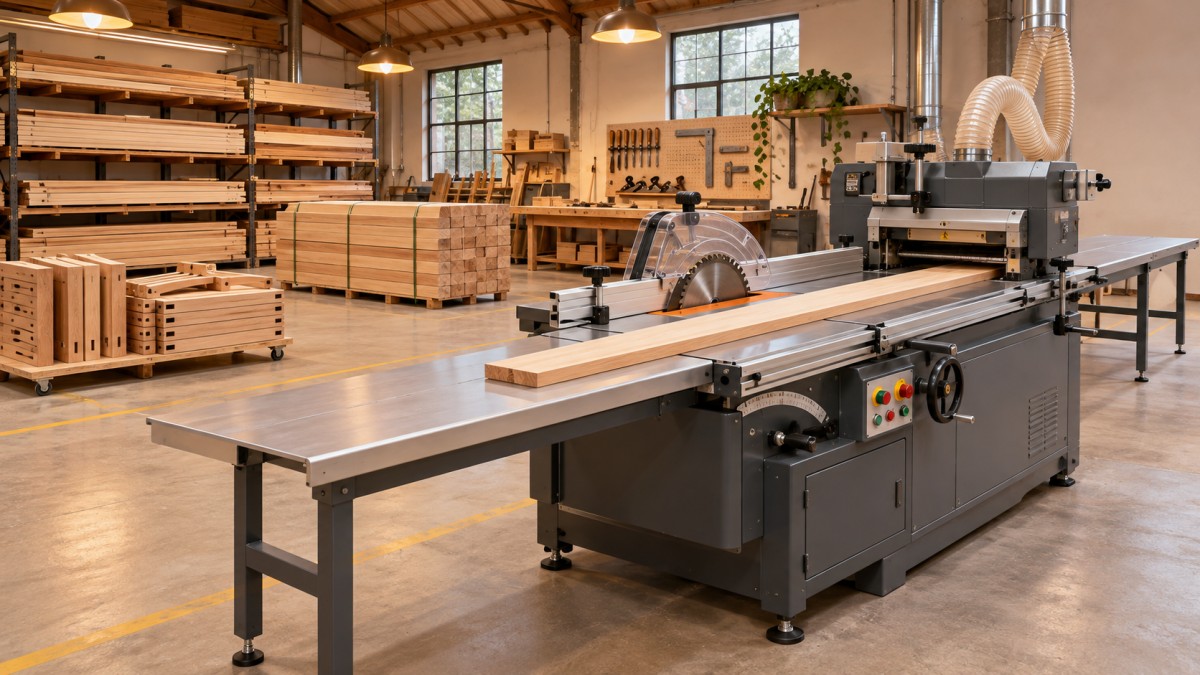
Three-phase supply is worth checking early. A machine that needs 380V three-phase will not run properly on a weak single-phase line with a converter. Voltage drop over a long cable run, a shared circuit and an undersized breaker all cause the same symptoms: slow start-up, stalling in thick hardwood, and nuisance tripping that gets blamed on the machine. Before ordering, ask the supplier for the full-load current, the recommended breaker size and the cable size for the run from your distribution board.
Do not forget the loads around the machine. Dust extraction is not optional for a planer and a spindle moulder, and it needs its own power: a typical workshop extractor adds several kilowatts, and it should start before the machine, not at the same moment. Compressed air, lighting and any separate feed unit belong in the same calculation. If the total is close to the limit of your existing supply, it is cheaper to know that now than to pay for an upgrade after delivery.
A practical power check before you sign
Ask for three things in writing: the installed power of each function, the recommended supply and breaker, and the starting method. A soft start or inverter drive softens inrush and makes the machine easier to live with on a limited supply. If the supplier cannot give you those details for the exact configuration you are buying, treat that as a warning sign.
Space: the footprint is the smallest number
Catalogues list length, width and height. That is the machine itself, not the workspace it needs. A joinery combination machine needs infeed and outfeed room on both the saw and the planer side. If you plan to rip a 2.4-metre board, you need clear space before and after the saw, plus room for the operator to stand safely to one side. In a cramped shop, the board hits the wall before the cut is finished, and the operator ends up lifting, turning or cutting the board down just to fit the room.
As a rough planning guide, allow the footprint plus at least one full board length on the infeed side and a similar length on the outfeed side for your longest regular workpiece. Add a working aisle of around 800 mm to 1,000 mm where the operator stands, and keep it clear of stacked timber, offcuts and finished parts.
Height matters too: check headroom with the fence and any guard raised, not just the height of the main body, and leave room for extraction ducting above.
Maintenance access is easy to forget until the first blade change. The operator needs to reach the saw blade, the planer knives and the spindle from a safe position. Leave access on at least one long side and the end where knives and cutters are changed; if that space becomes storage, blade changes take longer and safety suffers. Delivery access matters too: measure the door and any turn the machine must make before it arrives.
Capacity: daily output is about changeovers, not cutting speed
A combination machine can cut fast. It cannot change function fast unless the design and the working method allow it — and that is the point most capacity estimates miss. Switching from sawing to planing to the spindle means moving fences, changing cutters, adjusting tables and checking the first piece. On a good machine with clear scales and repeatable stops, that might take a few minutes. On a poorly set-up machine it can take much longer.
Daily capacity therefore depends on batch size. If you run 50 identical cabinet sides, changeover time is a small part of the day. With small mixed batches, changeover time can dominate. A shop doing mostly one-off joinery should judge a machine by how quickly and accurately it can be reset, not by its maximum feed speed: fence adjustment, table locking, cutter changing and how easily it returns to a previous setting. Those details decide whether the machine keeps up with the order book.
Material also sets the limit. Hardwood, wide boards and deep cuts need slower feeds and more power. A machine that planes softwood at a good speed may struggle with dense hardwood at the same depth of cut, so your daily target should be based on the hardest material you use regularly, not the easiest. The same applies to the spindle moulder: a large profile in hardwood needs a slower feed and a sharp cutter; a small round-over in softwood does not.
A realistic way to estimate output is to count finished pieces, not metres cut. Take a typical job, break it into sawing, planing, thicknessing and moulding steps, add handling time between them, then add changeover time for each switch. If that total does not fit the working day, the answer is not always a bigger machine: it might be a better sequence, a second set of cutters ready to go.
Three setups that usually work
There is no single right size. The table below is a planning starting point only; every figure should be checked against the specific machine and your own material and layout.
The point of the table is not to pick a row and stop thinking; it is to spot a mismatch. If your power supply fits the small row but your daily target fits the production row, something has to change: the supply is upgraded, the target is split across two machines or two shifts, or the work is sequenced differently. A mismatch found on paper is a conversation. The same mismatch found after installation is a rebuild.
Qingdao Zhongding Machinery Co., Ltd. has spent more than 20 years supplying woodworking machinery to furniture makers and workshops around the world. Much of that work is about helping a buyer check the supply, the floor plan and the daily workload together, so the machine ordered is the one the workshop can actually run. That check, done before shipment, saves more time than any later adjustment.
Mistakes that cost the most
The most expensive mistake is buying for the biggest job you have ever had, not the job you do every week. A machine sized for a rare 300 mm wide hardwood board will be oversized and underused for the other 95% of the work. The opposite mistake is just as common: buying the smallest machine that can just do the job on paper, then finding that every heavy cut needs a slower feed and every long board needs a second person.
Another common problem is forgetting dust extraction in the layout. If the extractor ends up far away with long, bent ducting, suction drops and the planer clogs; if it blocks the outfeed, the operator works around it all day. Plan the extraction route at the same time as the machine position, not afterwards.
Training is part of capacity too. An operator who is confident with the saw but unsure about the spindle will avoid it, or use it slowly, which lowers output and increases risk. A short, practical handover covering changeovers, cutter setting and safe feeding is not a luxury; it is what turns the specification into real daily output. Ask what training, manuals and spare parts support are included.
How to size it before you order
Before you ask for a price, write down four things: your longest and widest regular workpiece, your hardest regular material, your typical batch size, and the power available where the machine will stand. Add a simple sketch of the room with infeed, outfeed, extraction and access marked. That one page tells a supplier more than a list of maximum figures, and it makes quotations easier to compare.
Then ask the supplier to confirm the same four things back: the power and breaker for that configuration, the working space needed for your longest board, the changeover steps between your main functions, and what is included for extraction, training and spares. If any answer is vague, ask for the wiring diagram, the footprint drawing or a short video of a changeover.
A joinery combination machine earns its place when it fits the workshop, not just the catalogue. Get the power right so it starts and cuts without tripping, give it the room it needs, and judge its capacity by finished pieces in a real day, including changeovers. Do that, and the machine will do what it was bought for: steady, safe joinery work without stalled cuts, cramped handling or a costly upgrade a few months later.
Send Your Inquiry
We welcome your cooperation and we will develop with you.