


News & Exhibitions
Latest Factory Updates, Industry Trends & Global Exhibition Information
Six-Sided vs. Three-Sided CNC Drilling for Wood Panels
Six-sided drilling is usually the stronger choice when furniture panels regularly need holes on both broad faces and several edges, and when reducing panel turning is important. A three-sided machine can be a more economical fit when most work falls within its accessible drilling directions and any remaining operations can be completed without disrupting production.
The distinction is not simply the number in the machine description. A panel may have shelf-pin holes on one face, connector holes along two edges, and fixing holes on the opposite face. Whether a particular wood panel cnc drilling machine can complete that pattern in one pass depends on its spindle arrangement, panel handling, software, and access around clamps. Comparing machines against actual panel drawings is therefore more useful than comparing labels alone.
Start with the faces the machine can actually reach
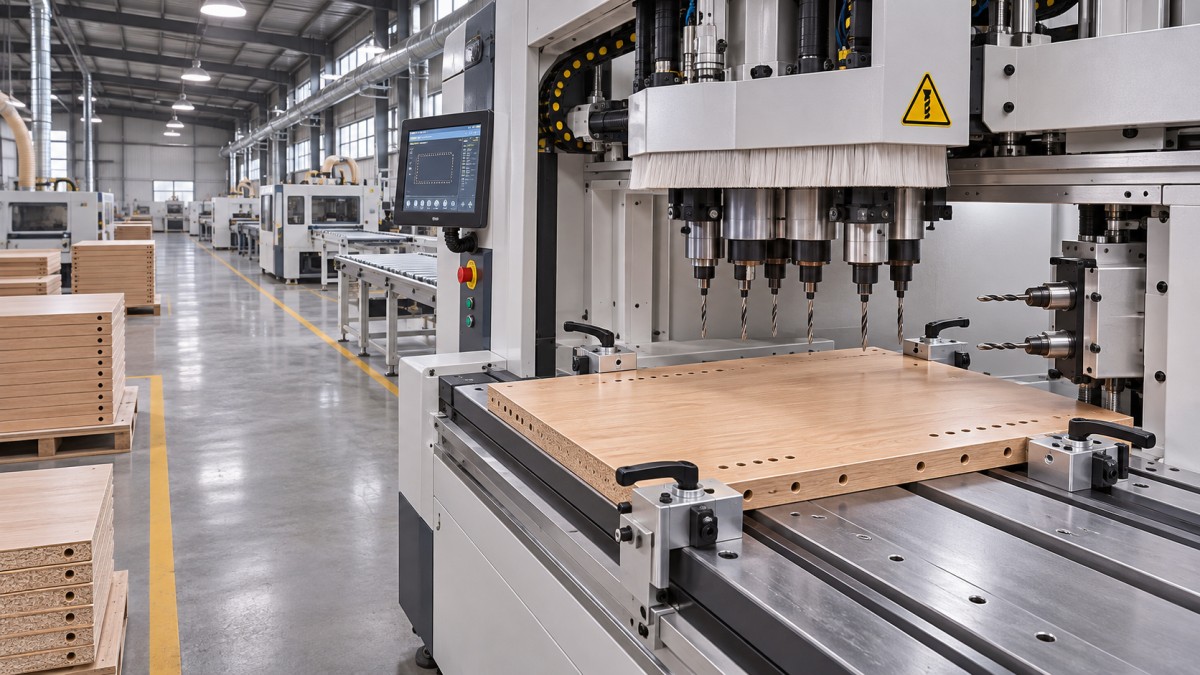
A rectangular panel has six faces: the top and bottom surfaces and four edges. A six-sided CNC drilling configuration is designed to machine all six, typically using drilling units and panel positioning systems that allow access to the upper and lower surfaces and the edges. Depending on the machine and the program, this may reduce or eliminate manual flipping between operations.
Three-sided is a less precise purchasing description. It generally indicates that the machine can drill a more limited selection of panel faces or directions, but suppliers do not necessarily use the term in exactly the same way. One configuration may provide vertical drilling from above plus horizontal drilling in selected directions; another may reach a different combination. Ask for a diagram showing accessible faces and spindle directions rather than assuming that every three-sided machine processes the same three faces.
Neither label guarantees that every hole can be completed without repositioning. A clamp may cover a required hole, a short workpiece may need special handling, or a drilling unit may lack the required bit or stroke. A six-sided configuration describes the machine’s potential access, not a promise that every component will run in one uninterrupted cycle.
Translate panel drawings into a machine requirement
Before requesting quotations, select a representative set of components rather than relying on the most complicated drawing alone. Include high-volume parts, small and large panels, thin components, and parts with holes on opposite faces. Mark each operation by face, diameter, depth, and orientation. Separate through holes from blind holes, and identify any slots or routing operations that are part of the same process.
Then ask each supplier to map those operations to the proposed machine. The answer should identify which holes are drilled from above or below, which are drilled horizontally, and which require a second setup. Do not assume a drilling machine includes routing or grooving simply because those operations appear in the furniture design. Verify the relevant spindle, cutter, working envelope, and software functions separately.
The distribution of work matters as much as the most demanding part. If only an occasional component needs a hole on the reverse face, a secondary operation may be reasonable. If reverse-face drilling is present throughout the daily mix, repeated unloading, flipping, re-referencing, and reloading can become a significant part of the workflow. A six-sided machine is more likely to justify its extra capability in the latter situation.
Check the panel size range, not just the maximum
A machine’s maximum panel dimensions are easy to compare, but minimum length and width can be equally decisive. Short or narrow parts may be difficult to grip while keeping the drilling area clear. Confirm the minimum and maximum workpiece dimensions, allowable thickness range, and whether small parts require a carrier, a special setup, or a separate process.
Also identify holes close to panel edges and corners. Suppliers should confirm edge distances, horizontal drilling depth, spindle reach, and restrictions caused by clamps or supports. A nominally accessible face is not useful if the machine cannot place a required hole where the drawing specifies it.
Compare the complete cycle, including handling
Machine drilling time is only part of the production cycle. A fair comparison includes loading, barcode or program selection, clamping, positioning, drilling, any clamp repositioning, unloading, and movement to the next operation. For three-sided equipment, include the time and space needed to turn the panel or transfer it to another machine. For six-sided equipment, include any extra positioning or clamp movements needed to reach the required holes.
Ask suppliers to estimate cycle times for the same drawings and operating assumptions. The comparison should state whether loading is manual or automatic, how programs are called, and whether the estimate includes all required holes. A short simulated drilling cycle is not comparable to a complete part cycle that includes handling and repositioning.
Batch size also changes the calculation. Repetitive panels can make a simple setup attractive, especially when the operator can process the remaining side efficiently in a separate step. A varied production mix may put more weight on program transfer, identification, and avoiding errors when panels change frequently. Consider whether the machine can read the production files already used in the workshop and what work is needed to convert them into drilling programs.
Look beyond the first machine quote
The purchase price should be compared with the cost of the entire proposed process. A lower-priced machine may need additional labor, a second workstation, more floor space, or an intermediate storage area. A more capable machine may require a larger initial investment, additional tooling, and more demanding maintenance. Neither configuration is automatically cheaper over its working life.
Build a simple comparison using figures from your own operation and supplier quotations:
- Initial scope: machine, drilling units, tooling, software licenses, installation, training, and any material-handling equipment.
- Operating work: expected labor for loading, unloading, turning, program preparation, and secondary operations.
- Ongoing support: consumables, spare parts, software support, preventive maintenance, and the availability of service.
- Capacity constraints: the number of panels required per shift and the effect of one machine stopping on downstream assembly.
Keep assumptions visible. For example, do not credit a six-sided machine with eliminating a second operation until the supplier has confirmed that the relevant hole pattern, panel size, and tooling are supported. Equally, do not treat all extra handling on a three-sided machine as dedicated labor if it can genuinely be absorbed into an existing workstation without affecting output.
Accuracy depends on referencing as well as drilling
Panel furniture relies on relationships between holes: connector bores must align with mating parts, and shelf-pin rows must be positioned consistently. A machine’s stated positioning accuracy is useful, but it does not by itself establish the accuracy of a finished component. Panel squareness, edge quality, clamping, bit condition, material stability, and the way the program references the part all affect the result.
Repositioning deserves particular attention when comparing the two configurations. Turning a panel for a second setup introduces another opportunity for orientation or reference errors. A six-sided machine may reduce that exposure, but its own clamp changes and positioning sequence still need to maintain the required relationship between faces. Ask suppliers to explain how the panel is referenced before and after repositioning, and whether the control system handles clamp avoidance automatically.
Acceptance criteria should use the dimensions that matter for assembly, not just a general statement that the part is accurate. Define which hole positions and depths will be measured, the reference edges, the measuring method, and the permissible deviation according to your drawings. Include at least one panel with holes on multiple faces and one near the proposed minimum workpiece size.
Where each option tends to fit
A three-sided configuration is worth serious consideration when the accessible directions cover the majority of regular work, the missing operations are predictable, and a practical secondary process already exists. It can also suit a workshop that wants to automate a defined drilling stage without replacing every subsequent operation. The limitation is that changes in product design may create more reverse-face or edge drilling than the machine can conveniently handle.
Six-sided drilling becomes more attractive when parts frequently combine top, bottom, and edge holes, or when panel turning creates a bottleneck. It is also relevant when the production system sends many different panel programs to the machine and consistent identification and handling are important. Its value depends on keeping it supplied with suitable work; purchasing unused drilling capability will not solve a bottleneck elsewhere in the line.
There is a middle ground: retain a simpler drilling stage for standard components and send only complex parts to a more capable machine or secondary operation. Whether that arrangement works depends on routing, available capacity, and the cost of moving panels between stations. Compare it against both machine options using the same expected product mix.
Put the comparison into the purchase specification
Provide each bidder with the same panel drawings, material types, thickness range, expected production mix, and required output. Request a written response identifying unsupported operations, necessary tooling, and any assumptions about handling. This exposes differences that a catalogue description can hide, including whether the quoted drilling heads contain the required bit positions and whether tool changes are manual or automatic.
For a representative part, request a demonstration or an agreed pre-delivery test where available. The test should cover the complete programmed sequence, including loading and unloading, rather than drilling alone. Record cycle time under the stated conditions and measure the agreed features. If the supplier cannot test a particular panel before purchase, document how that capability will be verified during acceptance.
Finally, make the quotation explicit about what happens after installation: training scope, documentation, spare parts, remote support, and response arrangements. For this equipment decision, the most useful purchase specification is not “six-sided” or “three-sided” by itself; it is a defined set of panels and operations that the proposed machine must complete, with any remaining manual work clearly identified.
Send Your Inquiry
We welcome your cooperation and we will develop with you.