


News & Exhibitions
Latest Factory Updates, Industry Trends & Global Exhibition Information
Combination vs. Standalone Woodworking Machines for Small Workshops
Combination vs. Standalone Woodworking Machines for Small Workshops
For small workshops, choosing between combination and standalone woodworking machines is a purchasing decision that shapes floor space, workflow, and long-term operating costs. When sourcing machines pour menuisiers, buyers need to look beyond the purchase price and assess changeover time, production capacity, maintenance access, and supplier support.
Combination machines can conserve valuable space, while standalone equipment may better support simultaneous operations and future expansion. Neither arrangement is automatically more economical. The better choice depends on how material moves through the workshop, how many people need access to machinery, and which operations are already slowing production.
What are you actually combining?
A combination woodworking machine brings several functions into one machine assembly. Depending on the configuration, these may include sawing, surface planing, thicknessing, spindle moulding, or mortising. Some functions share tables, drives, controls, or working space; others remain more independent. The exact arrangement matters more than the number of functions advertised.
Standalone machines dedicate separate units to individual operations, although a planer-thicknesser is itself a common two-function arrangement. In practice, the choice is not always between one multifunction machine and an entirely separate production line. Many small workshops use a mixed setup.
Before comparing quotations, request a clear configuration breakdown: which functions are included, which accessories are optional, what must be repositioned between operations, and whether simultaneous use is permitted. Never assume that separate motors mean multiple operators can safely use the machine at once.
Floor space: compare working envelopes, not machine footprints
A compact machine can still require substantial operating room. Long boards need infeed and outfeed clearance. Sliding tables need travel space. Operators need access to controls, guards, extraction connections, and maintenance points. The footprint shown on a sales drawing rarely captures the entire working envelope.
Combination equipment often reduces duplicated bases and tables, making it attractive where floor area is limited. However, its position must accommodate every included operation. A location that suits thicknessing may be awkward for handling a large panel on the saw.
Standalone equipment takes up more fixed space but offers greater freedom to arrange machines around the actual production sequence. A surface planer and thicknesser can sit near timber storage, while the saw serves a separate assembly area.
A useful layout drawing should show the largest routinely processed workpiece, operator positions, temporary material storage, and service access—not just rectangles representing machines. Check whether one operation blocks a doorway or another workstation.
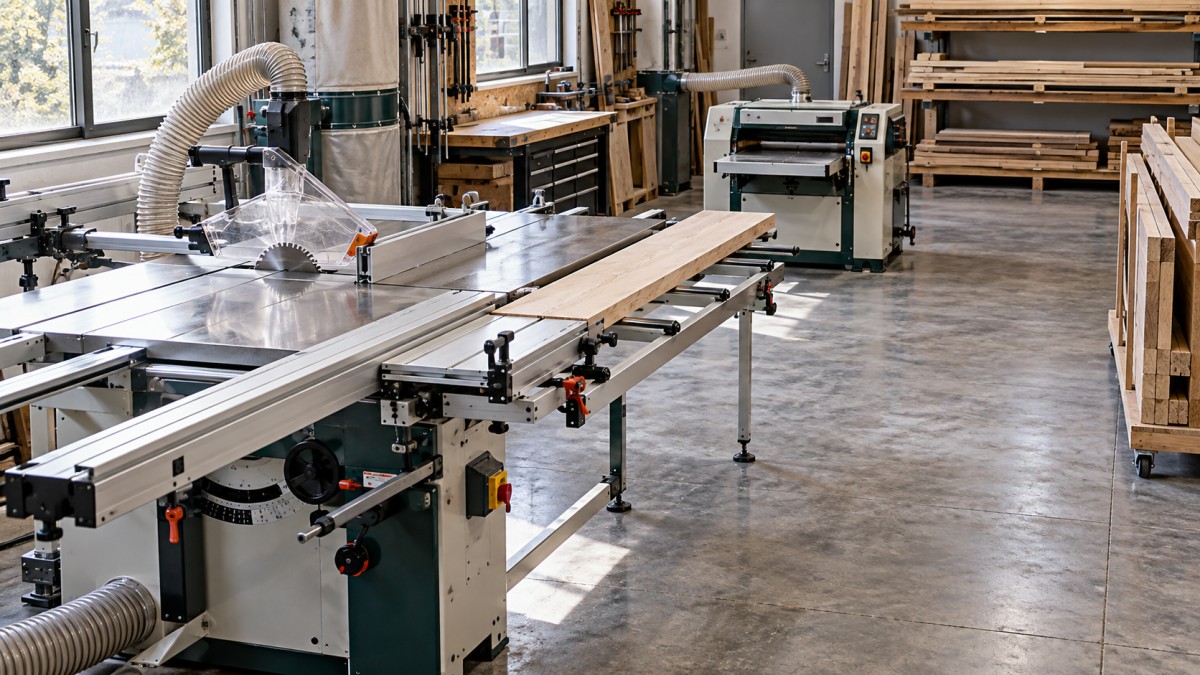
Also trace how material is turned and transferred. Saving floor area is less valuable if workers must repeatedly carry heavy boards around the same machine or move finished components out of the way.
Changeovers can matter more than cutting speed
A multifunction machine may perform each operation well yet still interrupt the working day. Switching functions can involve lifting tables, repositioning fences, changing extraction connections, fitting guards, and checking settings. The steps vary by model, so a general claim of “quick changeover” is not enough.
Consider a workshop producing solid-wood doors. If one operator surface-planes an entire batch, thicknesses it, then moves to cutting and profiling, a combination machine may fit the sequence comfortably. If components return repeatedly for small corrections, frequent switching becomes more disruptive.
Staffing changes the calculation. With one operator, separate machines cannot automatically produce more output; their benefit may simply be keeping settings ready. With several operators, dedicated equipment can allow rough preparation, sizing, and profiling to proceed in parallel, provided material supply and extraction capacity support that arrangement.
Ask for a demonstration using your expected sequence rather than an isolated cutting test. Observe the complete transition between functions, including safe shutdown and verification. Then estimate the daily burden:
Daily changeover time = function changes per day × observed average changeover time.
Use your own job mix for this calculation. A demonstration with conveniently prepared tooling may understate the time required in normal production.
Match capacity to the work, not the number of functions
The label “five-function machine” says little about whether the equipment suits a particular order book. One included function may become the limiting factor, even when the others have adequate capacity.
For solid-timber work, review planer width, usable table length, thicknessing limits, feed arrangements, and cutterhead options. Long or heavy stock also requires suitable support. For panel work, examine usable cutting travel, supported panel dimensions, fence positioning, and scoring capability where the material and finish requirements call for it.
For spindle moulding, confirm compatible tooling, spindle speeds, guarding arrangements, and any power-feed requirements. Do not infer acceptable tooling from motor power alone. Tool diameter, speed limits, spindle configuration, and the manufacturer’s instructions must be considered together.
Accuracy deserves a practical check, too. Ask whether changing functions disturbs fences or reference settings, how those settings are restored, and how alignment is verified. Standalone machines can retain dedicated setups, but they still require correct installation, adjustment, and maintenance.
The strongest acceptance test uses representative material and agreed tolerances. Cutting a convenient sample successfully does not establish suitability for the longest, widest, or most demanding components your workshop regularly handles.
Purchase price leaves several costs out
Combination machines can reduce duplicated equipment and installation work, but quotations need to cover equivalent working capability. One offer may include sliding-table accessories, guards, or tooling that another lists separately. Standalone equipment may cost more initially yet avoid repeated setup labour on recurring jobs.
Build the comparison around the equipment needed to complete the same production tasks. Include freight, unloading, positioning, electrical connection, extraction modifications, commissioning, training, tooling, and foreseeable consumables. For imported machinery, clarify delivery responsibilities and which destination charges remain outside the supplier’s price.
Power and dust collection require particular attention. Verify voltage, frequency, phase, motor starting requirements, and the available electrical supply. For extraction, obtain the manufacturer’s airflow and connection requirements for each operating mode. A matching hose diameter alone does not establish adequate dust capture.
Separate machines operating together may demand greater simultaneous electrical and extraction capacity. Conversely, a combination machine may need awkward duct routing if ports move during changeovers. Both issues belong in the layout and installation review before the order is placed.
Downtime is concentrated differently
When several operations depend on one machine, a fault in a shared control, supply, or mechanical component may interrupt more than one process. The extent depends on the design and fault location; not every failure disables every function.
Standalone equipment usually separates this exposure, although a failed bottleneck machine can still hold up the whole workshop. Assess which jobs could continue during a breakdown and which could not. Then ask about diagnostic support, spare-parts identification, maintenance access, and replacement procedures for critical components.
A mixed setup is often worth pricing
Buying every function separately is not the only route to better workflow. A workshop might combine surface planing and thicknessing while keeping a dedicated saw. Another may retain an existing combination machine for occasional operations and add standalone equipment where demand has become persistent.
This approach works best when the additional machine removes an identifiable constraint. If the saw is occupied throughout the day, separating it may help more than replacing the entire machine set. If planing happens only in occasional batches, dedicated planing equipment may be difficult to justify.
- Lean toward combination equipment when space is tight, one operator handles most machining, and work can be grouped into batches.
- Lean toward standalone equipment when several operators need concurrent access, settings must remain undisturbed, or one process has sustained demand.
- Price a mixed arrangement when only one operation creates queues or future demand remains uncertain.
These are starting points, not purchasing rules. Confirm them against an actual week of work, including urgent corrections and short runs—not only the ideal production sequence.
What to establish with the supplier before ordering
Send prospective suppliers a workshop drawing, representative workpiece dimensions, material types, staffing arrangements, and the operations you expect to perform. Request a proposed layout and an itemized configuration. This creates a more useful discussion than asking which machine offers the most functions for the lowest price.
Qingdao Zhongding Machinery Co., Ltd. manufactures and exports woodworking machinery, drawing on more than 20 years of industry experience. Its stated support scope includes technical assistance, spare-parts supply, and after-sales service. When comparing a proposal from Zhongding or another supplier, turn those capabilities into specific commitments: available documentation, commissioning scope, troubleshooting arrangements, and the process for identifying and ordering replacement parts.
Request documentation relevant to the destination market and proposed configuration; do not treat general certification language as confirmation of local compliance. Agree on acceptance checks covering function changes, guarding, settings, and representative machining results.
For a small workshop, the right purchase is the arrangement that fits the available space without creating an avoidable queue. Before approving it, walk through one real job from rough material to finished component. If the layout, changeovers, utilities, and support plan all hold up through that exercise, the decision has a sound operational basis.
Send Your Inquiry
We welcome your cooperation and we will develop with you.