


News & Exhibitions
Latest Factory Updates, Industry Trends & Global Exhibition Information
Woodworking Machinery Costs: Budgeting Beyond the Purchase Price
A woodworking machine can fit the purchasing budget and still exceed the budget needed to put it into production. The gap often appears when a workshop prepares the electrical supply, connects dust extraction, orders application-specific tooling, or schedules operator training. For buyers comparing machine menuiserie quotations, these omissions can delay production and make the lowest equipment price misleading.
Budget against total ownership cost, not the machine price alone. Separate the landed and installed cost from recurring operating expenses, then compare both against expected usable output over the same ownership period. A sound purchasing decision also accounts for maintenance access, spare-parts availability, and the cost of production interruptions—not just the features listed in the quotation.
Start with the production requirement, not the quotation
A meaningful cost comparison begins with a shared production specification. A machine intended for occasional solid-wood work faces different demands from equipment processing panel furniture throughout a shift. Material dimensions, batch sizes, finish requirements, and changeover frequency affect both the configuration required and the cost of running it.
Record the actual work the machine must perform before requesting prices:
- Material types, thickness ranges, and maximum workpiece dimensions.
- Required operations and acceptable dimensional or surface-quality limits.
- Expected production volume, shift pattern, and typical batch size.
- Available floor space, electrical supply, extraction capacity, and compressed air.
- Operator experience and the amount of programming or setup support needed.
Use representative products rather than only the easiest component in the range. A machine that meets its advertised feed speed may still miss the required output when loading, tool changes, inspection, and rework are included. Conversely, paying for capacity that downstream operations cannot use ties up capital without necessarily increasing shipments.
Build the budget in separate cost layers
Keep acquisition costs, operating costs, and production risks visible instead of combining everything into one allowance. This makes omissions easier to identify and prevents installation expenses from being mistaken for recurring costs.
Confirm the currency, quotation validity, payment milestones, and ownership period used in the comparison. For imported equipment, exchange-rate exposure and financing costs may change the cash requirement before production starts. Treat recoverable taxes separately from permanent costs, while still allowing for their effect on cash flow.
The gap between delivery and productive operation
A delivered machine is not necessarily a production-ready machine. The installation budget should follow the equipment from the delivery vehicle to accepted production, with responsibility assigned at every step.
Access, positioning, and utilities
Check packed dimensions, machine weight, unloading requirements, doorway clearance, and the route to the operating position. Include space for feeding long panels or timber, removing finished work, opening service covers, and handling waste. Any lifting or foundation requirements should be confirmed before transport is booked.
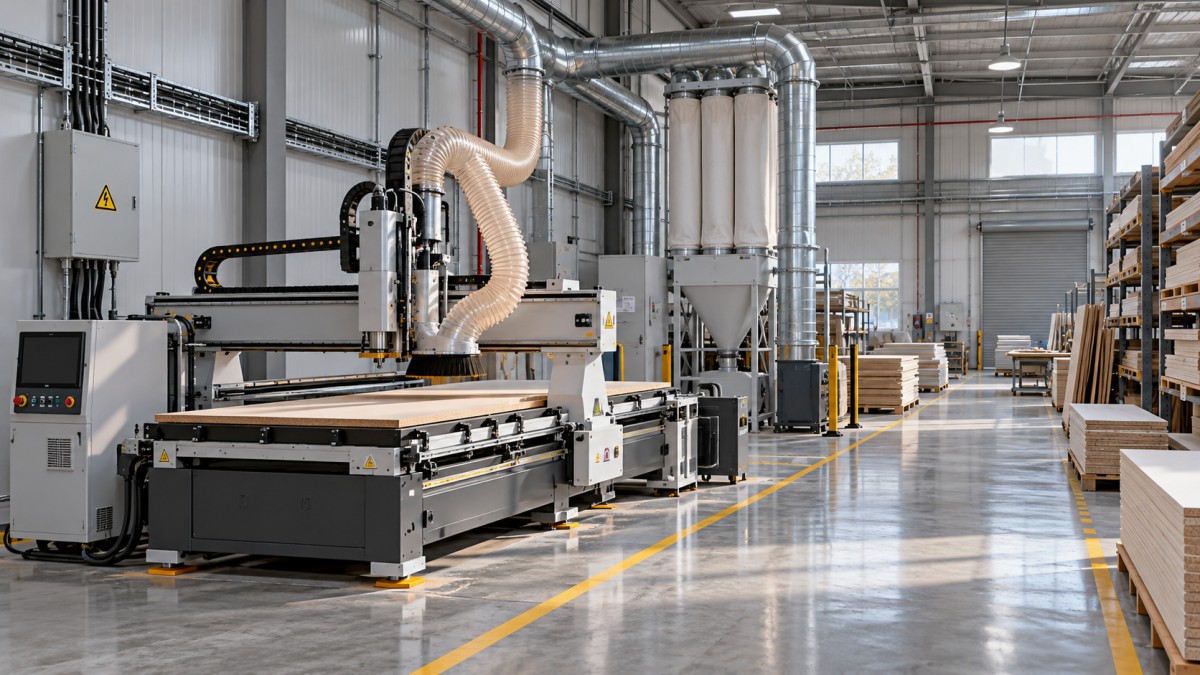
Electrical compatibility involves more than matching a voltage label. Have a qualified person assess supply capacity, phase and frequency compatibility, protection requirements, isolation, and connection work. Dust extraction must suit the machine connections and process demand; an existing collector should not be assumed adequate simply because a spare branch is available. Compressed-air quality and capacity also matter where pneumatic functions are used.
Commissioning, acceptance, and training
Clarify whether the supplier’s commissioning charge includes travel, accommodation, translation, operator instruction, and maintenance training. Remote guidance and on-site support have different practical limits, especially when the receiving team has little experience with the machine type.
Agree on acceptance criteria before placing the order. These should connect to representative materials, required quality, safe operation, and the supplied configuration. Document who provides test stock and tooling, how defects are recorded, and which unresolved issues prevent acceptance. Without this agreement, a successful no-load demonstration can be confused with readiness for production.
Include startup materials and trial production in the budget. Setup adjustments, operator familiarization, and process tuning can consume stock and labor even when the equipment is functioning correctly.
Estimate running costs from the work, not the motor rating
The nameplate power rating is useful for infrastructure planning, but it is not a reliable electricity bill forecast by itself. Actual consumption depends on operating load, idle time, duty cycle, and auxiliary equipment.
Estimated electricity cost = average operating power × operating hours × applicable electricity rate.
Use measured or supplier-supported average power assumptions where available. Add extraction, vacuum pumps, compressed air, and other auxiliaries when they are needed for the process. Where tariffs include demand charges or time-dependent rates, model those separately rather than applying a single flat rate to every scenario.
Tooling deserves its own calculation. Saw blades, cutterheads, router bits, sanding abrasives, and sharpening services can materially affect operating cost. Their consumption depends on material, contamination, machining parameters, finish requirements, and tool care. Ask which tools are included, whether they suit the planned materials, and which replacements are readily obtainable.
Other consumables vary by machine. Edge processing may require adhesive and cleaning materials; sanding requires abrasives and extraction-related maintenance; CNC work may require spoilboards, seals, collets, or workholding accessories. Include only items relevant to the proposed process, but do not hide them inside an undefined maintenance allowance.
Labor should reflect the complete cycle: loading, positioning, setup, programming, unloading, inspection, and cleaning. Automation reduces cost only where it removes work or increases usable output. A faster machining cycle may have little financial effect when one operator still spends most of the shift handling material.
Price maintenance and downtime separately
Scheduled maintenance is a planned expense. Unplanned downtime is a production exposure. Combining them into a single percentage obscures whether a machine is inexpensive to maintain or merely poorly supported.
Request the maintenance schedule and identify tasks the workshop can perform internally. Budget for lubricants, filters, wear components, inspection time, and specialist servicing where required. Check whether routine adjustments require proprietary tools or supplier access, and whether maintenance work can be completed without disrupting adjacent equipment.
For spare parts, distinguish standard industrial components from machine-specific items. A locally available component may be straightforward to replace, but compatibility still needs confirmation. A proprietary control module or mechanical assembly may involve diagnosis, overseas shipping, configuration, and recommissioning.
- Ask for a recommended startup and critical-spares list with itemized prices.
- Confirm typical availability and shipping arrangements rather than relying on “parts available.”
- Establish support hours, communication channels, and the escalation route.
- Check warranty exclusions, labor coverage, freight responsibility, and consumable treatment.
Estimate interruption exposure using the machine’s role in the production flow. A bottleneck machine with no alternative route creates a different risk from equipment with spare capacity elsewhere. Consider lost contribution from missed production, unavoidable idle labor, rescheduling, and emergency outsourcing. Avoid counting the same loss twice: lost revenue is not automatically equivalent to lost profit.
Where failure probabilities are unknown, use transparent downtime scenarios rather than presenting an unsupported expected cost. Show what a short interruption and a prolonged parts delay would mean for the business, then assess whether stocking a critical component or arranging backup production is justified.
Compare quotations on a common basis
Before ranking suppliers, normalize their offers. A lower quotation may exclude tooling, training, extraction connections, software functions, or installation work included elsewhere. Ask each supplier to confirm the same scope in writing and mark uncertain items as unresolved costs—not as zero.
A practical ownership calculation is:
Total ownership cost = acquisition and installation + operating and maintenance costs + modeled interruption costs + end-of-life costs − residual value.
Choose the same analysis period and production assumptions for every option. Where payment timing differs materially, finance teams can compare discounted cash flows using an agreed rate. Keep financing treatment consistent so interest is not counted twice.
Then divide by expected accepted output over that period. Cost per machine-hour can help compare operating expenses, but cost per accepted component is often more useful when machines differ in yield, changeover time, or throughput. Use output that the whole production line can absorb, not theoretical maximum capacity.
Residual value should remain conservative unless supported by credible resale evidence. Similarly, do not credit a machine with labor savings unless the operating plan explains how those hours will be redeployed, avoided, or converted into additional saleable production.
Make approval conditional on the unresolved costs
Build a base operating scenario around the expected production mix, then test the assumptions most likely to change the ranking: utilization, tool consumption, labor requirements, energy prices, and downtime. A machine that is economical only at near-continuous utilization may be unsuitable for uncertain orders or frequent short batches.
Keep contingency tied to identified uncertainty. Unconfirmed electrical work, incomplete import estimates, and unclear commissioning responsibilities deserve explicit provisional allowances. Known recurring expenses belong in the operating budget, not in contingency.
Before releasing the purchase order, close the commercial gaps: attach the agreed configuration, site requirements, acceptance procedure, training scope, warranty terms, and spare-parts arrangements. Where a cost cannot yet be fixed, record its owner, estimate basis, and confirmation deadline. This turns an attractive quotation into an accountable investment proposal—and shows exactly what must be resolved before the machine reaches the workshop.
Send Your Inquiry
We welcome your cooperation and we will develop with you.