


News & Exhibitions
Latest Factory Updates, Industry Trends & Global Exhibition Information
What affects woodworking machine shipping costs to Brazil?
What Affects Woodworking Machine Shipping Costs to Brazil?
For a finance team approving a machinery purchase, the supplier’s quoted price is only the starting point. The real investment is the landed cost: equipment value, export packing, ocean freight, Brazilian import charges, insurance, port handling, customs clearance, and delivery to the factory. With heavy woodworking equipment, a small omission in the transport plan can become a meaningful budget variance.
Woodworking machine shipping to Brazil is not priced by one formula. A compact edge bander, a palletized CNC router, and a 7.5-ton beam saw may all travel from the same exporting country, but their freight profile is very different. The machine’s packed dimensions, the departure and destination ports, the purchase terms, and the importer’s readiness in Brazil can change both the visible freight charge and the less obvious local costs.
The practical goal is not simply to obtain the lowest freight quotation. It is to make sure the quotation describes the shipment that will actually move, under terms that leave no major expense unassigned.
Machine Size, Weight, and the Container Decision
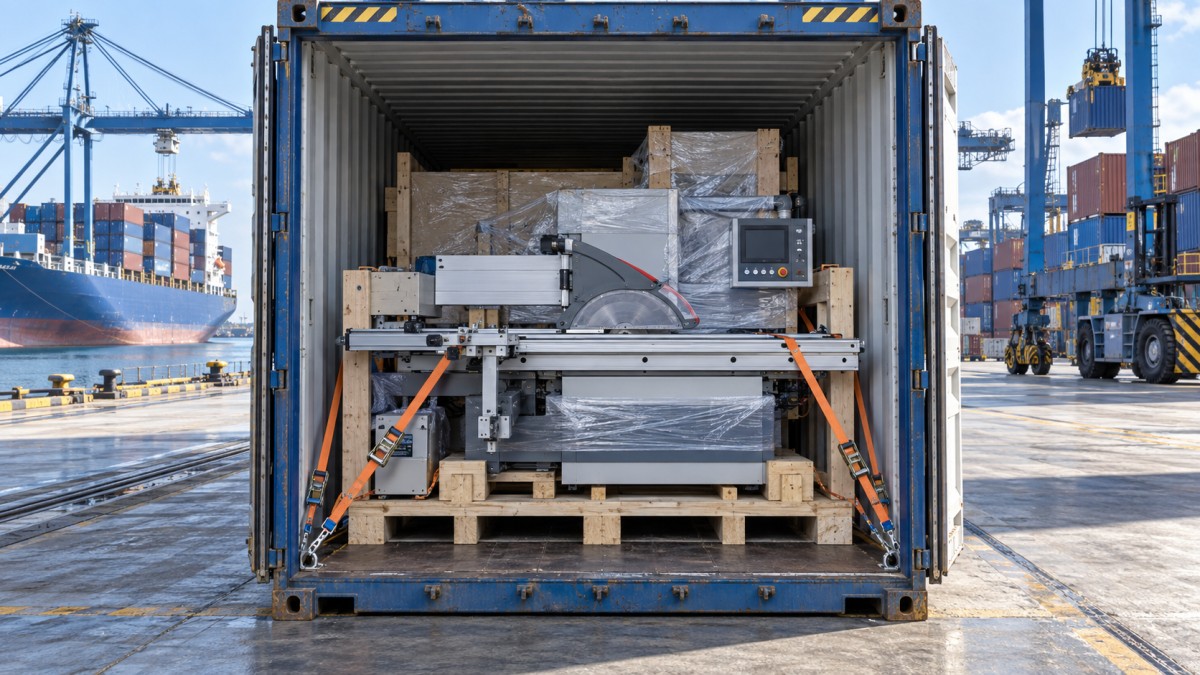
For industrial machinery, dimensions often matter as much as gross weight. Freight forwarders assess whether cargo can be loaded into a standard dry container, requires a high-cube container, must move on a flat rack, or needs breakbulk handling. Each option has a different cost structure and risk profile.
A machine can be heavy yet relatively easy to ship if it fits a container and has stable lifting points. Conversely, a lighter machine with a long bed, oversized frame, or awkward loading geometry may require special equipment. This is why decision-makers should request packed length, width, height, gross weight, number of packages, and package weight distribution—not only the machine dimensions shown in a brochure.
Container selection also affects protection. Full-container shipments usually offer more control over loading and cargo separation than less-than-container-load arrangements. For a high-value production asset, consolidating unrelated cargo may look economical at first but can create additional handling, longer transit coordination, and a greater chance of packaging damage. It may be reasonable for spare parts or small accessories; it deserves closer scrutiny for a major machine.
Consider a rear-loading beam saw used for panel processing. The CNC Beam Saw (Rear-Loading Model) ZD330 has stated machine dimensions of 9200 × 5700 × 1950 mm and a weight of 7500 kg. Those figures immediately signal that transport planning cannot be treated as a routine parcel freight exercise. The exporter and forwarder need to confirm how the unit is divided for shipment, the final crate or skid dimensions, lifting requirements, and whether the destination site can unload the heaviest package safely.
Freight Rates Are Only One Part of the Ocean Leg
Ocean freight changes with carrier capacity, equipment availability, fuel-related surcharges, port congestion, seasonal demand, and the specific route. A quotation to Santos may not resemble one to Paranaguá, Rio de Janeiro, Itajaí, or a northern Brazilian port. The apparent difference can be driven by sailing frequency, transshipment arrangements, empty-container positioning, or the carrier’s current allocation rather than by distance alone.
Financial review should separate the base sea freight from origin and destination charges. Some quotations are attractive because they highlight only the line-haul portion, while terminal handling, documentation, release fees, destination handling, or equipment-related charges appear later. That does not necessarily mean the forwarder has acted improperly; the issue is whether the quotation was compared on the same scope.
Ask for the quotation to identify the named port, container type, cargo validity period, inclusions, exclusions, and assumptions. If the shipment is subject to carrier inspection, overweight restrictions, or special lashing, those items should be visible before the purchase order is released. A freight estimate without the actual packing list is useful for early budgeting, but it should not be treated as a final landed-cost commitment.
Export Packing Is a Cost Control Measure, Not a Cosmetic Detail
Woodworking machinery contains precision parts, electrical components, rails, sensors, motors, and machined surfaces that do not benefit from a long humid voyage. Proper export packing can add cost, but inadequate packing can cost much more through corrosion, movement inside the crate, water exposure, or difficult insurance claims.
The packing plan should match the machine and route. It may include reinforced bases, moisture barriers, corrosion protection, clear center-of-gravity markings, lifting instructions, and separate packing for accessories or tooling. Where wooden packaging is used, the exporter should confirm the relevant phytosanitary marking and documentation requirements with the freight agent and Brazilian import side. It is better to settle this before cargo reaches the port than to discover a packaging issue during clearance.
There is a balancing act. Overbuilt crates increase volume and can push a shipment into a less favorable loading arrangement. Underbuilt crates may reduce the freight invoice while increasing the chance of damage. Experienced machinery exporters normally design packing around actual handling points and container loading conditions, not only around appearance. Qingdao Zhongding Machinery Co., Ltd., which has more than 20 years of woodworking machinery experience, approaches shipment preparation as part of the equipment delivery process rather than an afterthought once production is complete.
Brazilian Import Costs Depend on Classification and Documentation
For many buyers, Brazilian taxes and customs procedures are the largest unknown in the budget. Import duties, taxes, fees, and possible state-level elements depend on the machine’s classification, declared customs value, transaction structure, destination, and current regulatory treatment. It is risky to estimate these costs using a generic percentage from another machine purchase.
A CNC panel-cutting machine, for example, should be classified from its actual function and technical specification, not from a broad label such as “woodworking equipment.” The invoice description, packing list, bill of lading, model information, and technical documents need to be consistent. If the paperwork describes the machine differently from the technical file, customs clarification can delay release and create storage exposure.
The importer should work with a qualified Brazilian customs broker before shipment. The broker can review the likely tariff classification, importer registration status, applicable licensing or documentation questions, valuation basis, and destination-side process under the current rules. This pre-shipment review is usually less expensive than resolving a document issue after the container has arrived.
A useful internal rule is simple: do not approve an “all-in” number unless the party responsible for each element is named. If a broker estimates taxes, clarify whether the estimate includes port fees, inspection-related costs if applicable, storage beyond free time, and local delivery. Those are separate lines in many real shipments.
Incoterms Change the Budget Owner, Not the Physical Cost
Incoterms are often misunderstood as price labels. They are really a way to allocate responsibilities, risk transfer, and certain transport arrangements between seller and buyer. The machine still has to be packed, loaded, shipped, cleared, unloaded, and delivered regardless of whether the contract is EXW, FOB, CFR, CIF, or another agreed term.
Under EXW, the buyer may control more of the logistics chain but also takes on origin coordination that can be difficult from overseas. FOB can make comparison easier when the buyer has a preferred forwarder, provided the named loading port and origin charges are clear. CFR or CIF can simplify ocean booking, but the buyer should still understand exactly what destination charges and import obligations remain. CIF insurance should also be reviewed for scope and claim conditions rather than assumed to cover every type of loss.
For financial control, compare offers on a common basis. A low FOB machine price and a higher CIF machine price cannot be assessed sensibly until freight, insurance, origin charges, local costs, and risk ownership are mapped side by side.
The Inland Move Can Be More Complex Than the Port Arrival
Brazil is geographically large, and the factory may be far from the arrival port. Inland trucking is influenced by distance, road access, cargo dimensions, truck availability, delivery appointment rules, tolls, and the need for special unloading equipment. A container delivered to a metropolitan industrial district is a different operation from one sent to a remote furniture plant.
Before booking, confirm whether the site has adequate gates, turning radius, floor capacity, forklifts or cranes, and trained personnel for unloading. For a machine weighing several tonnes, the question is not merely “Can a truck reach the factory?” It is “Can the cargo be removed from the truck without delaying the carrier’s equipment or creating a safety problem?”
This is also where detention and storage costs can emerge. Delays in customs release, missed delivery appointments, lack of unloading equipment, or slow return of an empty container may generate charges that were not included in the original freight rate. Build schedule contingency into the project plan, especially when installation teams, electrical preparation, and production shutdowns are linked to the delivery date.
Currency, Payment Timing, and Insurance Deserve Their Own Review
International machinery purchases often involve one currency for the machine, another for ocean freight, and Brazilian-real expenses for clearance and local transport. Exchange-rate movement between deposit payment, shipment, arrival, and customs settlement can change the actual capital requirement. This is not a logistics detail; it is a cash-flow issue.
A practical budget separates fixed contractual amounts from variable local estimates and keeps a contingency line for rate movements, port delays, or adjustments after final packing. The same discipline applies to cargo insurance. The buyer should check the insured value, deductible, covered transit stages, claim notification requirements, and whether damage discovered after unpacking can be documented properly. Take photographs at container opening and before installation begins. That simple procedure can matter if a claim is needed.
A Better Approval Process for Machinery Imports
The strongest procurement decisions connect machine selection with delivery reality. For a beam saw intended to cut MDF, plywood, laminate boards, and other panel materials in batch production, capacity and cutting accuracy are important—but so are the cost and feasibility of getting the equipment into the building. The ZD330’s rear-loading arrangement, automatic positioning, and stated ±0.1 mm cutting accuracy may suit a cabinet factory’s production plan, yet the commercial decision should include packaging layout, site unloading, commissioning support, spare-parts planning, and the total time before the machine is productive.
Request a final packing list before confirming the ocean booking. Obtain at least a preliminary import-cost review from the Brazilian side. Compare logistics proposals by scope, not by headline freight. Finally, make one person accountable for reconciling the supplier invoice, freight invoice, broker estimate, and inland delivery quotation into a single landed-cost sheet.
That process may feel more detailed than necessary when the purchase order is being negotiated. In practice, it is where expensive surprises are avoided. For woodworking machine shipping to Brazil, disciplined preparation is usually more valuable than chasing the cheapest initial freight number.
Send Your Inquiry
We welcome your cooperation and we will develop with you.