


News & Exhibitions
Latest Factory Updates, Industry Trends & Global Exhibition Information
Choosing a plywood sanding machine for thickness calibration
Choosing a plywood sanding machine for thickness calibration
Choosing a Plywood Sanding Machine for thickness calibration requires more than comparing working widths and motor ratings. The real question is whether the machine can bring your actual panels within the required thickness range, at production speed, without damaging the face veneer. That depends on the incoming material as much as the sanding equipment.
A machine that produces an attractive surface may still leave unacceptable thickness variation. Conversely, a setup that removes high spots efficiently can be too aggressive for thin decorative faces. Technical evaluation should therefore separate dimensional control from surface finishing, then establish how both will be achieved in the proposed production route.
Define the thickness problem before specifying the machine
“Calibrate to nominal thickness” is not a complete purchasing requirement. Specify the acceptable finished thickness range, variation within a panel, and variation between panels. These are different measures, and a supplier’s accuracy claim may refer to only one of them.
Also distinguish thickness variation from bow or twist. A bowed panel can have reasonably consistent thickness, while a visually flat panel can contain local thick and thin areas. Pressure rollers may temporarily flatten a bowed sheet during sanding; after it leaves the machine, the bow can return. Thickness calibration is not a reliable cure for unstable or badly warped plywood.
Before requesting quotations, record the following for representative incoming stock:
- Thickness readings across the width and along the length, including edge areas.
- Face-veneer thickness and the minimum acceptable remaining face layer.
- Panel dimensions, construction, surface condition, and visible defects.
- Bow, twist, moisture condition, and storage history where available.
- Required output and whether one or both faces need processing.
A useful early rejection rule is simple: sanding cannot add material to an undersized panel. If incoming sheets already fall below the finished lower limit, tighter machine control alone will not make that stock acceptable.
Establish a safe stock-removal window
The available sanding allowance is governed by the thinnest vulnerable face, not just the average board thickness. Local veneer variation, patches, overlaps, and raised areas can consume that allowance unevenly. Ask the plywood supplier for construction details, then verify representative samples rather than assuming the nominal face thickness is available for removal.
This becomes especially important when a panel needs substantial calibration but carries a thin decorative veneer. The correct decision may be to calibrate the substrate before decorative veneering, improve incoming plywood control, or reject unsuitable sheets. Buying a more powerful sander does not resolve a missing material allowance.
For two-sided processing, define removal by face as well as total removal. Equal removal is not automatically appropriate for every construction, but concentrating all correction on one face can sacrifice appearance or affect panel balance. Confirm the intended sequence with the panel specification and examine the result after the sheet has been released from machine pressure.
Choose the sanding heads for the job, not the brochure
For thickness calibration, look for a clearly defined dimensional reference between the abrasive cutting surface and the supported panel. A relatively hard contact roller is commonly used for controlled stock removal. A compliant finishing platen follows surface contours more readily and serves a different purpose; it should not be treated as an equivalent calibration device.
A roller-and-platen combination can provide calibration followed by scratch refinement, but the details matter. Ask which head establishes thickness, how each head is adjusted, and whether finishing pressure changes the final dimension. Contact-roller diameter, hardness, abrasive specification, and machine rigidity need to be considered together.
Floating or segmented pressure systems can help protect sensitive surfaces during finishing. However, a system designed to accommodate panel variation may follow thickness differences rather than remove them. Have the supplier explain the operating mode being proposed and demonstrate its calibration performance.
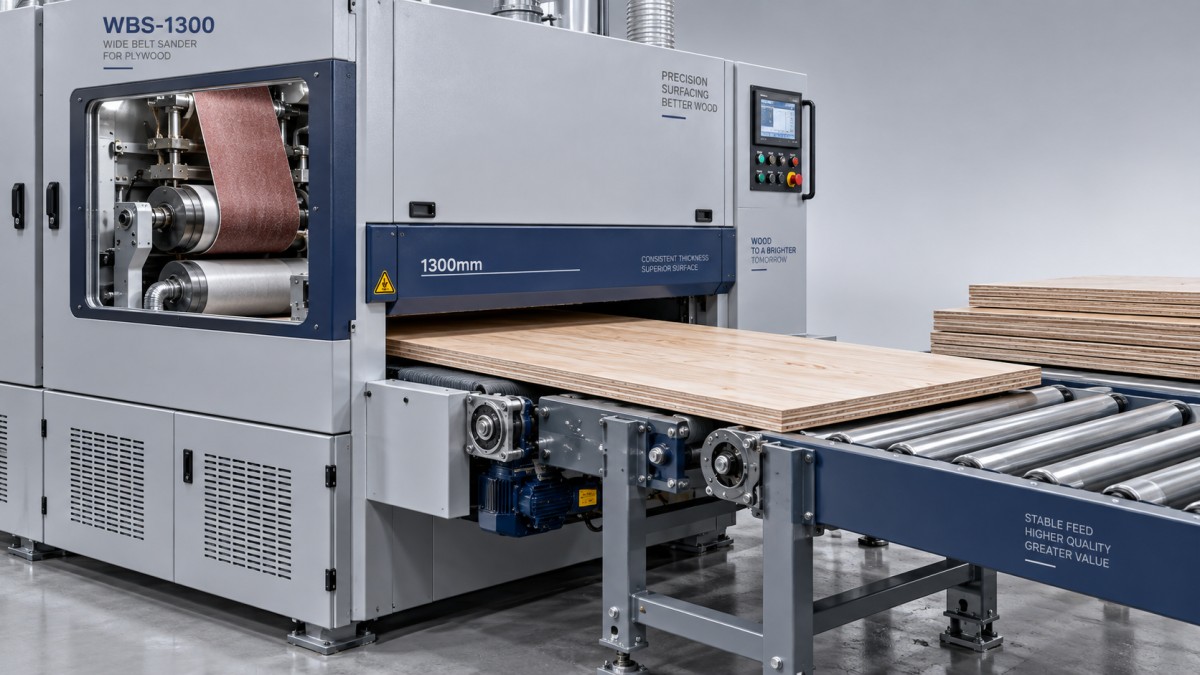
Single-sided and double-sided layouts involve another trade-off. A double-sided system may reduce handling and process both faces in one passage, but it requires careful coordination of removal and panel support. A single-sided machine may suit a more flexible workshop, provided turning, repeat passes, and operator handling are included in the capacity calculation.
Motor power is only one part of removal capacity
A large motor does not establish how much material can be removed safely from your plywood. Usable capacity also depends on working width, feed speed, abrasive condition, wood species, glue lines, extraction, and acceptable finish. Ask for a demonstrated removal rate on the intended material, not a maximum figure detached from operating conditions.
The abrasive sequence should be part of that demonstration. Coarse belts may remove material efficiently but leave scratches that require additional sanding allowance. Starting too fine can increase loading and heat. The right sequence is the one that meets both thickness and surface requirements without exhausting the face veneer.
Feed stability often decides the result
A rigid sanding head cannot compensate for a panel that slips, lifts, or changes support conditions during the pass. Inspect conveyor condition, tracking, bed support, hold-down arrangement, and pressure adjustment. Too little restraint allows movement; excessive pressure can compress the panel or force a warped sheet temporarily flat.
Pay particular attention to leading and trailing edges. Local over-sanding near an end can result from changes in support or pressure as the panel enters and exits. Include those areas in the inspection plan rather than measuring only the easy-to-reach center.
Minimum panel dimensions also deserve checking. A machine may accommodate the required width yet handle short components poorly because of roller spacing or support geometry. If the factory processes both full sheets and cut parts, test both. Do not assume that successful full-sheet trials establish short-part suitability.
Run an acceptance trial that exposes variation
Send a representative batch, including normal production variation and the more difficult panels still permitted by your incoming specification. A few unusually flat sheets prove little. Identify each panel and mark repeatable measurement locations so before-and-after readings can be compared.
Use a calibrated thickness instrument with suitable resolution and consistent measuring pressure. Record moisture condition and agree when measurements will be taken after sanding. Measurement uncertainty must be small enough to distinguish an acceptable panel from a rejected one.
- Fix the operating conditions: record belt type and grit, feed speed, head settings, removal target, and extraction conditions.
- Measure the whole panel: check a defined grid, including edges and ends, rather than relying on an average.
- Inspect surface integrity: look for sand-through, exposed glue, persistent scratches, localized depressions, and damaged patches.
- Check repeatability: process consecutive panels and repeat the assessment after the machine has reached normal operating temperature.
- Test recovery: change thickness settings and return to the original recipe to assess setup repeatability.
Where practical, include a longer run to observe abrasive loading and dimensional drift. A fresh belt on a clean machine is a useful starting point, not a complete production test. Agree on acceptable results before the trial so that attractive samples do not replace measurable acceptance criteria.
Check the downstream process without confusing specifications
Calibration targets should reflect what follows: lamination, machining, assembly, or edge banding. Uneven panel thickness can complicate pressure settings and trimming adjustments, but the downstream machine’s permitted thickness range is not the same as an acceptable thickness tolerance.
For example, the Straight Automatic Edge Banding Machine ZD450C lists a working thickness range of 10–60 mm and feeding speeds of 12–23 m/min, with automatic feeding, gluing, trimming, and polishing. Those figures help assess component compatibility and production planning. They do not establish how much within-panel variation the finished cabinet or furniture component can tolerate.
Nor should its feed speed simply become the sanding speed target. Sanding capacity must include sheet spacing, turning, repeat passes, and inspection. Compare completed acceptable panels per shift, not just conveyor speeds.
Buy a maintainable process, not just a passing sample
Request extraction requirements for the proposed operating conditions, including airflow and connection details. Poor dust removal can load abrasives and degrade cutting consistency. Wood-dust collection and fire precautions also need assessment against the installation and applicable local requirements.
Ask which maintenance tasks preserve calibration: conveyor inspection, bed alignment, roller servicing, thickness-setting verification, and abrasive changes. Confirm replacement belt availability, wear-part lead times, operator training, and access to technical assistance. These details matter more once the installation team has left.
Qingdao Zhongding Machinery Co., Ltd. brings more than 20 years of woodworking machinery experience and offers technical support, spare parts supply, and after-sales service. When evaluating its proposal, turn those service provisions into specific commitments: commissioning scope, recommended spares, troubleshooting procedures, and responsibility for confirming acceptance results.
The strongest purchase specification links incoming plywood limits, safe stock removal, finished thickness, surface quality, and sustained output. Choose the Plywood Sanding Machine that demonstrates those requirements on representative material—and document the settings and maintenance conditions needed to keep achieving them.
Send Your Inquiry
We welcome your cooperation and we will develop with you.