


News & Exhibitions
Latest Factory Updates, Industry Trends & Global Exhibition Information
CNC Panel Saw Machine Price: What Determines the Purchase Cost?
The cnc panel saw machine price is influenced by more than the initial equipment specification. For procurement teams, cutting capacity, automation, component quality, installation, and after-sales support can all affect the total cost of ownership. A lower quotation may look attractive until freight, site preparation, tooling, or operator training is added. Understanding these variables makes it easier to compare offers, avoid unexpected expenses, and select a machine that fits both current production and future plans.
There is no single purchase price that applies to every CNC panel saw. Machines differ substantially in size, configuration, control functions, and supply scope, while shipping and local installation costs vary by destination. The most useful starting point is therefore not a price list alone, but a clear description of the work the saw needs to perform.
What Is Included in a CNC Panel Saw Quotation?
A quotation may refer only to the machine itself, or it may include accessories and services needed to put the equipment into production. Two offers can appear similar while covering very different scopes. Before comparing totals, ask each supplier to identify what is included, optional, or excluded.
For example, an offer that includes a basic machine but excludes blades, extraction equipment, and commissioning should not be compared directly with a more complete package. Ask suppliers to quote against the same list of requirements, then record any differences separately.
Machine Specifications That Drive the Purchase Cost
Cutting size and panel capacity
The maximum cutting length, cutting height, and panel dimensions are among the most important specification choices. A furniture manufacturer processing full-size sheets may need a different configuration from a workshop cutting smaller panels or producing short runs of custom parts.
Buyers should provide suppliers with the dimensions and thicknesses of the materials they use most often, along with the largest panels they expect to process. If stacked cutting is required, state the intended stack height and material type rather than assuming that the maximum cutting height will deliver the desired result in every application. Blade choice, motor power, material properties, and cut quality requirements all matter.
Buying capacity far beyond the actual workload can tie up capital and consume valuable floor space. On the other hand, a machine that cannot accommodate common sheet sizes may require extra handling or pre-cutting, adding labor to every production shift.
Automation and control functions
CNC panel saws can differ in how they position panels, execute cutting sequences, and manage production data. Depending on the configuration, features may include programmable cutting cycles, automatic positioning, optimization software, label printing, or links to other production systems.
These functions affect price, but their value depends on the production environment. A plant processing many repeat orders may benefit from a smooth flow of cutting instructions and labels. A smaller workshop with varied, occasional jobs may place greater value on straightforward programming and easy changeovers.
When evaluating software, ask whether it is included in the quoted price, which functions are standard, and whether licensing, updates, training, or integration will cost extra. Confirm how cutting files are created and transferred, and whether the proposed system can work with the software already used at your facility.
Mechanical construction and component selection
The saw beam, carriage, guides, clamps, drive system, and control components all contribute to the machine’s performance and long-term maintenance requirements. Differences in construction are not always obvious from a brochure, especially when competing models advertise similar cutting dimensions.
Ask for a detailed configuration list rather than relying on broad descriptions. Identify the principal components, their specifications, and the arrangements for obtaining replacements. Also discuss how the supplier checks cutting accuracy and what conditions apply to the stated tolerances. Accuracy depends not only on the machine, but also on installation, tooling, material condition, and operating practices.
Component selection should be judged in the context of serviceability. A lower initial price may be less compelling if a failed part is difficult to source or if technical support is unavailable when production stops.
Material handling and supporting equipment
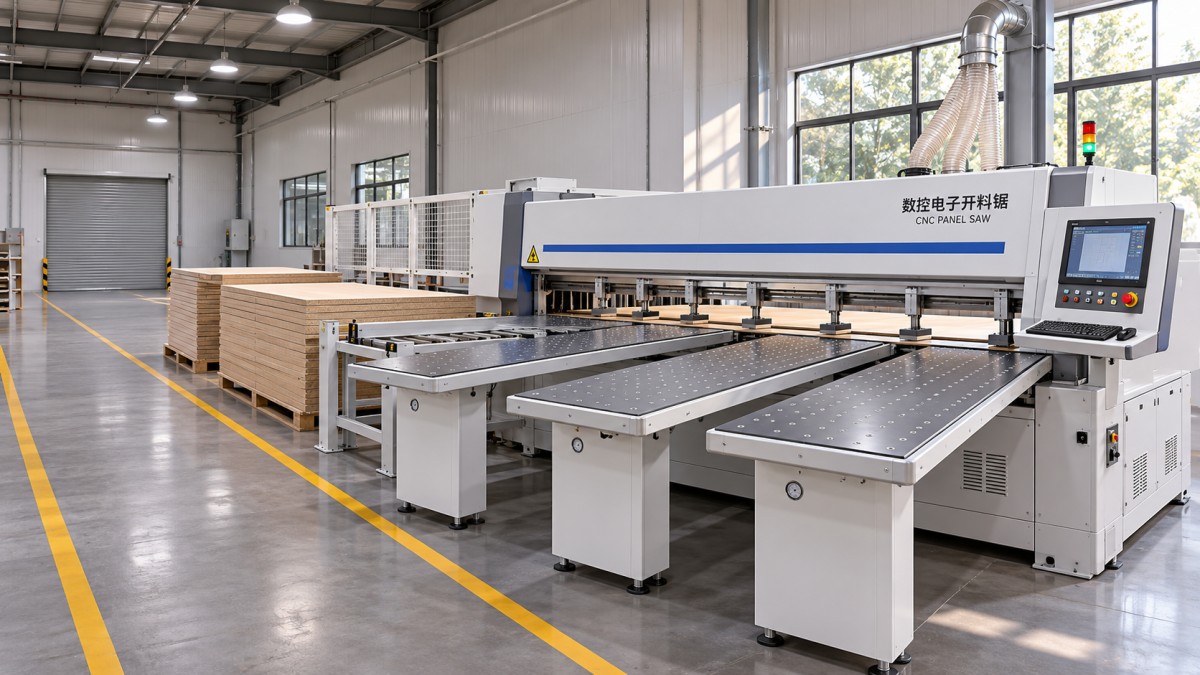
The saw is only one part of the cutting process. Operators must bring panels to the machine, load them, remove cut parts, and move materials to the next operation. Depending on the configuration and production volume, buyers may consider air tables, lifting equipment, conveyors, or automated loading and unloading systems.
These additions increase the purchase scope and require floor space, but they may also reduce manual handling or help maintain a steadier workflow. The right choice depends on panel size, staffing, available space, and how frequently the saw will run. Map the movement of a typical sheet through the cutting area before deciding which options are necessary.
Look Beyond the Machine Price: Total Cost of Ownership
The amount on the purchase order is only the beginning. For procurement teams, the better question is how much the equipment will cost to acquire, operate, maintain, and support over its useful life.
Delivery and import costs. International quotations can be based on different delivery terms. Confirm where the supplier’s responsibility ends and which party pays for freight, insurance, customs clearance, duties, local transport, and unloading. Use the agreed delivery term and named location when comparing offers; otherwise, an apparently lower price may simply exclude more of the journey.
Site preparation. Check the required electrical supply, compressed air, dust extraction, foundation or floor conditions, and access for delivery. A machine that fits on a layout drawing may still need additional clearance for loading sheets, maintenance, and safe operator movement. Obtain these requirements before finalizing the budget.
Commissioning and training. Confirm who installs and tests the saw, what commissioning includes, and whether assistance is provided remotely or on site. If a technician must travel, establish who pays for travel and accommodation. Training should cover routine operation, basic maintenance, safety procedures, and the control functions included in the purchase.
Tooling and maintenance. Blades need to suit the material and finish requirements, and they will require sharpening or replacement. Allow for consumables, routine inspections, lubrication, and replacement parts. Ask for a recommended spare parts list and check which items can be sourced locally versus ordered from the manufacturer.
Downtime and support. A saw that is central to a furniture production line can create disruption when it stops. Consider the supplier’s support channels, working hours, parts ordering process, and ability to diagnose faults remotely. Avoid treating a warranty as a substitute for understanding how service will actually be delivered.
How to Compare CNC Panel Saw Prices Fairly
A practical comparison begins with a shared specification. Give each supplier the same information about materials, sheet dimensions, typical cutting patterns, production volume, available utilities, and required level of automation. Then request an itemized quotation rather than a single lump-sum figure.
- Confirm machine capability. Compare usable cutting dimensions, stack-cutting requirements, motor specifications, positioning functions, and the materials each machine is intended to process.
- Separate standard equipment from options. List software, labeling, tables, blades, handling equipment, and safety-related items individually. Do not assume a feature shown in a photograph is included.
- Normalize delivery and service scope. Calculate each offer using the same destination and include estimated costs for freight, import, installation, and training where they are excluded.
- Review documentation and acceptance criteria. Ask what manuals, electrical information, spare parts lists, and test records will be supplied. Agree on how the machine will be checked against the purchase specification.
- Record unresolved risks. Note unclear warranty exclusions, uncertain parts lead times, software compatibility questions, and any infrastructure costs that still need confirmation.
This process may reveal that the lowest quoted machine is still the right purchase. It may also show that a higher-priced offer includes items the facility would otherwise have to buy separately. Either way, the decision is based on comparable costs rather than assumptions.
Questions Worth Asking Before Placing an Order
- Can the proposed machine process our usual panel sizes, materials, and intended stack heights with the required finish?
- Which blades and consumables are included, and what alternatives are recommended for our materials?
- What are the machine’s utility, space, and dust extraction requirements?
- Does the quotation include software, updates, labels, and integration with our existing workflow?
- What commissioning and training are included, and who pays any travel expenses?
- What does the warranty cover, what is excluded, and how are service requests handled?
- Which spare parts should be kept on site, and how can replacements be ordered?
- What are the payment terms, estimated production schedule, and delivery responsibilities?
It is also sensible to ask for a cutting demonstration or test using representative materials where practical. Agree in advance on the dimensions, finish, and measurements to be checked. A demonstration can clarify how the proposed configuration performs, although results should be interpreted in light of the tooling, material, and operating conditions used.
Choosing a Supplier for Long-Term Production
Price matters, but so does the quality of the information behind it. A useful supplier should be able to explain configuration choices, identify exclusions, and discuss the practical requirements of installation and maintenance. Clear communication before an order can also make it easier to resolve technical questions later.
Qingdao Zhongding Machinery Co., Ltd. manufactures and exports woodworking machinery and has more than 20 years of industry experience. Its business includes equipment for woodworking applications as well as technical support, spare parts supply, and after-sales service. For buyers considering a CNC panel saw, sharing the intended materials, production requirements, and destination allows the discussion to focus on a suitable configuration and the associated purchase scope.
The most useful cnc panel saw machine price is not simply the smallest number on a quotation. It is a price understood in context: what the machine can do, what is included, what remains to be paid, and how the equipment will be supported once production begins.
Send Your Inquiry
We welcome your cooperation and we will develop with you.