


News & Exhibitions
Latest Factory Updates, Industry Trends & Global Exhibition Information
CNC Beam Saw Machine Price: What to Include Beyond the Quote
The cnc beam saw machine price on a supplier’s quotation is only the starting point. Freight, unloading, installation, dust extraction, tooling, training, and future maintenance can change the amount required to put the saw into production and keep it there. A lower machine price may still offer good value, but only if it covers the capacity and support the operation actually needs.
The most useful comparison is the cost of a working cutting operation over a defined period. Start by establishing what each machine must cut, then compare quotations on the same delivery terms and add the costs that fall outside each supplier’s scope.
Start with the cutting job before comparing prices
A CNC beam saw, often called a computer-controlled panel saw, cuts sheet material with a programmed cutting cycle. Its value depends on how well its capacity and workflow match the work entering the factory. Before requesting quotations, prepare a representative list of board materials, sheet sizes, thicknesses, cut quantities, and finished part sizes. Include both the usual workload and any demanding jobs the machine must handle regularly.
Board size affects the required cutting length and the space around the saw. Material and stack height affect the cutting capacity and the tooling needed. Production mix matters too: a factory cutting repeated batches of cabinet parts may benefit from a different loading and labeling arrangement than a workshop producing changing batches with frequent setup adjustments.
Pay attention to what the advertised capacity describes. Cutting length, maximum saw projection, and the thickness of a single board are different measurements. Saw projection helps indicate the potential cutting stack height, but the practical stack depends on the blade, material, cut quality, and the machine’s configuration. Ask suppliers to explain the proposed stack for your actual boards rather than treating the largest quoted figure as a guaranteed production setting.
Also check the sizes of the smallest parts and narrow strips the machine needs to cut. A saw may accommodate a large sheet but require particular handling or cutting sequences for small components. If parts move to edge banding or drilling, the required edge quality and identification method should be part of the quotation discussion.
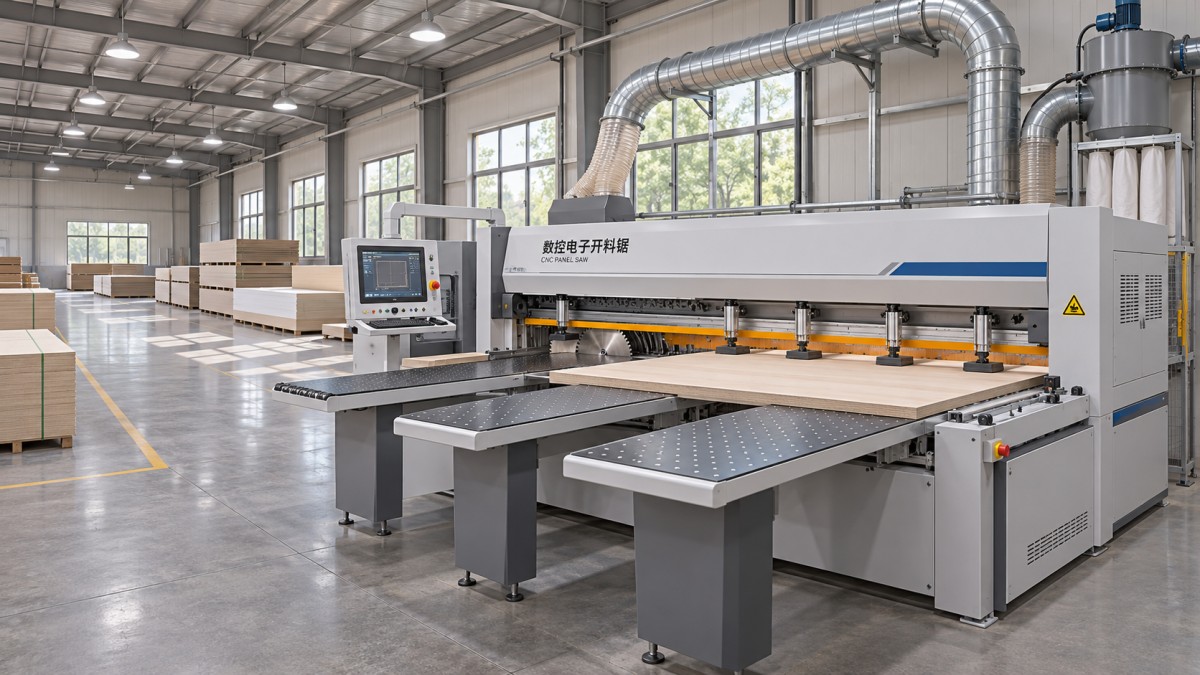
What should be included in a CNC beam saw quotation?
Ask each supplier for an itemized offer using the same production requirements. A useful quotation identifies the machine configuration, included accessories, optional equipment, and services separately. That makes it possible to see whether an apparent price difference comes from the saw itself or from items one supplier has left out.
For every excluded item, assign a realistic allowance or obtain a separate quote. Keep optional items visible rather than simply removing them from the comparison: a feature that appears optional to the supplier may be essential to your workflow.
Account for getting the machine onto the factory floor
Two quotations can use the same currency and still cover very different delivery obligations. One may price the machine at the supplier’s premises; another may include transport to a port or a destination facility. Record the named delivery point and who is responsible for export arrangements, freight, insurance, import clearance, duties, taxes, and onward transport. These costs depend on the route, shipment, and applicable local requirements, so they should be calculated for the actual transaction.
Unloading deserves its own line. A beam saw may arrive in sections or packaging that requires suitable lifting equipment and a clear route into the building. Check access through gates and doorways, turning space, floor suitability, and whether the unloading contractor can place the equipment where the installer needs it. Storage or additional handling can become necessary if the machine arrives before the site is ready.
For imported equipment, coordinate the shipment documents and customs arrangements with the parties handling the delivery. Delays at this stage can affect both the installation schedule and the availability of rented lifting equipment or technicians.
Budget for installation and a usable production setup
Installation costs extend beyond positioning the saw. The site may need electrical work, compressed air, dust extraction, network connections, and floor preparation. Ask for the machine’s utility requirements and connection locations early enough for the relevant contractors to quote. Match the electrical supply to the machine’s specified requirements; adapting an unsuitable supply after delivery can add cost and delay.
Dust extraction is especially easy to understate. The saw’s connection points must be matched to an extraction system and ducting suitable for the installation. If the factory already has extraction, assess whether it has enough available capacity at the machine while other equipment is operating. Include ducting, controls, installation, and any changes to the existing system in the project budget.
Clarify what commissioning covers. Does the supplier level and assemble the machine, connect services, test the cutting cycle, and help establish initial settings? Who supplies the boards used during setup? If a technician travels to the site, identify whether travel, accommodation, and waiting time are included. Remote commissioning may reduce travel costs, but the buyer still needs capable local personnel and a clear division of work.
Set a practical acceptance procedure before signing. Use representative material and agree on the cutting tasks, dimensions to be checked, and any edge-quality requirements. The aim is to confirm that the delivered configuration performs the agreed work under defined conditions, not to rely on a demonstration using an easier material or a different setup.
Choose automation for the bottleneck you actually have
Automation affects both the purchase price and the people and space required around the saw. A configuration with more automatic loading or unloading may be useful when high, repeatable sheet volumes make material handling the limiting step. It may be harder to justify when jobs change frequently, the saw is lightly loaded, or upstream board supply cannot keep pace.
Consider the complete movement of material: how sheets reach the machine, who loads them, where cut parts are placed, and how operators identify and sort them. Additional equipment can reduce manual handling, but it can also add layout constraints, maintenance points, and integration work. Allow for conveyors, lifting devices, or handling aids where the proposed process requires them.
Software deserves the same scrutiny. Cutting optimization can help organize parts into cutting patterns, while labels and data transfer can support sorting and downstream work. Their value depends on the accuracy of the incoming job data and the way the factory manages parts. Ask whether the quoted software imports your existing file formats, whether operators must enter orders manually, and whether licenses, updates, labels, or integration services carry separate charges.
A smaller workshop with varied jobs may prefer a simpler setup that operators can change quickly. A larger operation with regular batches may gain more from integrated loading and production data. Compare the expected workload and staffing for each option instead of assuming that the most automated configuration has the lowest operating cost.
Include blades, maintenance, and downtime in the cost model
Blades are a continuing expense, and the required tooling depends on the material and finish. Laminated panels, for example, may use a scoring blade to help reduce chipping on the underside of the cut. Ask what blades are supplied, which materials they are intended for, and whether the machine requires particular blade dimensions or mounting arrangements. Include a spare set and the cost of sharpening or replacement in the operating budget.
Maintenance planning should cover routine cleaning, lubrication, inspection, adjustments, and replacement wear parts. Request the maintenance schedule and a recommended spare-parts list with part descriptions and prices. Distinguish consumables that the factory can replace from repairs that require a trained technician. A low-cost component can still cause an expensive interruption if it is difficult to identify or obtain.
Support terms need to be specific enough to use. Establish the warranty period and when it begins, which components and labor are covered, and what happens if a part fails. Ask how remote diagnosis is provided, how replacement parts are ordered, and whether local service is available. Shipping a replacement part and installing it are separate responsibilities; identify who pays for each.
Operator training also belongs in the cost model. Training should cover safe operation, loading and clamping, job setup, blade changes, routine care, and fault reporting, as appropriate to the machine. If staff turnover or shift coverage is relevant, ask how many people can be trained and whether manuals, electrical diagrams, and operating materials are supplied in a language the team can use.
Compare the offers on one cost sheet
Use a fixed evaluation period that suits the purchase and list both the initial project cost and the expected operating costs. A practical calculation is:
Total evaluated cost = machine and options + delivery and import costs + site preparation and commissioning + training + estimated tooling, maintenance, software, and service costs over the evaluation period.
Use the same assumptions for material volume, operating hours, staffing, and evaluation period across all offers. Separate firm quotations from internal allowances, and state what each allowance covers. If a supplier has not included an item, assign the cost to the buyer’s side of the sheet rather than treating it as free.
Running costs are estimates, not guarantees. Where a value depends heavily on workload—such as blade consumption or service visits—compare a lower and a higher usage assumption. This shows whether the preferred offer remains attractive if production changes. Keep financing costs and the timing of payments in view as well: deposits, shipment payments, and final acceptance payments affect cash flow even when the quoted machine prices are similar.
Do not reduce the decision to one total. Record the capacity, delivery scope, acceptance criteria, support arrangements, and exclusions beside the cost. A machine that is cheaper over the evaluation period still needs to handle the required boards and fit the factory’s workflow.
Make the request for quotation specific enough to compare
A clear request helps suppliers propose comparable machines and exposes gaps before negotiations reach the final price. Include:
- The materials, sheet dimensions, thicknesses, and representative part sizes to be cut.
- Expected job mix and production volume, including whether work is repetitive or frequently changes.
- Required loading, unloading, labeling, software, and connections to other production systems.
- The delivery destination, available utilities, installation constraints, and preferred commissioning scope.
- Required documentation, operator training, acceptance tests, and spare-parts information.
Send the same requirements to each supplier and ask for deviations to be identified. If an offer proposes a different capacity or excludes a requested service, the difference can then be evaluated deliberately. Qingdao Zhongding Machinery Co., Ltd. supplies woodworking machinery and describes technical support, spare parts, and after-sales service as part of its offering; a request for quotation can establish how those services would apply to the proposed machine and destination.
Before placing an order, bring purchasing, production, maintenance, and the site team together around the final scope. The decision is stronger when the people who will operate and support the saw can see the same assumptions, exclusions, and acceptance conditions as the people approving the expenditure.
Send Your Inquiry
We welcome your cooperation and we will develop with you.