


News & Exhibitions
Latest Factory Updates, Industry Trends & Global Exhibition Information
Automatic Panel Saw vs Sliding Table Saw for Cabinet Production
Automatic Panel Saw vs Sliding Table Saw for Cabinet Production
Choosing between an automatic panel saw and a sliding table saw can significantly affect cutting accuracy, throughput, labor requirements, and material utilization in cabinet production. Automatic systems are designed for efficient, repeatable panel processing, while sliding table saws offer flexibility for varied cutting tasks. The better choice depends less on the machine’s label than on the mix of cabinet parts, the condition of the production data, and what happens before and after the cut.
For technical evaluation, the question is not simply which saw cuts faster. It is whether the complete cutting process can deliver correctly identified parts, within tolerance, at the rate the rest of the factory can use them. A machine with more automation can expose weaknesses in scheduling and material handling just as readily as it removes manual work.
How the two cutting processes differ
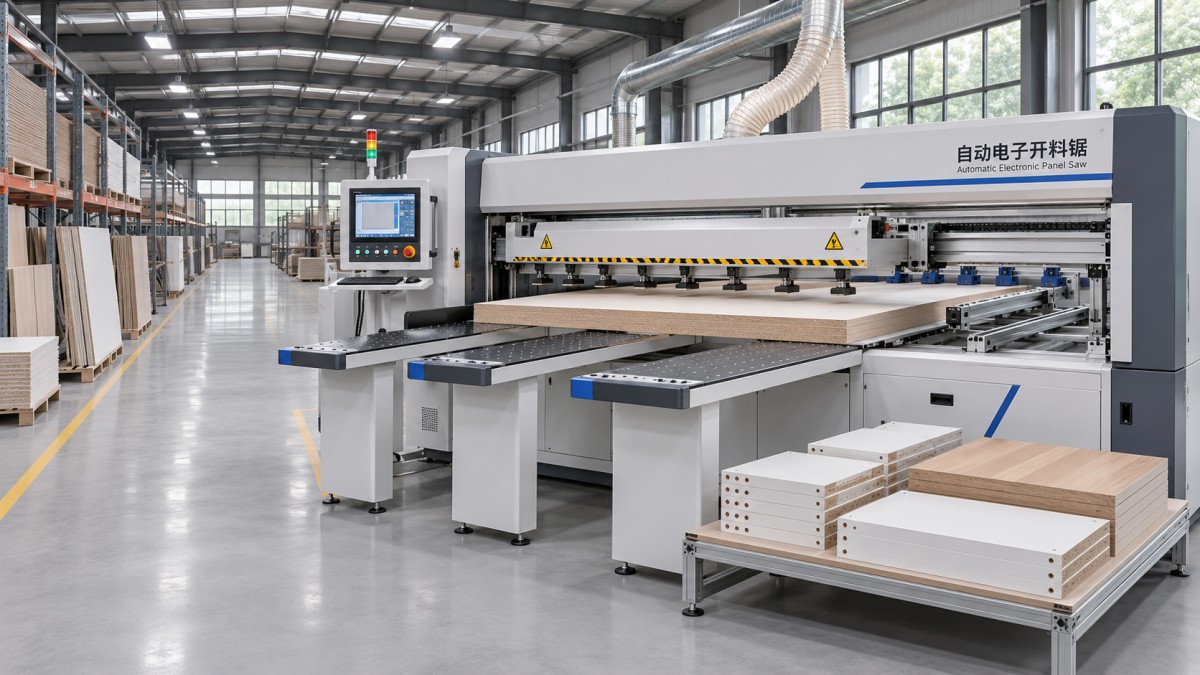
In a typical automatic panel saw configuration, a programmable pusher positions the material for the cut while a saw carriage travels through the panel or stack. The operator loads material, selects or receives a cutting program, and handles the resulting parts. Depending on the configuration, loading, labeling, and downstream movement may also be assisted or automated.
A sliding table saw uses a manually guided sliding carriage to move the workpiece past the blade. The operator sets fences and stops, positions the material, and controls the cutting sequence. Digital readouts or powered positioning can reduce setup work on some models, but they do not make every sliding saw equivalent to a programmed panel saw.
The distinction matters because the equipment shifts work to different parts of the process. With an automatic system, more effort moves upstream into cut-list preparation and material organization. With a sliding table saw, more decisions remain at the machine, where an experienced operator can adjust the sequence as the job changes.
Throughput depends on the cutting pattern, not just cycle time
An automatic panel saw is often attractive when a shop processes full sheets into repeated cabinet components. Once a cutting program is prepared, the pusher can position successive cuts without the operator resetting a fence for every dimension. Where the machine, blade, and material permit stack cutting, several sheets may be processed together. The practical limit must be checked against the specified cutting height and the quality required at the edge; a stack that fits physically is not necessarily a stack that cuts well.
That advantage can shrink when orders contain many materials, frequent changes of thickness, or small quantities of unusual parts. A saw may spend less time cutting than waiting for the correct board, separating pieces, or resolving an incorrect program. Similarly, an operator at a sliding table saw may lose time repeatedly measuring and resetting stops, but can respond quickly when a one-off filler panel or replacement part appears.
Compare output using a representative production mix rather than the fastest cycle shown in a demonstration. Include loading, alignment, cutting, unloading, sorting, labeling, and material changes. If cut-list preparation happens on a separate workstation, include that labor as well. The useful measure is accepted, identifiable cabinet parts delivered to the next operation per shift—not saw strokes per minute.
Accuracy is a system property
A programmable pusher can reduce repeated manual positioning, but it cannot correct every source of error. Panel squareness, pusher alignment, clamping, blade condition, machine setup, and thermal or mechanical changes all influence the finished part. On a sliding table saw, carriage condition, fence calibration, stop settings, and the operator’s handling are equally consequential.
For cabinet production, dimensional accuracy should be evaluated together with squareness and edge quality. A side panel that measures correctly along one edge may still create assembly problems if it is out of square. Melamine-faced board adds another concern: chipping can occur even when the dimensions are acceptable. Blade selection, scoring arrangements where fitted, feed conditions, and support for the workpiece all affect the result.
Ask suppliers to define the conditions behind any stated tolerance. Check whether it applies to positioning, the finished part, or both, and whether it assumes a particular material, panel size, cutting direction, or maintenance condition. A meaningful acceptance test uses the intended board and measures several parts across the cutting area, rather than relying on one favorable sample.
Material yield and part identification
Neither saw automatically guarantees good sheet utilization. Yield depends on the cutting plan, usable sheet dimensions, saw kerf, grain or decor direction, edge defects, and whether offcuts can be stored and retrieved. Optimization software can help arrange rectangular parts efficiently, but its output is only as reliable as the dimensions and constraints entered.
The type of cutting pattern is also important. A beam saw generally produces a sequence of straight cuts across the available material; some nested arrangements generated for a CNC router may not translate directly into that sequence. Confirm that the intended software and saw can exchange usable files and that the plan accounts for trim cuts, blade kerf, and the actual panel sizes supplied.
Part identification deserves the same attention as yield. Similar-looking cabinet sides, shelves, and stretchers can be difficult to distinguish after cutting, especially when dimensions differ only slightly. Printed labels, clear stack locations, or a disciplined manual marking process can prevent sorting mistakes. If an automatic saw produces parts faster than they can be identified, the apparent cutting gain may reappear as delays at edge banding or assembly.
Where flexibility still favors the sliding table saw
A sliding table saw is often the more practical machine for mixed workshop tasks: trimming individual components, cutting small batches, producing angled parts, or adjusting pieces during installation preparation. Its value is not limited to lower initial complexity. It lets an operator make a controlled judgment at the machine when a drawing changes or a damaged component needs replacing.
That flexibility comes with a dependency on operator skill and consistent work practices. Handling large sheets manually can also be demanding, particularly when the shop lacks adequate infeed and outfeed support. Evaluate how the heaviest and largest boards will be loaded, not just whether the table dimensions appear adequate on paper.
The choice need not be exclusive. A cabinet plant may use an automatic saw for repeatable rectangular panel work and retain a sliding saw for special cuts and rework. Whether that arrangement makes financial sense depends on actual special-part demand and available floor space, not on the assumption that every automated line needs a second saw.
Check the surrounding workflow before specifying a machine
A capacity bottleneck at cutting is not always caused by the saw. Boards may arrive in mixed pallets, operators may search for offcuts, or completed parts may wait for an edge bander. Map the route from board storage to the next operation and record where material accumulates. If the constraint is downstream, a faster saw may simply create a larger queue.
The following checks are useful when comparing quotations or preparing a trial:
- Material envelope: Maximum and minimum panel dimensions, thicknesses, weights, surface finishes, and the real mix of sheet sizes.
- Cutting capability: Usable cutting length, cutting height, minimum practical strip width, blade and scoring options, and any limits on stack cutting.
- Handling: Loading direction, required operator positions, support for large sheets, unloading space, and access for forklifts or lifting equipment.
- Data flow: How cut lists are created, checked, transferred, revised, and matched to labels or job numbers.
- Site requirements: Electrical supply, compressed air if required, dust extraction connection and capacity, foundation conditions, and maintenance access.
Request a layout showing the full working envelope, not only the machine footprint. A long panel needs room to enter, rotate, or leave the cutting area; service personnel also need access to components. Confirm guarding, extraction, and electrical requirements against the applicable rules in the destination market and the actual machine configuration.
Compare ownership cost against the work it replaces
The purchase price is only the starting point. An automatic panel saw may require investment in software, installation, training, material handling, extraction, and spare parts. A sliding table saw may involve fewer integration steps, but its cost model should still account for operator time, repeated setup, blade maintenance, and the support equipment needed to handle full sheets safely.
For a realistic comparison, estimate the annual difference in total operating cost using the factory’s own expected hours, labor rates, consumable usage, and material waste. Divide the difference in installed investment by the estimated annual savings to obtain a simple payback indication. Treat it as a screening calculation, not a guarantee: utilization, financing, downtime, and changes in product mix can materially alter the result.
It is also worth asking what happens when a control component, sensor, blade, or wear part needs replacement. Confirm which spares are recommended, how they are identified, what support is available in the operating language, and whether remote diagnosis is possible. A machine that suits the cutting list but cannot be maintained promptly may be a poor fit for a tightly scheduled line.
Make the decision with a representative job
Before committing, prepare a sample cut list that reflects normal production rather than an ideal batch. Include common board types, grain constraints, small parts, quantity changes, and the identification information required downstream. Ask each supplier to explain the proposed cutting sequence, expected manual interventions, and any parts or operations outside the machine’s intended capability.
Qingdao Zhongding Machinery Co., Ltd., a woodworking machinery manufacturer and exporter with more than 20 years of industry experience, provides machinery and complete woodworking solutions as well as technical support and spare parts. For a project discussion, the most useful starting documents are the production mix, representative drawings, available floor plan, and required delivery and service arrangements—not a target output figure in isolation.
Choose automation when repeatable panel work, reliable production data, and downstream capacity support it. Choose the sliding table saw when varied cuts and quick manual adjustments dominate. In either case, confirm the decision against measured part quality and the complete workflow before treating the quotation as a final specification.
Send Your Inquiry
We welcome your cooperation and we will develop with you.