


News & Exhibitions
Latest Factory Updates, Industry Trends & Global Exhibition Information
Is a Traditional Woodworking Machine Still Worth Buying for a Small Workshop?
Machine bois traditionnelle still pays off in a small workshop for varied, small-batch work. Check tooling, space, power and support before you buy.
Every few years, someone declares the traditional woodworking machine finished. CNC routers nest a whole kitchen out of sheet goods before lunch, and the argument goes that a manually set panel saw or spindle moulder belongs to another era. Yet small workshops keep buying them, keep running them for decades, and keep making money with them. That is not nostalgia. It is arithmetic. Whether a traditional machine is worth buying depends on what your workshop actually makes, in what quantities, and with how many changeovers a day — a question worth answering properly before you spend anything.
What "traditional" actually means in a workshop today
The term covers the mechanically driven, manually set machines most workshops grew up with: the sliding table panel saw, the planer and thicknesser, the spindle moulder, the band saw, the mortiser, the edge sander, the straightforward wide belt sander. There is no program to write. The operator sets the fence, fits the tooling, checks the first piece with a tape and a square, and feeds the work. Accuracy comes from the machine's castings, slides and bearings, and from the person running it.
That sounds like a limitation, and for long runs of identical parts it is one. But it is also the source of the traditional machine's strength. There is almost nothing between the decision and the cut. No file to prepare, no software to learn, no toolpath to check. A dimension changes, you move the fence and cut again. For a workshop whose work changes every day, that directness is worth a great deal, and it is why the machine bois traditionnelle has not disappeared from small shops even as CNC has taken over the big production lines.
Where a traditional machine still earns its floor space
Varied work and short runs
The clearest case is variety. A small furniture workshop might cut panels for a wardrobe in the morning, thickness a batch of solid oak after lunch, and mould a one-off profile before the end of the day. On work like that, a traditional machine's setup is measured in minutes and done by hand, while the programming and proving time on a CNC can exceed the machining time on a run of five pieces. When the batch is small and the next job is different, the machine that starts cutting soonest usually wins, and it is rarely the computerised one.
One-offs, repairs and awkward pieces
Small workshops also live on work that production equipment handles badly: the replacement drawer side that has to match an existing cabinet, the curved or tapered piece, the repair to a customer's table, the prototype a designer wants to hold before committing to a run. A skilled operator on a band saw, a spindle moulder or a sliding table saw can feel their way through that kind of work in a way a programmed cycle cannot. Much of it is also the best-paid work a small shop gets, because customers cannot buy it off a shelf.
Simple running, simple fixing
A traditional machine is mostly motor, bearings, belts and steel. When something wears, a competent local engineer can usually see what is wrong, and the parts are standard more often than not. There is no control board to become obsolete and no software licence to renew. For a small workshop far from a service centre, or one that cannot afford a machine standing idle for two weeks waiting for a specialist, that simplicity is a business argument, not just a mechanical one.
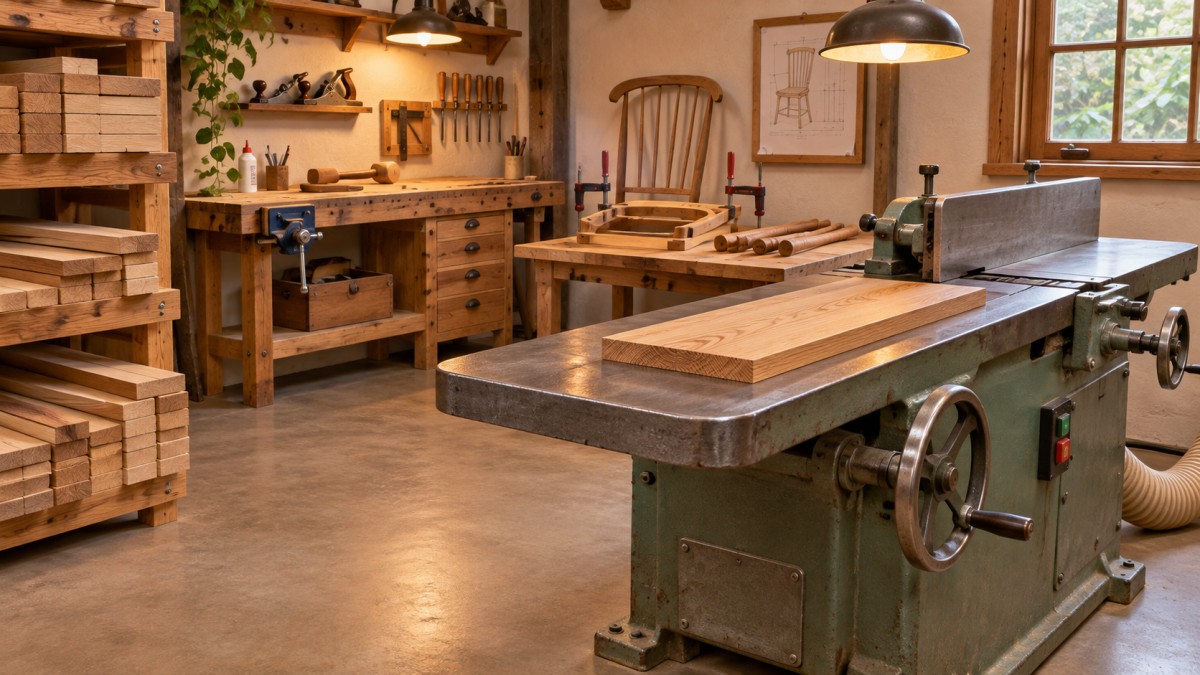
Where it honestly struggles
None of this makes the traditional machine the right answer for everything. If your work is long runs of identical panels, the labour cost per piece on a manually fed machine will lose to automation every time, and no amount of operator skill closes that gap. Repeatability also rests on the operator: a good one holds tolerances all day, a tired or inexperienced one drifts, and the machine will not warn you. Changeovers, though quick, still cost time, and a shop doing thirty setups a day spends real hours on them.
Older machines bring two further problems. Guarding and braking on a machine built decades ago may not meet what you would specify today, and dust extraction points were often an afterthought. Neither is a reason to refuse a sound used machine outright, but both belong in the budget: a modern guard, a brake, and proper extraction hoods cost money, and pretending otherwise is how a bargain turns into a liability.
The money: the price is only the first number
A new traditional machine from a reputable maker costs a fraction of an equivalent CNC installation, needs no software, and can be working the day it is levelled. A used one costs less again — sometimes strikingly little, because large old iron is expensive to move and the market knows it. That low price is where buyers get caught. A used machine with worn slides, a tired spindle and no tooling is not cheap; it is an unfinished purchase. Rebuilding a sliding table or a thicknesser feed system can cost more than the machine did.
Tooling is the cost most often left out of the comparison. A spindle moulder without cutter blocks, a saw without good blades, a planer without knives and the means to set them — each is only half bought. Price the tooling for the work you actually do, add delivery, levelling, extraction connections and any electrical work, and compare that total against the alternatives. Done honestly, the traditional machine still usually wins on capital cost for a small shop.
Four checks before you buy
Whether you are buying new or used, four things decide whether a traditional machine pays off or becomes an expensive obstruction. Check them in this order, because a failure on any one can cancel out the other three.
Tooling and consumables
Confirm that the tooling the machine needs is available, affordable and quick to get. Standard blade bores, common knife sizes and widely used cutter blocks mean you can buy from several suppliers and never wait on one source. An unusual spindle diameter or a discontinued tooling system turns every blade change into a project. If you are buying used, ask what tooling is included and value it honestly — a machine sold with a full set of blocks and blades can be worth more than a cheaper machine sold bare.
Space and extraction
A sliding table saw needs room for the table to travel and for the longest panel you cut, not just room for its own footprint. A thicknesser needs infeed and outfeed clearance for your longest stock. Measure the working envelope, including where the operator stands and where material waits. Check extraction at the same time: the volume of air each machine needs, and whether your existing system can supply it, because a bigger extractor fitted afterwards is another unbudgeted cost.
Power supply
Traditional machines are electrically simple, but they still have to match your supply. Check the motor rating against what your workshop can deliver, especially if the machine is three-phase and your supply is not. A phase converter or a new supply line can add a significant sum to a used machine's real price. Starting current matters too: a large saw motor that trips the supply every cold morning will be resented within a week, however well it cuts.
Parts and support
Before buying, find out who can supply bearings, belts, switches and the wearing parts for that specific model, and how long they take to arrive. Ask the seller directly what breaks, what wears, and what they stock. A maker or dealer who answers plainly, and can put a parts list and a manual in your hands, is worth more than a small saving from one who cannot. On a used machine of an unfamiliar make, assume nothing: if you cannot identify a source for its wearing parts, you are buying a machine with an unknown remaining life.
Traditional, used traditional, or CNC instead?
The honest way to decide is by work mix, not by fashion. If most of your hours go on varied, small-batch work — bespoke furniture, shopfitting one-offs, repairs, prototypes — a traditional machine matches that work, costs the least to buy, and asks the least of your cash flow. If most of your hours go on repeating the same panels in quantity, the calculation reverses, and a CNC earns its price through labour saved on every sheet. Many growing workshops end up with both: CNC for the repeat work, traditional machines for everything around it, because the one-off jobs never actually go away.
Between new and used traditional, the deciding factor is usually condition plus support rather than age. A twenty-year-old machine with true slides, a quiet spindle and a parts source behind it is a better purchase than a newer machine with wear you cannot price. Buy used only when you can inspect under power and cut your own material on it. Buy new when the warranty, the guarding standard and the certainty matter more than the saving, which for a shop that cannot afford downtime is a perfectly rational choice.
Questions worth asking before you pay
- What tooling is included, and what will the tooling for my first three jobs cost on top?
- Can I see the machine cut my own material, at the sizes I actually work with?
- Who stocks the wearing parts for this model, and how long do they take to reach me?
- What does the machine need from my power supply and extraction system that I do not already have?
- If it stops in the middle of a job, who do I call, and what will the first visit cost?
Qingdao Zhongding Machinery Co., Ltd. has supplied woodworking machinery to furniture makers, workshops and production lines for more than 20 years, and the pattern across those installations is consistent: the workshops that get value from a traditional machine are the ones that matched it to their work mix and checked the tooling, space, power and support before paying. The ones that regret the purchase almost always skipped a check that would have taken an afternoon. A good supplier should be willing to work through those checks with you, state plainly what a machine will and will not do, and still be there for parts in ten years' time.
The verdict
So, is a traditional woodworking machine still worth buying for a small workshop? Yes — if your work is varied, your batches are small, and your skill is in your operators rather than in a library of programs. In that workshop, a machine bois traditionnelle is not a compromise. It is the tool that fits the work: quick to set, cheap to run, simple to fix, and capable of earning its keep for decades. It is the wrong purchase if your future is long runs of identical parts, where labour per piece decides whether you make money. Know which workshop you are, run the four checks before you buy, and the decision mostly makes itself.
Send Your Inquiry
We welcome your cooperation and we will develop with you.