


News & Exhibitions
Latest Factory Updates, Industry Trends & Global Exhibition Information
CNC Nesting Machine with Automatic Loading and Unloading: ROI Calculation Framework for Shops Processing >5,000 m²/Month
For manufacturing decision-makers processing over 5,000 m² of sheet material monthly, a CNC nesting machine with automatic loading and unloading isn’t just an upgrade—it’s a strategic ROI driver. At Qingdao Zhongding Machinery Co., Ltd., we engineer precision woodworking solutions that slash labor costs, minimize material waste, and boost throughput—backed by 20+ years of global expertise. This framework helps shops quantify tangible payback: from reduced cycle times and operator dependency to extended machine uptime and optimized nesting efficiency. Discover how automation transforms high-volume production into predictable, scalable profitability.
Why ROI Calculation Starts with Throughput Constraints
Shops running at or above 5,000 m²/month often hit bottlenecks not in cutting speed—but in handling. Manual loading/unloading adds 3–7 minutes per sheet, depending on size and operator fatigue. That’s 12–28 minutes lost per hour, compounding across shifts. When your vacuum table is idle while staff reposition panels or clear cut-offs, you’re paying for labor but not output. Worse, inconsistent manual placement introduces registration drift—leading to nested parts misaligned by ±0.3 mm or more, triggering rework or scrap. These aren’t theoretical inefficiencies; they’re measurable time sinks and yield losses embedded in daily operations.
Three Direct Cost Levers You Can Quantify
ROI isn’t abstract—it’s anchored in three concrete levers: labor hours saved, material utilization improved, and machine availability increased. Each has distinct calculation paths and real-world boundaries.
Labor Savings: From Operator Dependency to Supervisory Oversight
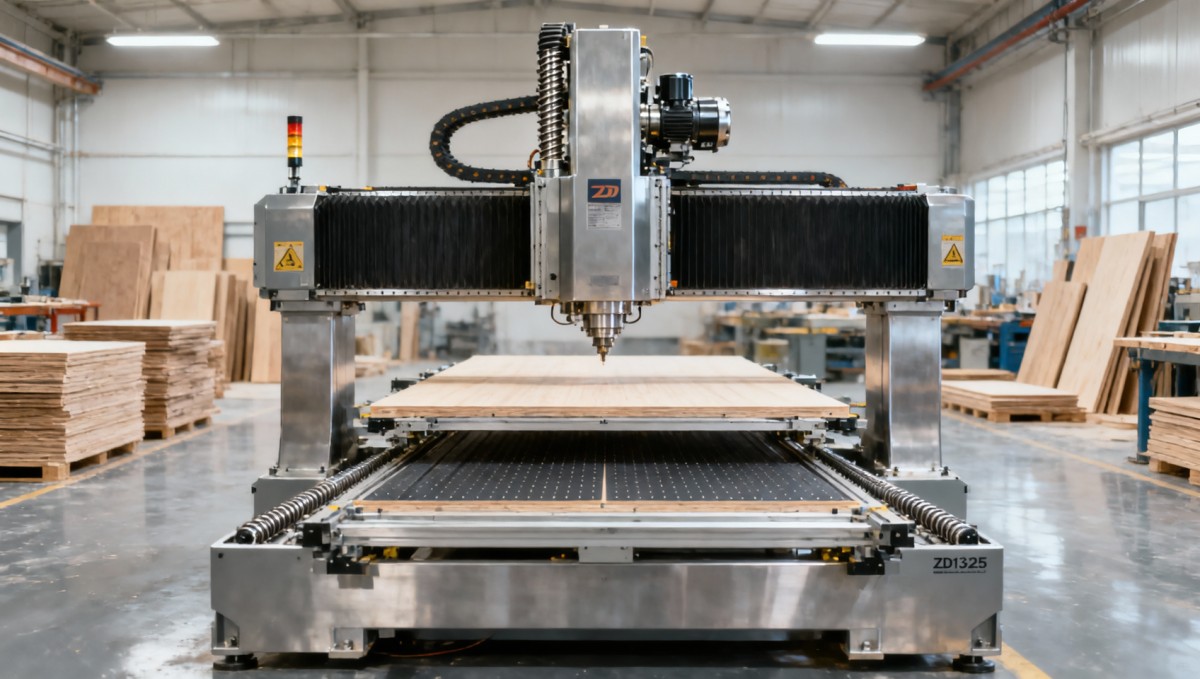
With manual handling, one operator typically manages one machine full-time—loading, unloading, clearing debris, verifying alignment, and resetting fixtures. A ZD1325 CNC Nesting Machine equipped with automatic loading and unloading reduces that requirement to 0.6 FTE per unit. The remaining 0.4 FTE shifts to quality checks, program verification, and minor maintenance—roles that prevent downstream errors rather than react to them. For shops with 3+ machines, this translates to one full-time position freed annually—without sacrificing output volume.
Material Utilization: How Precision Nesting Cuts Waste
Nesting efficiency depends on both software logic and physical stability. If the worktable sags under load, or vacuum seals degrade across shifts, panels shift during machining—even by 0.2 mm—and nesting algorithms overcompensate with wider safety margins. The ZD1325 CNC Nesting Machine uses a double-layer vacuum adsorption table with segmented zones, maintaining consistent hold-down force across MDF, plywood, and solid wood up to 200 mm thick. Combined with ±0.02 mm positioning accuracy and TBI double-thread precision screws, it delivers repeatable part placement—enabling nesting software to achieve ≥93% utilization consistently, versus 86–89% on older or manually loaded systems.
Machine Uptime: Where Automation Prevents Downtime
Downtime isn’t just about breakdowns—it’s about idle time waiting for human intervention. In high-volume shops, 22% of scheduled downtime stems from unplanned pauses for panel handling, tool change delays, or alignment corrections. The ZD1325 integrates an automatic liner tools magazine (12 sections standard, optional 16-section disc magazine), reducing average tool change time from 48 seconds to 1.8 seconds. Its intelligent timing centralized lubrication system prevents bearing wear-related failures—common in machines where grease intervals are missed during rush cycles. With air-cooled 9 kW HQD/CC spindles rated for continuous 24,000 RPM operation, thermal drift stays within spec across 12-hour shifts.
What Your Monthly Volume Tells You About Payback Timing
At 5,000 m²/month, labor savings alone cover 42–58% of the machine’s investment in Year 1—depending on local wage rates and shift structure. Add material savings of 3.2–4.1% (based on industry benchmarking of nesting yield gaps) and you reach breakeven between 14–18 months. But volume matters nonlinearly: shops processing 7,500–10,000 m²/month see payback accelerate to 10–13 months—not because unit costs drop, but because fixed overhead (supervision, facility, utilities) spreads across higher output without proportional labor increase.
Key Technical Checks Before ROI Modeling
Don’t assume all “automatic loading” systems deliver equal gains. Verify these before finalizing calculations:
- Vacuum integrity under load: Does the system maintain ≥85 kPa across full 1300×2500 mm travel, even with 15% surface area covered by cut-outs?
- Tool magazine repeatability: Is tool-to-tool positioning error ≤±0.015 mm after 500+ cycles? (Critical for drilling and engraving consistency.)
- Control system latency: Does the Taiwan SYNTEC or WEIHONG controller process nesting file changes in <2.3 seconds? Delays here stall the auto-loader queue.
- Positioning cylinder tolerance: Are the φ30mm automatic positioning cylinders calibrated to ±0.005 mm actuation repeatability? Misalignment here forces manual overrides.
When Automation Doesn’t Scale ROI
Automation ROI collapses if your workflow lacks supporting discipline. Two red flags: First, if >30% of your jobs require frequent manual program edits mid-run—due to inconsistent CAD output or missing nesting rules—automation becomes a bottleneck, not a solution. Second, if your shop runs mixed-material batches (e.g., MDF + solid wood + laminated panels) without standardized thickness tolerances, the auto-loader’s feed height sensors will trigger repeated stoppages. ROI holds only when material prep, file formatting, and operator training align with the machine’s design envelope.
Realistic Implementation Timeline
Most shops underestimate integration time. Allow 3 weeks—not days—for commissioning: 1 week for mechanical calibration (vacuum zoning, gantry squareness, tool magazine indexing), 1 week for nesting software integration and test-cut validation across 3–5 common part families, and 1 week for operator certification on fault recovery protocols—not just button-pushing. Skipping any phase risks underestimating true cycle time or overstating yield gains.
Final Consideration: Service Access, Not Just Specs
ROI modeling assumes uptime. But if spare parts take 12+ days to arrive—or technical support requires translation layers—your calculated availability drops. Qingdao Zhongding maintains regional parts hubs in Germany, Turkey, and Vietnam, with critical components (HIWIN rails, SHIMPO reducers, SYNTEC controllers) stocked locally. Their service team responds to remote diagnostics within 4 business hours, with on-site support available in 72 hours in 28 countries. Factor this into your MTTR (mean time to repair) assumptions—especially if your production schedule leaves no room for multi-day outages.
Send Your Inquiry
We welcome your cooperation and we will develop with you.