


News & Exhibitions
Latest Factory Updates, Industry Trends & Global Exhibition Information
Are PUR/EVA dual-function edge banding machines worth the investment for export-oriented panel lines?
Time:Sep 12, 2026
Author:Zhongding Buying Guide Editors
Number of views:
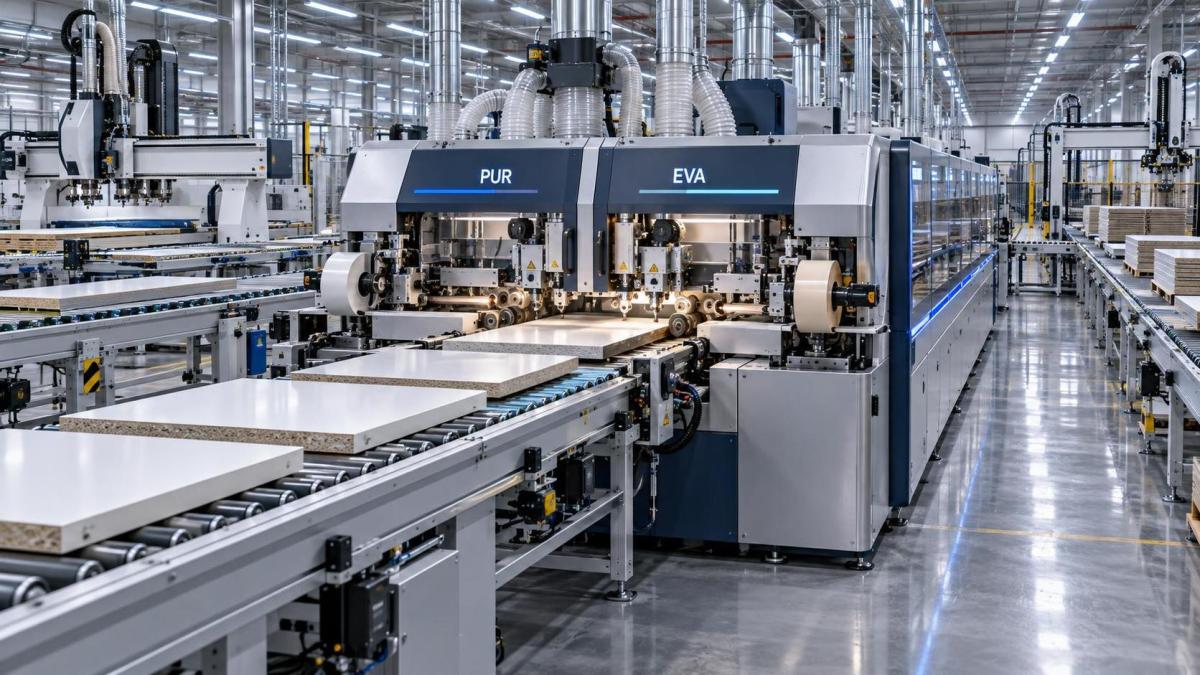
For export-oriented panel producers, the question isn’t whether PUR or EVA edge banding delivers better results in isolation — it’s whether a single machine that handles both glue systems meaningfully improves line efficiency, quality consistency, and long-term cost control across diverse international orders.
Dual-function edge banding machines are not simply “two-in-one” devices. They represent a specific operational compromise: trading some of the peak performance each glue system achieves on dedicated machines for greater flexibility, faster response to order changes, and reduced dependency on multiple machines, operators, and maintenance routines. Whether that trade-off pays off depends less on theoretical capability and more on how edge banding fits into the actual workflow of an export-focused panel line — where substrate variety, climate-driven bonding requirements, certification expectations, and batch-size volatility shape real-world ROI.
The core value proposition lies in eliminating glue-system changeover as a bottleneck — not just time spent swapping glue pots or cleaning nozzles, but the downstream consequences: recalibration delays, test-run waste, inconsistent edge adhesion across early panels in a new run, and operator hesitation when switching between high-strength PUR for kitchen cabinets bound for Northern Europe and fast-cure EVA for flat-pack furniture destined for Southeast Asia. In practice, dual-function machines reduce those transitions from 20–45 minutes (typical for full reconfiguration on separate units) to under 8 minutes — provided the machine’s design addresses thermal stability, glue-path isolation, and automatic parameter recall.
But technical feasibility doesn’t equal operational suitability. Two critical constraints define where dual-function systems succeed — and where they fall short.
First is substrate and environmental variability. PUR adhesive requires precise temperature control (typically 110–125°C), moisture management, and extended clamp time to achieve full cross-linking. EVA operates at lower temperatures (90–110°C) with shorter dwell times and tolerates higher ambient humidity. A dual-system machine must maintain tight thermal separation between glue paths and avoid residual heat carryover from PUR mode into EVA mode — otherwise, EVA glue degrades prematurely, causing stringing, poor flow, or premature setting in the nozzle. Machines that rely on shared heating zones or simplified thermal zoning often fail this requirement, especially during rapid back-and-forth switching. The result isn’t slower output — it’s inconsistent bond strength across a single production run, which becomes a compliance risk when shipping to markets with strict EN 14322 or ANSI A208.1 requirements.
Second is volume structure. Dual-function machines deliver strongest ROI in lines handling frequent small-to-medium batch shifts — for example, producing 300 panels of melamine-faced chipboard for German kitchens one week, then 800 panels of HPL-laminated MDF for Australian office furniture the next. In such environments, dedicating two separate edge banders means one sits idle over 40% of the time, while the other bears disproportionate wear. A dual-function unit runs continuously, spreading depreciation, energy use, and maintenance costs across more billable hours. But if a line runs >85% of its time on a single glue type — say, exclusively PUR for premium cabinetry exports — then the added complexity, higher initial cost (typically 25–38% above a comparable single-system machine), and slightly lower peak throughput become hard to justify.
There is also a hidden cost tied to operator skill and process discipline. Dual-function operation demands tighter adherence to sequence protocols: verifying glue type selection before loading, confirming temperature stabilization before starting, checking clamp pressure calibration per substrate thickness, and validating glue spread width against board density. Miss one step, and the machine doesn’t “fail” — it produces panels that pass visual inspection but fail accelerated aging tests or peel resistance checks months later. This makes training, SOP documentation, and parameter-locking features non-negotiable — not convenience extras.
Maintenance behavior differs too. PUR systems require rigorous daily cleaning to prevent cured residue buildup in nozzles and gear pumps; EVA systems demand regular filter replacement and viscosity monitoring. A dual-function design must allow independent access to each glue path without disassembling shared components. Machines with overlapping service points — where cleaning one system forces partial disassembly of the other — increase downtime and raise the risk of cross-contamination. Real-world reliability hinges on service architecture, not just build quality.
Finally, compatibility with upstream and downstream automation matters more for export lines than domestic ones. Panels moving through CNC nesting, edge profiling, and automated stacking rarely stop for manual glue verification. Dual-function machines integrated with PLC-controlled material tracking can auto-load glue-specific parameters based on barcode-scanned panel specs — reducing human error and enabling true lights-out operation for mixed batches. Standalone units without open communication protocols (Modbus TCP, OPC UA) may technically switch glue types but remain disconnected from the broader MES logic, limiting their scalability in Industry 4.0-aligned facilities.
 So is the investment justified? Not universally — but increasingly so for exporters facing three converging pressures: rising labor costs in key manufacturing regions, tightening delivery windows from global retailers, and stricter post-delivery quality accountability. When a single machine reduces glue-change scrap by 1.2% across mixed batches, cuts average setup time by 6.4 minutes per transition, and extends mean time between failures by 18% through intelligent thermal management and isolated glue paths, the payback period compresses — particularly when factoring in avoided capital expenditure for a second dedicated unit and associated floor space, utilities, and operator allocation.
The decision ultimately rests on mapping current and projected order profiles against machine capabilities — not brochure claims. If your export mix includes ≥3 distinct substrate/glue combinations per month, serves ≥2 climate zones with differing humidity-temperature specifications, and operates under third-party quality audits, dual-function edge banding moves from option to operational necessity. If your line runs stable, high-volume mono-glue campaigns with minimal variation, the simpler, more robust single-system approach remains the more economical choice.
What matters isn’t owning the most advanced machine — it’s ensuring every edge banding cycle contributes predictably to on-time, compliant, profitable shipments. That requires matching technology to workflow reality, not just glue chemistry.
So is the investment justified? Not universally — but increasingly so for exporters facing three converging pressures: rising labor costs in key manufacturing regions, tightening delivery windows from global retailers, and stricter post-delivery quality accountability. When a single machine reduces glue-change scrap by 1.2% across mixed batches, cuts average setup time by 6.4 minutes per transition, and extends mean time between failures by 18% through intelligent thermal management and isolated glue paths, the payback period compresses — particularly when factoring in avoided capital expenditure for a second dedicated unit and associated floor space, utilities, and operator allocation.
The decision ultimately rests on mapping current and projected order profiles against machine capabilities — not brochure claims. If your export mix includes ≥3 distinct substrate/glue combinations per month, serves ≥2 climate zones with differing humidity-temperature specifications, and operates under third-party quality audits, dual-function edge banding moves from option to operational necessity. If your line runs stable, high-volume mono-glue campaigns with minimal variation, the simpler, more robust single-system approach remains the more economical choice.
What matters isn’t owning the most advanced machine — it’s ensuring every edge banding cycle contributes predictably to on-time, compliant, profitable shipments. That requires matching technology to workflow reality, not just glue chemistry.
Send Your Inquiry
We welcome your cooperation and we will develop with you.