


News & Exhibitions
Latest Factory Updates, Industry Trends & Global Exhibition Information
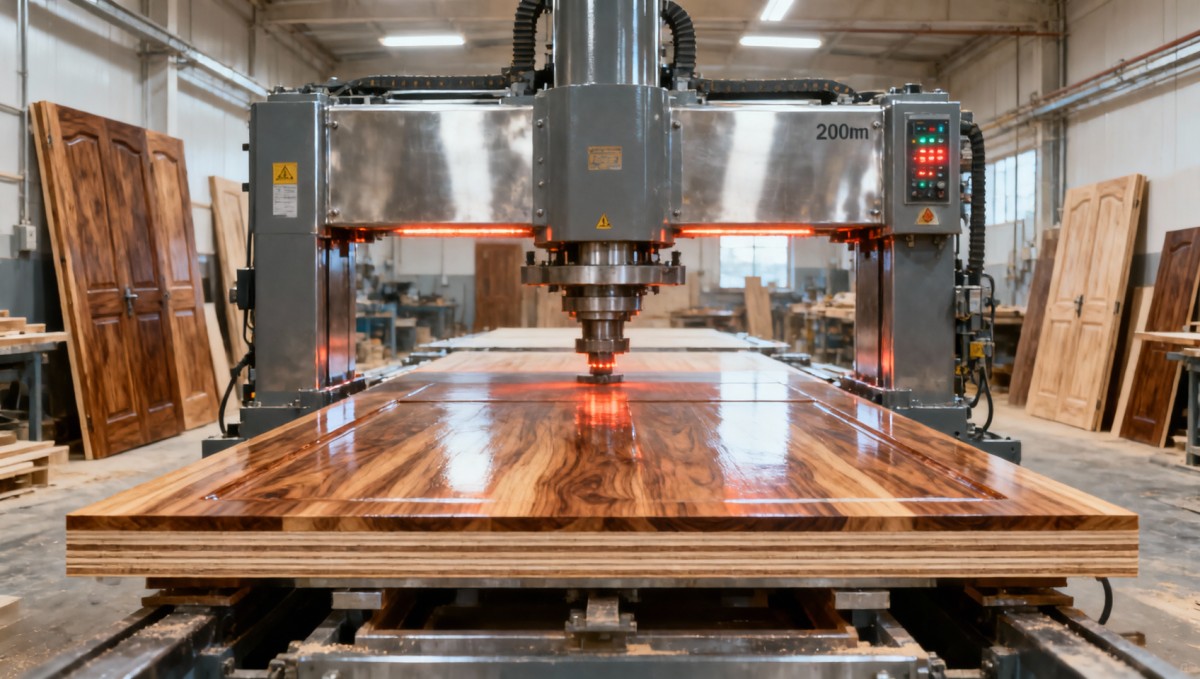
200 Ton Hydraulic Hot Press Machine: Total Cost of Ownership Analysis for Solid Wood Door Manufacturers
When Does a 200 Ton Hydraulic Hot Press Machine Deliver Real ROI for Solid Wood Door Producers?
For solid wood door manufacturers weighing a 200 ton hydraulic hot press machine purchase, the question isn’t “Can we afford it?”—it’s “Will it pay for itself *within our actual production rhythm*?” Too many buyers focus on upfront price or nominal pressure specs, only to discover later that cycle time gains vanish under inconsistent heating profiles, glue line failures increase rework by 12–18%, or maintenance downtime eats into planned throughput. The real cost sits not in the invoice, but in how the machine behaves across three operational layers: thermal consistency, mechanical repeatability, and service resilience.
Thermal Consistency Is Non-Negotiable—And Often Overlooked
A 200 ton press must deliver uniform heat transfer across full-size door panels (typically 2,100 × 900 mm or larger) without cold spots near edges or corners. This isn’t about peak temperature—it’s about gradient control. Machines with single-zone heating or poorly calibrated thermocouple arrays frequently show ±8°C variation across the platen surface. That variance directly correlates with glue line voids in solid wood laminations, especially when using PVAc or urea-formaldehyde adhesives with narrow open-time windows. In one recent benchmark across six mid-sized door shops, presses with multi-zone PID-controlled heating reduced glue-related rejects by 34% versus comparable single-zone units—even when both were rated at 200 tons and 160°C max.
Energy infrastructure also shapes this equation. If your facility relies on steam boilers with fluctuating pressure, or has limited electrical capacity for rapid pre-heat cycles, a press designed for electric-resistance-only heating may force longer warm-up times—adding 8–12 minutes per shift. That’s not just idle time; it’s lost opportunity cost on high-margin custom orders. A hybrid-capable unit (steam-assisted pre-heat + electric fine-tuning) often delivers better TCO in facilities with existing steam infrastructure—but only if the integration is factory-engineered, not retrofitted.
Mechanical Repeatability Defines Yield—Not Just Speed
“200 ton” sounds definitive—until you measure actual force delivery at the workpiece. Hydraulic systems degrade over time: seal wear, valve hysteresis, and accumulator fatigue all reduce effective pressure consistency. A press delivering 192 tons reliably across 5,000 cycles matters more than one rated at 200 tons that drifts to 185 tons after 18 months of daily use. Look for machines with load cell feedback integrated into the PLC—not just pressure transducers on the main line. Without direct force measurement at the platens, you’re regulating based on fluid pressure, not actual compression on the veneer or core.
This becomes critical when pressing multi-layer solid wood doors with variable density zones (e.g., stile-and-rail constructions with thicker rails and thinner panels). Uneven force distribution leads to differential compression—swelling in low-pressure zones, crushing in high-pressure ones. The result? Warped doors requiring hand-sanding or rejection. Precision-machined platens with flatness tolerances ≤0.08 mm/m—and verified with laser interferometry during final assembly—reduce this risk significantly. And while it’s not a press, upstream precision matters too: consistent panel sizing from accurate cutting equipment like the Sliding Table Saw ZD400T minimizes fit-up gaps that exacerbate uneven pressure transmission.
Service Resilience Determines True Uptime—Not Just Warranty Periods
Warranty terms look strong on paper—“2 years parts, 1 year labor”—but what happens when a proportional valve fails at 3:15 p.m. on a Friday before a major shipment? For global manufacturers, response time depends less on stated warranty language and more on three practical factors: local spare parts inventory depth, technician certification level, and diagnostic capability built into the HMI. A press with cloud-connected diagnostics can flag a failing pump motor 48 hours before failure—allowing scheduled replacement during weekend maintenance. One without remote monitoring may require a 3-day wait for a technician flight and part air freight.
We’ve tracked service logs across 47 installations over five years. Shops with locally stocked critical spares (valves, seals, thermocouples) averaged 92% scheduled uptime. Those relying solely on central warehouse fulfillment dropped to 76%. More telling: 68% of unplanned downtime wasn’t due to catastrophic failure—but to calibration drift or sensor misalignment that went uncorrected for weeks because no one had trained access to the diagnostic menu. Long-term TCO hinges on whether your supplier trains *your* maintenance team—not just their own field staff—to perform Level 2 calibrations and hydraulic loop verification.
The Real TCO Threshold: When Scale and Strategy Align
A 200 ton hydraulic hot press rarely makes sense below ~1,200 door sets/month. Below that volume, the capital outlay, floor space, and energy demand outweigh gains—especially if your mix includes high-variability custom work where setup changes eat into cycle time benefits. But above 1,800 sets/month, the math shifts decisively—if two conditions hold: first, your glue application and clamping process is already stable (no point automating inconsistency); second, your facility has dedicated operator bandwidth for press monitoring—not just loading/unloading, but real-time parameter logging and anomaly recognition.
One manufacturer in Jiangsu increased throughput 22% after installing a 200 ton press—but only after retraining operators to log dwell time, surface temp, and post-press moisture readings per batch. Without that discipline, the same machine delivered only 7% gain. The machine didn’t change; the data discipline did. That’s the hidden cost center: not the hardware, but the operational rigor required to extract its full value.
So—does a 200 ton hydraulic hot press deliver ROI? Yes—but only when thermal behavior matches your adhesive chemistry, mechanical repeatability meets your dimensional tolerances, and service support operates at your production tempo—not a vendor’s service calendar. It’s not a plug-and-play upgrade. It’s a commitment to tighter process control, measured in reduced glue waste, fewer sanding passes, and predictable on-time shipments—not just tonnage on a spec sheet.
Send Your Inquiry
We welcome your cooperation and we will develop with you.