


News & Exhibitions
Latest Factory Updates, Industry Trends & Global Exhibition Information
What makes a wood panel press machine China supplier reliable for long-term service?
What makes a wood panel press machine China supplier reliable for long-term service?
It’s not about price per ton, or even the number of hydraulic cylinders. It’s about what happens in month 18 — when the first major seal wears, when a regional supplier can’t ship a replacement platen within five days, when your line supervisor calls at 6 a.m. because pressure calibration drifted overnight and three batches are now out of spec.
Procurement professionals don’t buy machines. They buy continuity. And with wood panel press machines — especially those running 24/7 in furniture factories or engineered-wood plants — continuity depends less on the initial quote and more on how deeply a supplier understands operational reality across time zones, languages, and production cycles.
Reliability isn’t built in the factory — it’s proven in the field
A “reliable” wood panel press machine China supplier doesn’t just meet ISO 9001 or CE standards. Those are entry tickets — not proof of resilience. What matters is whether their machines have run continuously for 3+ years in environments like humid Malaysian MDF lines, dusty Vietnamese plywood workshops, or high-cycle European laminating facilities — without requiring structural retrofitting or recurring control-system resets.
That kind of validation takes time. Not just years of manufacturing, but years of observing how machines behave under real load profiles: thermal cycling from repeated heating/cooling, vibration from unbalanced panel feeding, corrosion from residual glue vapors, or electrical drift in tropical humidity. Qingdao Zhongding Machinery Co., Ltd. began as a small workshop over two decades ago — not as a trading company or OEM broker. That origin shaped how they approach durability: by repairing early units themselves, tracking which components failed first, and redesigning around actual wear patterns — not theoretical specs.
Long-term service starts before delivery — not after
Many buyers assume after-sales begins post-installation. In practice, it starts the moment technical documentation arrives — or doesn’t arrive. A reliable supplier provides machine-specific schematics (not generic PDFs), PLC ladder logic with comments in English, torque specs calibrated to local fastener standards, and commissioning checklists that reflect actual startup conditions — not lab-mode ideal scenarios.
For example, if your facility uses 400V/50Hz power but sources panels from multiple suppliers with varying moisture content, your press needs adaptive pressure ramping — not fixed-time cycles. A supplier who only supplies hardware won’t help you tune that. One focused on long-term service will include parameter templates, remote diagnostics access, and pre-commissioning support — even before the container clears customs.
Spare parts aren’t accessories — they’re insurance
Here’s what procurement teams often discover too late: many “China-based” suppliers outsource critical subassemblies — hydraulic manifolds, PLC controllers, or heating element housings — to third-party vendors with no direct accountability. When those parts fail, lead times stretch to 8–12 weeks. Worse, replacements may lack traceability, calibration records, or material certifications required for compliance audits.
At Qingdao Zhongding, core components — including main frame castings, hydraulic cylinder bodies, and custom-machined platens — are manufactured in-house. That means spare parts aren’t sourced on demand; they’re stocked based on failure-rate analysis across hundreds of installed units. If your press uses a specific type of thermocouple bracket or hydraulic valve manifold, it’s likely already cataloged, tested, and warehoused — not waiting for a new order cycle. That doesn’t eliminate downtime — but it compresses recovery windows from weeks to days.
Support isn’t measured in response time — but in resolution depth
“24-hour response” sounds reassuring — until the response is “please send photos.” Real support means diagnosing via live screen share while your technician runs a diagnostic routine, cross-referencing your machine’s firmware version against known thermal drift patterns in similar installations, and shipping a verified replacement module with pre-loaded configuration — all within 72 hours.
This requires more than multilingual staff. It requires engineers who’ve stood beside presses in Turkey, Brazil, and Indonesia — who recognize the difference between a sensor error caused by voltage fluctuation versus one triggered by glue residue buildup on a proximity switch. That kind of contextual knowledge isn’t outsourced. It’s accumulated — and embedded into service protocols.
Total cost isn’t just purchase price — it’s uptime, yield, and labor stability
A wood panel press machine China supplier offering the lowest upfront cost rarely delivers the lowest total cost of ownership. Why? Because inconsistent pressing leads to higher sanding waste. Unplanned stops trigger overtime pay and shift rework. Repeated calibration drift increases QA sampling frequency — slowing throughput. And every time a local technician spends half a day reverse-engineering undocumented wiring, that’s lost production time.
Reliable suppliers factor those variables into design and service architecture. For instance, Qingdao Zhongding builds redundancy into critical circuits — not just for safety, but to avoid single-point failures that halt entire lines. Their control systems log process anomalies automatically, helping customers spot trends before they become scrap events. And their service contracts include preventive maintenance planning aligned to your production calendar — not just annual visits.
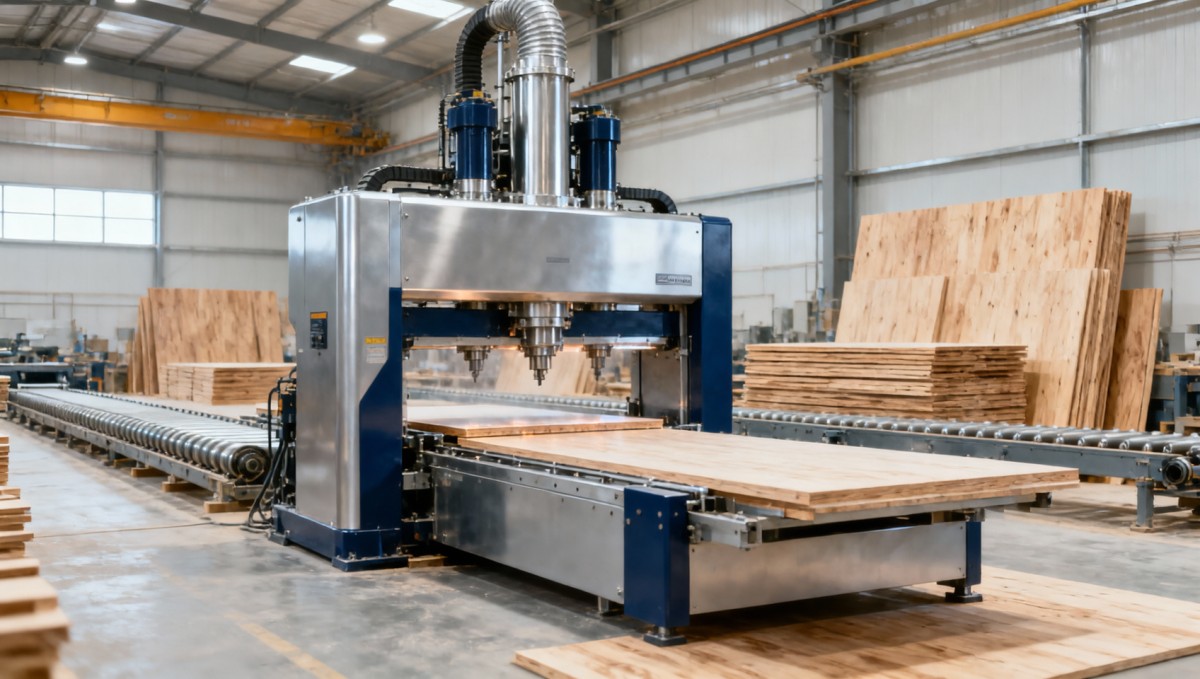
So — how do you test reliability before signing?
Ask for installation references — not just names, but contactable engineers at sites with similar scale, product mix, and operating environment. Request access to their spare parts catalog — specifically search for items like “heating plate gasket,” “hydraulic filter housing,” or “PLC I/O module” and verify part numbers match your machine’s serial prefix.
Review warranty terms carefully: Does it cover labor? Are consumables excluded? Is software updates included for the full term? And most importantly — does the supplier maintain a documented history of firmware revisions and compatibility notes? That tells you whether they treat software as infrastructure — or as an afterthought.
Finally, assess how they handle exceptions. What happens if your site requires non-standard voltage input, or needs integration with legacy MES software? A truly reliable partner doesn’t say “that’s custom — extra cost and 16-week lead time.” They say “we’ve done that twice before — here’s how we solved it, and here’s the updated interface spec.”
Because in the end, reliability isn’t a feature on a spec sheet. It’s the quiet confidence that comes from knowing — when the press hits its 10,000th cycle — the supplier hasn’t moved on. They’re still there. Still calibrated. Still accountable.
Send Your Inquiry
We welcome your cooperation and we will develop with you.