


News & Exhibitions
Latest Factory Updates, Industry Trends & Global Exhibition Information
Automatic Beam Saw Machine Costs: Beyond the Purchase Price
The price quoted for an automatic beam saw machine is only the starting point. Freight, installation, dust extraction, tooling, training, and downtime can change the investment substantially. A lower-priced machine may be the better purchase, but only if it handles the required workload and the quote includes the equipment and support needed to put it into production.
Compare machines on the same basis: the total cost to buy, install, and operate each option over a period that reflects your investment plans. Then compare that cost with the usable output each machine can deliver under your own working conditions. This approach makes it easier to distinguish a useful production upgrade from automation that the factory cannot fully use.
Start with the complete cost of getting the saw running
Two quotations can look similar while covering very different scopes. One may include loading equipment, software, installation, and training; another may list the saw alone. Ask each supplier for an itemized quotation that identifies what is included, what is optional, and which expenses remain your responsibility.
Pay particular attention to these items:
- Freight and delivery: Transport, insurance, unloading, and movement from the delivery point to the installation area can be separate charges. International purchases may also involve customs clearance, duties, and local taxes.
- Site preparation: The machine needs suitable floor space, access for installation, and clearance for loading and removing panels. Electrical work, compressed air, and dust extraction connections may require outside contractors.
- Installation and commissioning: Establish whether the supplier will assemble, align, and test the machine on site, support the work remotely, or charge separately for a technician’s travel and time.
- Software and integration: Cutting optimization, label printing, data transfer, and connections to other production systems may be included, optional, or subject to ongoing fees.
- Initial tooling and spares: Check whether the quotation includes the main saw blade, scoring blade if applicable, and any recommended wear parts. A low initial price is less useful if essential items must be purchased separately.
Also establish the delivery terms in writing. Knowing where the supplier’s responsibility ends helps prevent a low equipment quote from becoming an unexpectedly expensive delivered and installed machine.
Match capacity to the work the factory actually does
Capacity affects both price and operating cost. A saw sized for large panels, high stacks, and continuous production can be appropriate for a busy panel furniture plant. The same specification may offer little return in a workshop processing small batches, frequent custom orders, or irregular workloads.
Give suppliers representative cutting lists rather than asking only for a machine capable of a stated number of cycles. Include panel dimensions, materials, thicknesses, typical batch sizes, finish requirements, and the proportion of repeat work. A machine’s ability to cut several sheets in a stack, for example, is useful only when the material, finish, and order mix allow stacking without creating damage or sorting problems.
Look beyond the cutting cycle itself. Loading panels, positioning them, changing cutting programs, removing parts, and sorting components all affect usable output. If cut parts accumulate at the outfeed because there is no space or staff to handle them, a faster saw may spend much of its time waiting.
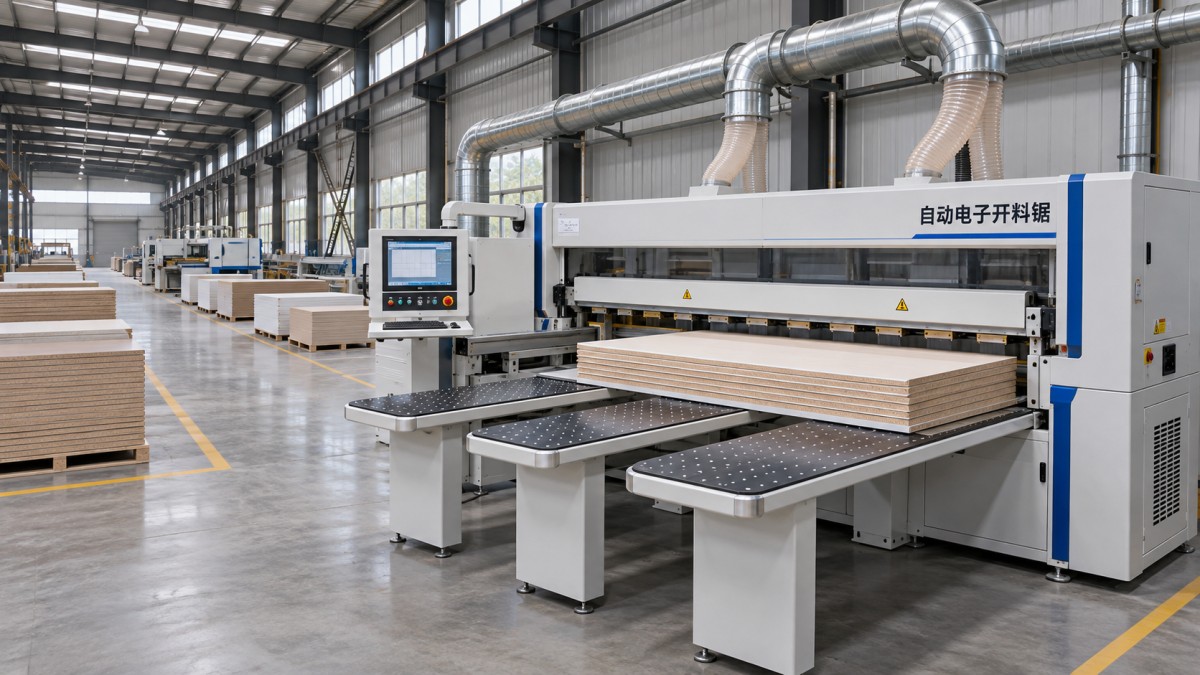
Conversely, buying too little capacity can be costly when the saw becomes the bottleneck for edging, drilling, and assembly. Assess the full flow of work through the factory, including peak periods and likely changes in product mix, before paying for a larger machine or additional automation.
Installation costs depend on the surrounding factory
A beam saw is part of a material-handling system, even when purchased as a standalone machine. A practical layout needs room for incoming boards, safe operator access, cut-part removal, offcut storage, and routine maintenance. Measure the path from the unloading point to the final location as well as the footprint of the machine in operation.
Dust extraction deserves early attention. The existing system may already serve other machines, so its available capacity and connection arrangement matter more than its nominal size alone. Ask the saw supplier for the machine’s extraction requirements and have the system assessed under the conditions in which all connected machines will run. Any ductwork or extraction upgrade belongs in the project budget.
The same applies to electrical supply and compressed air. Motor ratings help identify connection requirements, but installation costs depend on the distance to the supply, available capacity, protection, cabling, and local work needed. Coordinate these details before delivery to avoid paying for a machine that must wait for the site to be ready.
Estimate operating costs using your production pattern
Operating cost is driven by what the saw cuts and how it is used. A factory cutting abrasive panels for long shifts will face different blade and maintenance costs from a shop cutting occasional batches of standard board. Use your own materials and expected operating hours when building an estimate.
Blades, cut quality, and material waste
Main blades require cleaning, sharpening, and eventual replacement. Where a scoring unit is fitted for laminated panels, its blade also needs adjustment and maintenance. Costs vary with panel material, blade specification, cutting conditions, and the standard of edge finish required.
Do not treat blade expense as a simple consumables line. A worn or poorly adjusted blade can contribute to chipping, burning, or dimensional problems, leading to rejected parts and rework. A blade that remains in service too long may appear economical until the cost of damaged panels and interrupted production is included.
Cutting optimization also affects material use. Software can help arrange parts on a sheet, but the result depends on the quality of the input data, grain direction, edge allowances, usable offcuts, and the needs of downstream operations. Ask suppliers to demonstrate their proposed workflow using representative cutting lists. Compare usable parts and offcuts as well as the number of sheets consumed.
Energy, labor, and routine maintenance
Electrical consumption includes more than the saw motor. Dust extraction, compressed air equipment, and associated handling systems may also run while the line is operating. Nameplate motor power is useful for planning the electrical connection, but it does not by itself show actual energy consumption: load and running time vary during a shift.
Automation may reduce manual measuring and improve consistency, but it does not eliminate the work of preparing boards, checking programs, handling cut parts, and maintaining the machine. Labor savings depend on how duties are organized and whether workers can use the time released for other productive tasks. Include supervision and support during the learning period when estimating the change.
Budget for routine cleaning, lubrication, inspection, adjustments, and replacement of wear parts specified for the machine. Ask for a maintenance schedule and parts list with the quotation. This provides a more useful basis for comparison than assuming that two saws with similar purchase prices will cost the same to maintain.
Training and support influence the cost of downtime
Operators need to understand more than how to start a cutting cycle. Training should cover program entry, safe loading and unloading, basic adjustments, routine checks, and what to do when a fault occurs. A technically capable machine can still produce waste or sit idle if only one person knows how to run it.
Clarify who receives training, how long it covers, which language is used, and whether manuals and electrical documentation are included. If software is part of the purchase, include the staff who prepare cutting lists and manage production data, not just the machine operators.
After-sales support should be assessed in practical terms. Ask how faults are reported, what remote assistance is available, how spare parts are identified and ordered, and what options exist when a technician is needed on site. Review warranty coverage alongside exclusions, travel charges, and the process for obtaining replacement parts.
Qingdao Zhongding Machinery Co., Ltd. describes technical support, spare parts supply, and after-sales service as part of its woodworking machinery offering. When discussing a specific machine, use the same questions you would ask any supplier to establish the support arrangements and costs that apply to your location.
Build a comparison that exposes the trade-offs
Use a consistent ownership period and production assumption for every option. Add the delivered purchase cost, site work, commissioning, training, expected consumables, energy, maintenance, software fees, and financing costs where relevant. Include an allowance for production interruption if installation or training will temporarily reduce output.
Then estimate the value created under the same conditions. Potential benefits may include more usable parts per shift, less panel waste, reduced rework, or labor time available for other tasks. Count a benefit only where it can affect the business: extra cutting capacity has limited immediate value if orders, material supply, or downstream operations cannot absorb it.
For a simple payback view, divide the additional investment by the estimated annual net benefit. The net benefit should account for any increase in operating costs as well as savings. Treat the result as a planning measure, not a guarantee, and test it again with a lower workload or smaller savings. If the purchase only makes sense under the most optimistic assumptions, the investment carries more risk.
Where production is intermittent and current cutting quality is acceptable, a simpler saw or an upgrade to the existing process may be more economical. Where repeat panel work is steady and cutting limits the rest of production, a more automated system may justify its higher installed cost. The deciding factor is the cost and output of the complete process, not the price of the machine in isolation.
Before selecting a supplier, request a written scope, a layout with utility requirements, a demonstration based on your materials and cutting lists, and a clear support proposal. Those documents turn competing quotations into a comparison that can be evaluated on cost, capacity, and risk.
Send Your Inquiry
We welcome your cooperation and we will develop with you.