

A two-head sander often suits consistent plywood and moderate removal requirements. Three heads become valuable when additional sanding stages improve throughput, abrasive sequencing, or finish.
The better choice depends on incoming panel variation, target thickness tolerance, feed speed, and surface requirements. Head count alone cannot establish calibration accuracy or productivity.
For plywood manufacturers, the central challenge is achieving dimensional consistency without removing excessive face veneer. An additional head creates options, but does not guarantee results.
This guide helps production managers, purchasing teams, and process engineers compare configurations, identify operating risks, and specify a meaningful trial before committing to equipment.
What Does an Extra Sanding Head Actually Change?
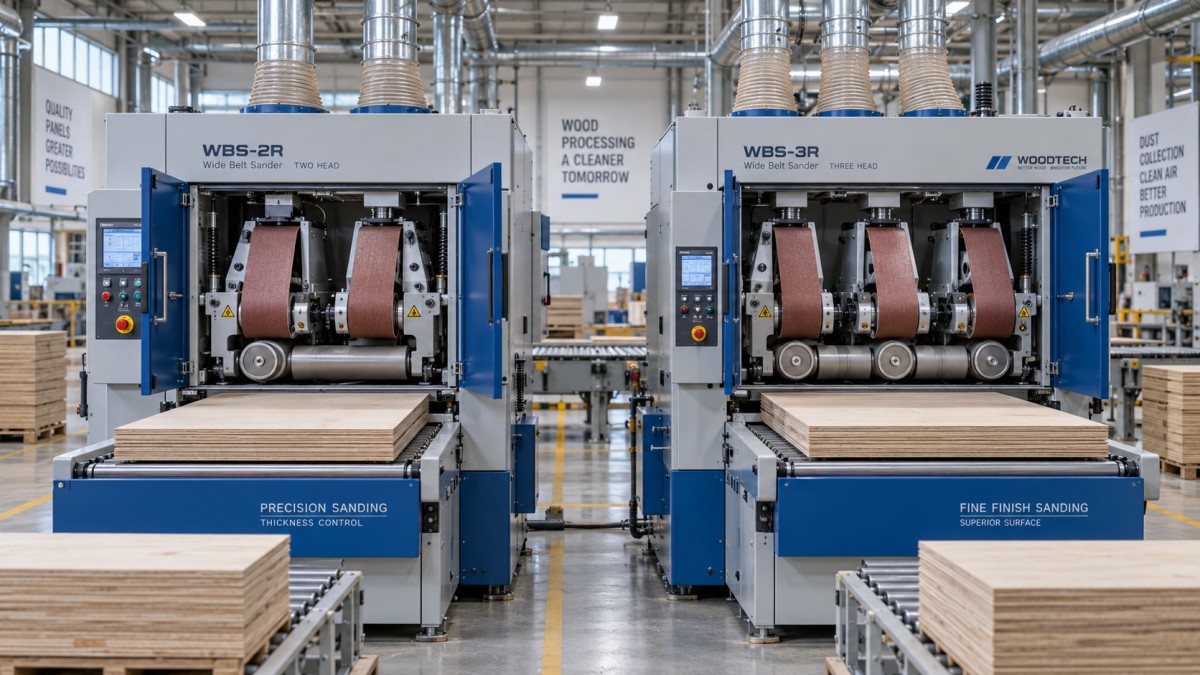
A sanding head is one processing station within the machine. Its function depends on the contact element, abrasive belt, pressure settings, and supporting machine structure.
Two-head configurations commonly combine calibration with subsequent sanding. Three-head configurations can separate heavier removal, scratch refinement, and final surface preparation, depending on the installed equipment.
However, three heads do not necessarily mean three calibration stages. A finishing platen performs a different task from a contact roller selected for thickness control.
Contact rollers generally concentrate cutting pressure over a smaller area. Platens provide broader abrasive contact and are commonly used to refine surfaces after dimensional correction.
Roller hardness, diameter, abrasive characteristics, and machine settings influence cutting behavior. Ask suppliers to explain each proposed head’s role against your actual plywood specifications.
Compare complete configurations, including frame rigidity, conveyor support, hold-down arrangements, drive power, and adjustment systems. These features help determine whether additional heads deliver useful capacity.
When Is a Two-Head Sander the Better Investment?
A two-head machine is often appropriate when upstream pressing produces reasonably consistent panels and calibration requires limited removal before the surface reaches its intended condition.
It can also suit production where existing feed speeds meet demand and one properly configured pass achieves both thickness requirements and acceptable downstream surface quality.
For a manufacturer selling construction plywood, surface requirements may differ substantially from those for furniture panels. Specify the intended application before paying for additional finishing capability.
Two heads usually involve fewer abrasive belts and processing assemblies to manage. Actual savings depend on machine specifications, operating hours, abrasive consumption, and maintenance requirements.
A lower purchase price becomes less attractive if panels routinely require another pass. Include additional handling, labor, work in progress, and delivery pressure in comparisons.
Choose two heads when trials demonstrate consistent saleable output at the required speed. That evidence matters more than assumptions about what a larger machine might provide.
When Does a Third Head Deliver Practical Value?
A third head becomes useful when two stations cannot complete the required removal and scratch refinement within one pass at the desired production rate.
Dividing work across suitable heads can reduce the burden on individual belts. Whether this improves belt life or stability must be verified under production conditions.
It also allows more flexibility in abrasive sequencing. An intermediate stage may reduce coarse scratches before final sanding, provided sufficient material remains available for refinement.
This flexibility can matter for plywood destined for visible furniture components or sensitive overlays. Acceptance should follow the actual coating, bonding, or laminating process requirements.
Higher throughput is possible only when sufficient cutting power, extraction, conveyor control, and handling capacity support it. An extra station cannot overcome every production bottleneck.
Three heads also introduce additional setup variables. Operators need documented settings and clear responsibilities to prevent unnecessary cutting, uneven loading, and inconsistent results between shifts.
For mixed production, evaluate changeover frequency alongside output. Additional flexibility has limited value if complex adjustments increase downtime or make repeatable settings difficult to maintain.
Can Either Configuration Hold Your Thickness Tolerance Without Sanding Through?
Before comparing machines, define the finished thickness range and how it will be measured. A nominal thickness alone provides insufficient information for equipment selection.
Separate variation within individual panels from variation between panels. Also record moisture condition, warpage, face defects, and any thickness change after sanding and conditioning.
For example, suppose incoming panels measure between 18.3 and 18.7 millimeters, while the required finished range is 18.0 to 18.2 millimeters under agreed measurement conditions.
Reaching the upper finished limit would require approximately 0.1 to 0.5 millimeters of total thickness reduction. That difference creates substantially different demands across the batch.
These illustrative figures describe required correction, not recommended sanding allowances. Whether removal is feasible depends on face veneer availability, panel construction, and the sanding process.
Usable veneer allowance must cover thickness correction and surface refinement while retaining the specified face thickness. Thin decorative faces can make aggressive calibration commercially unacceptable.
If an incoming area is already below minimum finished thickness, sanding cannot restore it. Such panels require upstream correction, segregation, or an agreed alternative disposition.
More heads cannot make insufficient veneer allowance safe. Improve pressing consistency, veneer control, or incoming sorting when the removal requirement exceeds what the product permits.
Also distinguish thickness correction from flattening. Hold-down pressure may temporarily restrain a distorted panel, so assess its condition after release as well as during processing.
Compare Configurations Against the Same Production Requirements
Use a common specification when requesting quotations. Otherwise, differences in head construction, motor capacity, automation, and included services can make headline comparisons misleading.
Request the intended abrasive sequence, removal allocation, and feed speed for each proposal. Suppliers should explain how those settings satisfy your product requirements together.
Verify whether the quotation covers one-face or simultaneous two-face processing. Head count alone does not establish which surfaces are processed or the resulting line capacity.
Where both faces require sanding, include turning, additional passes, and handling equipment in the comparison. Assess the resulting face thickness and balance on both sides.
Extraction requirements also deserve confirmation. Obtain the supplier’s specified airflow and connection requirements, then check whether the existing system can support sustained production reliably.
How Should You Test a Machine Before Buying?
A supplier trial should reproduce your production challenge using representative panels. Include normal material, difficult batches, and the thinnest face veneers you intend to process.
Send written acceptance criteria before testing. Define finished thickness limits, sampling locations, surface requirements, permitted veneer defects, and the minimum sustained rate of accepted production.
Measure panels before sanding at marked locations using suitable, checked instruments. Repeat measurements after processing under agreed conditions, recording results by panel and location.
Assess surface quality separately from thickness. Check for coarse scratches, chatter, burning, edge rounding, localized sanding-through, and defects that become visible after subsequent finishing.
When coatings or overlays determine acceptance, process trial panels through that downstream operation. A visually smooth sanded face does not establish coating or bonding performance.
Run enough material to observe belt loading, machine warm-up, extraction behavior, and repeatability. A few carefully selected demonstration panels cannot establish sustained production capability.
Record feed speed, abrasive specification, belt condition, settings, power demand where measurable, and all additional passes. These records make competing proposals easier to evaluate.
Ask the supplier to document the successful setup and operator procedure. Repeatable production depends on transferring trial conditions into practical settings your team can maintain.
Will the Third Head Pay for Itself?
Compare cost per accepted panel, including abrasive use, labor, energy, maintenance, rejects, and rework. Purchase price alone cannot show the economic effect of either configuration.
Separate theoretical feed speed from accepted output. Loading gaps, panel turning, changeovers, inspection, and second passes can reduce the benefit of a faster machine.
Calculate the additional annual value from greater saleable output, reduced rehandling, and verified waste savings. Subtract additional operating costs before estimating the investment payback period.
For illustration, an additional investment of $30,000 producing $15,000 in annual net operating benefit has a simple payback of two years, before financing and taxes.
Use your trial results and production schedule for the calculation. Unused capacity produces little return when demand, upstream pressing, or downstream processing limits factory output.
Include support in the assessment: replacement belt availability, critical spare parts, maintenance access, technical assistance, and operator training all influence downtime and long-term operating value.
Which Configuration Should You Choose?
Is a two-head or three-head sander better for plywood thickness calibration? Choose the configuration that meets thickness, surface, and output requirements with acceptable veneer loss.
Favor two heads when representative trials confirm one-pass performance at your required production rate. Favor three when the extra stage delivers measurable quality or productivity benefits.
If neither configuration meets tolerance without damaging faces, investigate the incoming panels and process assumptions. Additional sanding capacity cannot compensate for every upstream manufacturing problem.
When discussing a project with Qingdao Zhongding Machinery Co., Ltd., provide panel dimensions, thickness distribution, face veneer details, finish requirements, and the required production rate.
Request a configuration proposal supported by representative trials, documented acceptance criteria, training, and service arrangements. The strongest purchase decision connects proven panel results with sustainable operating costs.