


Solution Center
Customized One-Stop Wood Processing Production Solutions for Global Furniture Factories
Woodworking Machines for Small vs Large Factories: What Is the Real Difference?
Woodworking Machines for Small vs Large Factories: What Is the Real Difference?
Choosing the right woodworking machines is not just about size or budget. It shapes efficiency, product quality, and long-term profitability.
The real difference between small-shop equipment and factory-scale systems goes much deeper than machine dimensions.
In practice, the best choice depends on output targets, labor structure, process stability, and future expansion plans.
For manufacturers comparing woodworking machines, a clear decision framework matters more than a simple price comparison.
Production Scale Changes Everything
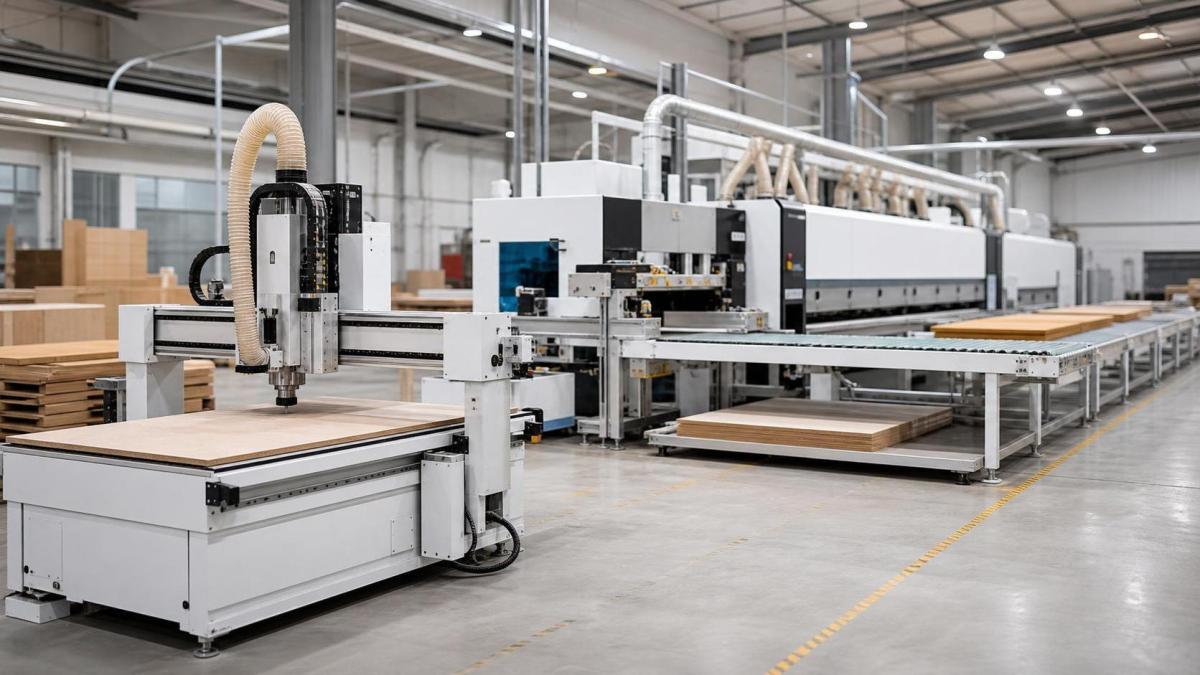
Small workshops usually focus on flexible production, custom orders, and shorter batches.
Large factories, by contrast, depend on stable throughput, repeatability, and process coordination across multiple stations.
That difference changes what woodworking machines must deliver every day.
A small facility may value quick setup and operator versatility.
A large plant usually values cycle consistency, line integration, and lower cost per finished panel or component.
This also means machine utilization is measured differently.
In a workshop, one machine may handle many tasks during the same shift.
In a factory, each machine often supports a defined step in a continuous production flow.
Machine Design: Flexibility vs Throughput
One of the biggest differences in woodworking machines is design priority.
Smaller operations often need versatile equipment that can switch between products with limited downtime.
Examples include sliding table saws, compact edge banders, and CNC routers built for varied job orders.
Larger factories usually choose woodworking machines engineered for sustained output.
These may include automatic panel saws, return conveyors, drilling cells, nesting lines, and industrial sanding systems.
The goal is not just cutting or shaping wood.
The goal is maintaining flow without bottlenecks.
- Small-scale woodworking machines often emphasize compact size and easy operation.
- Large-scale woodworking machines emphasize durability, speed, and integration.
- Smaller setups often accept manual loading.
- Larger setups usually require automated feeding and discharge.
From a buying perspective, this is where many decisions go wrong.
A machine that performs well in a workshop may become a bottleneck in industrial production.
Automation Is More Than Labor Saving
Automation is often seen as the dividing line between small and large factory woodworking machines.
That is true, but only partly.
In real operations, automation also improves process control, quality consistency, and production visibility.
For small businesses, semi-automatic woodworking machines can already create meaningful gains.
They reduce operator fatigue and improve output without forcing a full line redesign.
For larger factories, automation becomes a system requirement.
Machines must exchange data, match takt time, and support predictable scheduling.
This is why advanced woodworking machines often include barcode scanning, servo positioning, and smart diagnostics.
The more obvious signal is that automation changes management decisions, not just operator routines.
Questions to Ask Before Choosing Automation
- How many hours per shift does the machine actually run?
- How often do product specifications change?
- Is labor availability stable enough for manual handling?
- What is the cost of one hour of line stoppage?
- Can current orders justify a higher-capacity woodworking machine within two to three years?
Quality Control Requirements Are Not the Same
Quality expectations may look similar on paper, but production scale changes the risk profile.
In a small shop, one experienced operator can often catch defects early.
In a large factory, small errors multiply quickly across hundreds of parts.
That is why factory-grade woodworking machines often require tighter tolerances and more stable calibration.
A minor alignment issue on one drilling unit can affect assembly accuracy downstream.
An unstable edge banding temperature can increase rework rates across an entire batch.
This makes machine stability a strategic issue, not just a technical one.
Cost Comparison: Purchase Price Is Only the Beginning
Many buyers compare woodworking machines mainly by initial quotation.
That approach is incomplete.
The real comparison should include labor cost, maintenance demand, training time, spare parts availability, and downtime exposure.
Smaller woodworking machines usually cost less to buy and install.
They may also need less factory space and lower power capacity.
However, lower-capacity machines can create hidden costs when orders grow.
Large-factory woodworking machines require higher upfront investment.
Still, they often reduce unit cost over time through output stability and labor efficiency.
In actual business planning, the best machine is rarely the cheapest one.
It is the one that supports target margin without creating operational friction.
Hidden Costs That Deserve Attention
- Frequent manual adjustment between orders
- Unplanned downtime caused by unstable components
- Delayed spare parts supply
- Low operator adoption because controls are too complex
- Future replacement after capacity is outgrown too quickly
The Better Buying Strategy Is to Match the Machine to the Business Model
The most useful question is not whether small or large factory woodworking machines are better.
The better question is whether the machine fits the current and near-future business model.
A custom furniture producer may benefit from flexible CNC woodworking machines with fast changeover.
A panel furniture manufacturer may need a linked solution built around throughput and repeatability.
This is where an experienced machinery partner adds value.
Qingdao Zhongding Machinery Co., Ltd. has over 20 years of experience in woodworking machinery manufacturing and export.
From compact workshop machines to complete woodworking solutions, we focus on reliable performance and long-term value.
Our machines serve furniture manufacturers, woodworking workshops, and industrial production lines worldwide.
Just as important, we support customers with technical guidance, spare parts supply, and responsive after-sales service.
That matters because machine selection is only the start of the return-on-investment cycle.
Final Decision Checklist for Woodworking Machines
Before choosing woodworking machines, review the decision from five angles.
- Define monthly output targets and product mix clearly.
- Check whether flexibility or throughput is the bigger business need.
- Calculate total operating cost, not just purchase price.
- Assess service support, training, and spare parts response time.
- Choose woodworking machines that still make sense after the next growth stage.
The real difference between small and large factory equipment is not simply machine size.
It is the role those woodworking machines play inside your production system.
When the machine matches production goals, quality expectations, and growth plans, the investment becomes much easier to defend.
A structured evaluation now can prevent capacity limits, quality issues, and unnecessary cost later.
Send Your Inquiry
We welcome your cooperation and we will develop with you.