


Solution Center
Customized One-Stop Wood Processing Production Solutions for Global Furniture Factories
Woodworking Equipment List for a New Factory: What Machines Are Actually Needed?
A new factory works best when the equipment list follows the production route
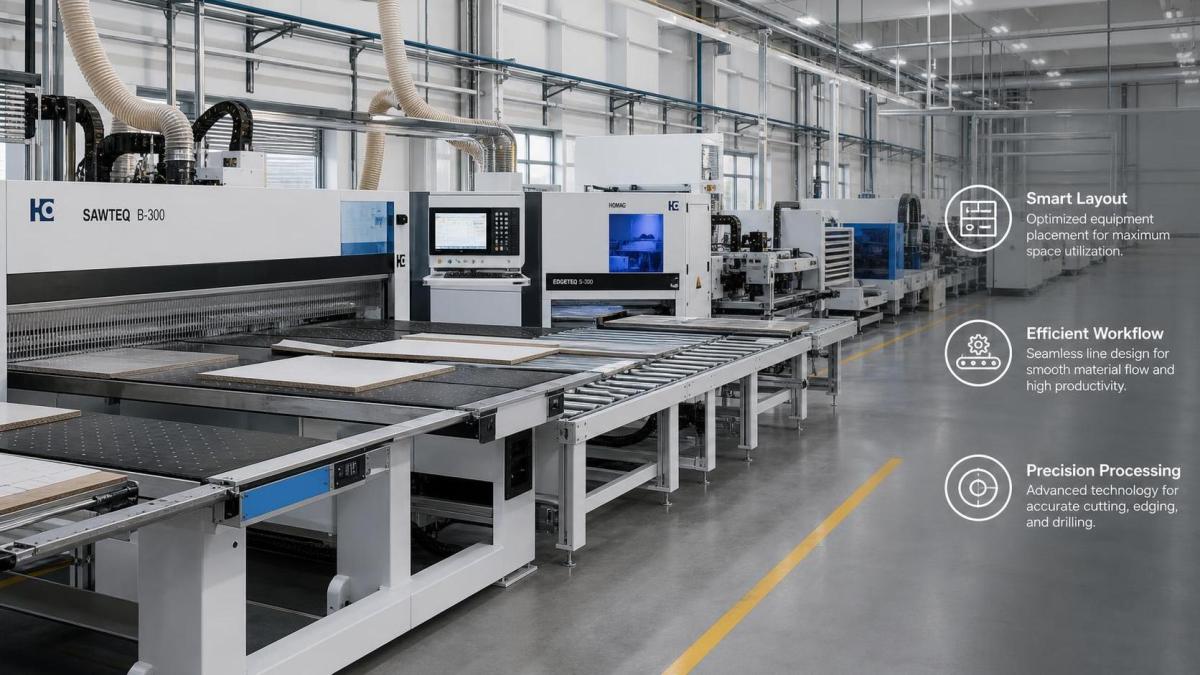
Starting a new plant is rarely about collecting as many machines as possible.
The real question is which woodworking equipment supports the products, batch size, and required finish level.
That is why two factories making wood products can need very different machine combinations.
A cabinet line usually values panel accuracy, drilling consistency, and clean edge quality.
A solid wood workshop often cares more about ripping stability, profiling flexibility, and sanding control.
In practical terms, the best woodworking equipment list starts with workflow, not catalog size.
Material entry, cutting, shaping, assembly, finishing, and packing should connect without creating bottlenecks.
This is also where long-term planning matters.
A factory launched with only today’s order pattern in mind often struggles when output grows or product mix changes.
With more than 20 years in woodworking machinery, Qingdao Zhongding Machinery has seen this pattern repeatedly across furniture plants, workshops, and industrial lines.
Reliable woodworking equipment matters, but the sequence and fit of each machine matter just as much.
Different production scenes create different equipment priorities
The same budget can lead to very different decisions depending on what the factory plans to produce first.
More often, the key difference comes from four factors.
- Board material or solid timber, because cutting and shaping loads are not the same.
- Order volume, because single-shift custom work needs flexibility more than line speed.
- Surface standard, because premium visible parts need tighter sanding and edge control.
- Expansion plan, because future automation affects current machine interfaces and plant layout.
Without these checks, a woodworking equipment purchase can look correct on paper and still perform poorly on site.
That is why experienced factories usually begin with process mapping, power conditions, dust extraction, and operator skill level.
Panel furniture production usually needs accuracy before heavy complexity
For cabinets, wardrobes, and office furniture, the essential woodworking equipment often centers on panel processing.
In this scene, cut size stability affects almost every downstream operation.
A practical starter line often includes a sliding table saw or CNC panel saw, edge banding machine, drilling machine, and sanding support.
If the product mix includes many hinge holes, connector holes, or line boring patterns, drilling capacity becomes critical early.
In smaller setups, a beam saw may not be necessary at the beginning.
A precise sliding table saw with disciplined workflow can still support stable output.
Once order volume rises, automatic feeding and CNC nesting often become more valuable than adding another manual cutting station.
Edge quality is another common divider.
A basic edge bander may suit utility furniture, while visible premium panels need pre-milling, corner trimming, scraping, and polishing.
This is where woodworking equipment selection moves beyond speed and into finish consistency.
Solid wood factories usually judge machines by flexibility and material behavior
Solid wood production introduces more variation in grain, hardness, moisture, and defect rate.
As a result, woodworking equipment for this scene needs stronger adaptability.
A core machine list often starts with rip saws, crosscut saws, thickness planers, jointers, spindle moulders, sanders, and pressing equipment.
If curved parts, doors, or profile components are common, CNC routers or copy shaping solutions may become essential earlier.
In actual use, the key judgment is not only machine function.
It is whether the woodworking equipment can hold accuracy when timber quality changes between batches.
For example, a factory making dining tables can tolerate slower profiling more easily than unstable sanding.
Surface rework on solid wood consumes labor fast and affects finishing results later.
This is one reason many growing plants invest in better sanding and dust extraction earlier than expected.
Custom workshops and volume lines should not copy the same equipment list
A frequent mistake is treating a custom-order workshop and a repetitive production line as the same factory model.
They are not.
Custom production usually benefits from flexible woodworking equipment that reduces setup time between jobs.
That often means CNC routers, adjustable boring systems, and compact edge processing that can change specifications quickly.
A volume line focuses more on takt balance, feeding efficiency, and minimizing manual transfer.
There, conveyor integration, automatic loading, return systems, and standardized drilling patterns usually deserve more attention.
The difference is easier to see in a simple comparison.
What is actually essential in a first-stage woodworking equipment list
When the first investment needs control, essential does not mean minimal in a careless way.
It means every machine should protect the main process.
For many new factories, the first-stage woodworking equipment list includes these categories.
- Primary cutting equipment matched to board or solid wood processing.
- Thicknessing or calibration equipment where material consistency affects assembly.
- Edge processing or shaping equipment tied to product appearance requirements.
- Drilling or slotting equipment for repeatable assembly points.
- Sanding equipment sized to surface quality targets, not just to throughput.
- Dust collection, air supply, and electrical support sized for the real load.
Support systems are often overlooked because they do not look like production machines.
Yet poor dust control or unstable air pressure can reduce the value of otherwise good woodworking equipment.
The usual misjudgments happen outside the machine brochure
One common error is comparing only machine specifications while ignoring the factory environment.
Floor space, material flow direction, and power distribution can limit performance before production even starts.
Another mistake is buying woodworking equipment for the largest possible output from day one.
If upstream and downstream steps remain manual, a single high-speed machine simply creates waiting stock.
Maintenance is another quiet risk.
Factories sometimes choose complex systems without confirming spare parts lead time, technician access, or training needs.
For this reason, machine reliability should be judged together with service support.
Companies with long manufacturing experience, stable parts supply, and responsive after-sales service usually reduce downtime more effectively than low-price alternatives.
That long-view approach has helped established suppliers such as Qingdao Zhongding Machinery build lasting customer relationships in global woodworking applications.
A practical way to match woodworking equipment to the real factory plan
Before locking the equipment list, it helps to test each machine against the intended production path.
The following checks usually reveal whether the plan is balanced.
- Confirm the top three products, their materials, and monthly output range.
- Map each processing step from raw stock to finished packing.
- Mark the operations where accuracy loss causes rework later.
- Check whether utilities, dust extraction, and layout support every planned machine.
- Review which woodworking equipment can scale by adding automation later.
- Estimate maintenance intervals, consumables, and operator training requirements.
This method keeps the investment grounded in operating reality.
It also avoids buying extra woodworking equipment that adds cost without solving a true bottleneck.
In the end, the right list is the one that matches product structure, site conditions, and growth plans with the fewest weak links.
A careful review of scenarios, machine interfaces, service support, and future expansion points usually leads to a more dependable factory launch.
Send Your Inquiry
We welcome your cooperation and we will develop with you.